
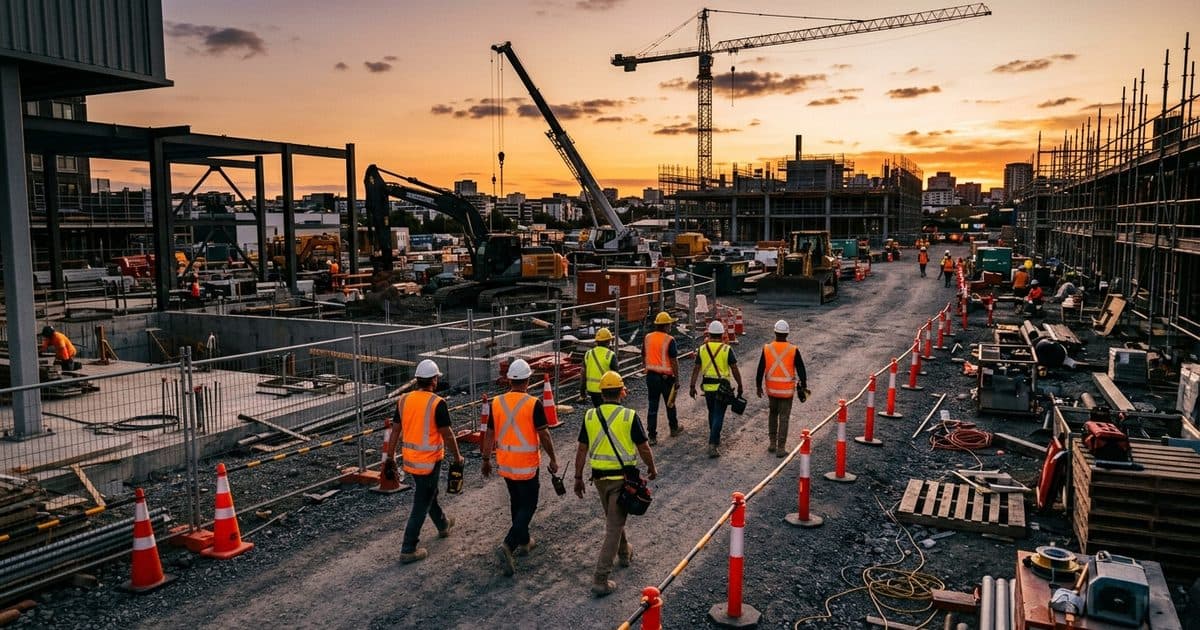
What can AI jobsite safety monitoring detect today?
Camera-based safety analytics are object detection models trained to recognize specific visual patterns: a person, a hard hat, a vehicle, a zone boundary, a smoke plume. When the model sees a pattern that matches a configured rule, say a person without a hard hat inside an active work area, it generates an event with a video clip and a timestamp. Our overview of how AI video analytics work in security cameras covers the detection pipeline in depth; the four capabilities below are the ones that are production-ready on jobsites today.
PPE presence detection
PPE detection identifies whether workers in view are wearing visible protective equipment, most commonly hard hats and high-visibility vests. On a well-positioned camera with decent lighting, it catches the obvious cases: a worker who walked onto the pour deck bareheaded, a visitor in street clothes wandering past the gate. Accuracy drops with distance, glare, and occlusion; a worker bent over a task or half-hidden behind a lift may not be classified at all. And presence is not proper use. A model can see that a harness is on a worker's body, but it cannot confirm the lanyard is tied off to an anchor point, and no responsible vendor should tell you otherwise.
Zone intrusion and restricted-area alerts
Zone intrusion analytics let you draw virtual boundaries over the camera image, around an open excavation, a crane swing radius, an energized equipment area, or a leading edge, and trigger an event when a person or vehicle crosses the line. This is the most mature of the safety analytics because it borrows directly from perimeter security detection. The same capability pulls double duty after hours, flagging trespassers when the site is empty, which is why it anchors most construction site monitoring deployments.
Vehicle-pedestrian proximity detection
Struck-by incidents are one of construction's persistent killers, and proximity analytics address the visible part of the problem. The model tracks people and mobile equipment in the same frame and flags when a worker enters a configured buffer around a moving machine, useful on haul roads, in laydown yards, and around backing zones. What it cannot judge is operator awareness or right of way. Treat proximity events as prompts to review your traffic control plan and coach crews, not as a collision-avoidance system.
Smoke and fire detection
Visual smoke and flame detection watches for the early signatures of a fire, which matters most during hot work and overnight, when nobody is on site to notice. A camera that spots a smoke plume at 2 a.m. buys response time that a passerby's 911 call cannot. The limits are physical: cameras cannot see smoldering inside a wall cavity, and they do not detect gas. They supplement, and never replace, code-required fire protection.
What AI safety analytics cannot do
None of these capabilities amounts to a safety program. Analytics detect visible conditions inside a camera's field of view. They do not conduct job hazard analyses, deliver training, inspect rigging, classify trench soil, or make the competent-person judgments that many OSHA standards explicitly assign to qualified people. If a vendor pitch implies a camera can carry those responsibilities, that should lower your confidence in the vendor, not raise your confidence in the camera.
| Analytic | What it flags | What it cannot determine |
|---|---|---|
| PPE detection | Visibly missing hard hats or hi-vis vests | Whether a harness is anchored or gear is worn correctly |
| Zone intrusion | A person or vehicle crossing a defined boundary | Whether the entry was authorized, trained work |
| Proximity alerts | A worker inside a buffer around moving equipment | Operator awareness, right of way, or blind-spot risk |
| Smoke and fire | Visible smoke plumes or flame signatures | Concealed smoldering, gas leaks, or ignition causes |
The honest framing: AI monitoring is an extra set of eyes with perfect attendance and no judgment about anything it was not trained to see. It strengthens a safety program run by people. It cannot substitute for one.
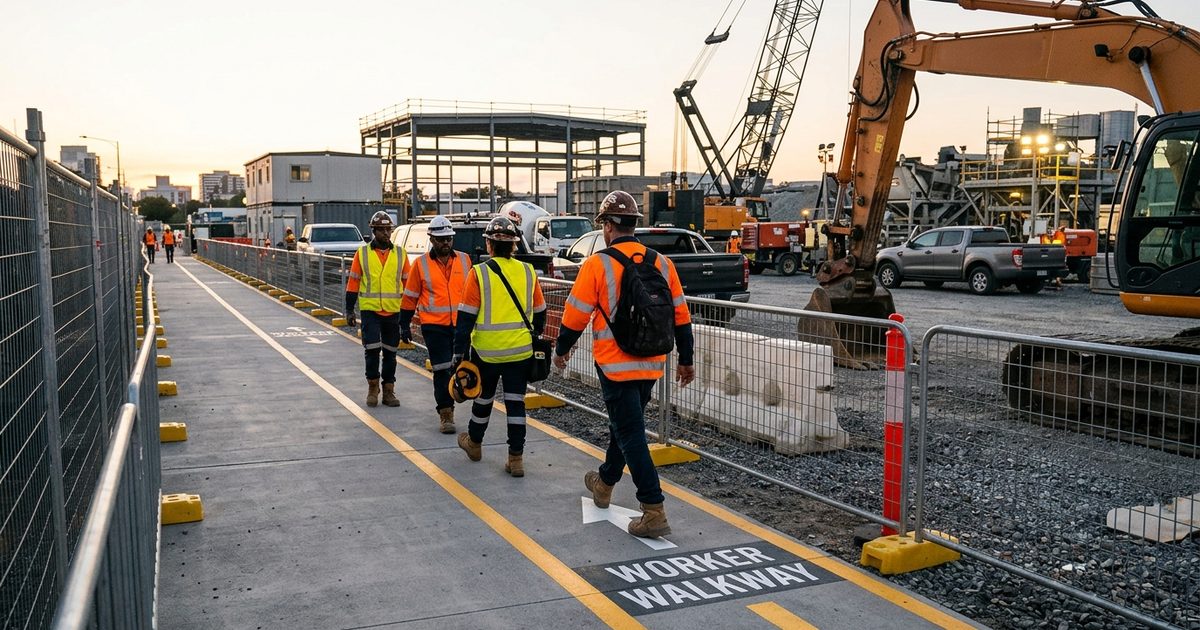
How does AI monitoring support OSHA documentation?
The financial exposure behind safety documentation keeps growing. For 2026, OSHA set maximum penalties at $16,550 per serious violation and $165,514 per willful or repeated violation. Fall protection in construction was OSHA's most-cited standard in FY2024, the most recent published list from the agency's Top 10 cited standards. Those two facts together explain why safety directors care about proof, not just practice.
Where cameras help is the record. Continuous, time-stamped video establishes what conditions looked like on a given day: whether guardrails were in place, when a hazard appeared, how quickly a supervisor responded after an alert. That trail supports internal incident reviews, insurance claims, and the corrective-action documentation that matters when an incident is investigated. Detection logs also give safety managers trend data, such as which gate produces the most PPE events, that toolbox talks can act on.
Two cautions belong in any honest version of this pitch. First, OSHA does not endorse or require camera analytics, and running them does not make a site compliant; compliance lives in your program, training, and abatement, not in your NVR. Second, video documents what actually happened, favorable or not. The contractors who benefit from it are the ones who pair detection with prompt, logged correction.
Why does monitored deployment matter more than the model?
An unattended analytics feed fails the same way an unattended alarm panel does: volume. Every shadow, tarp flap, and marginal PPE classification becomes a notification, and within weeks supervisors tune the whole channel out. We cover the mechanics in how to reduce false alarms in video analytics, but the short version is that filtering and human verification, not a better model alone, are what make alerts trustworthy.
Monitored deployment puts trained operators between the model and your phone. When an analytic fires, an operator confirms what the camera actually shows, discards the false positives, and escalates verified events with the clip attached. That is the force-multiplier model: the technology finds candidate events at machine speed, and verification means people, yours or your security partner's, handle confirmed incidents instead of chasing noise.
The same monitored infrastructure earns its keep around the clock. A 2026 vendor-commissioned industry survey reported by ForConstructionPros found 88% of surveyed businesses said physical security incidents stayed flat or rose in 2025. Cameras running safety analytics by day and intrusion detection by night amortize one system across both problems.
How do you put AI safety monitoring to work on a jobsite?
A deployment succeeds or fails on configuration and workflow, not hardware. The sequence that works:
- Map hazards to sightlines. Position cameras where the risks are: gates, excavation edges, crane radii, haul road crossings. Coverage gaps are silent failures.
- Configure zones and rules with your safety manager. The person who wrote the site-specific safety plan should define what counts as an event, and rules should change as phases change.
- Write the escalation path down. Decide who gets a verified safety alert during work hours, who gets after-hours intrusion calls, and what response is expected. Fold this into your broader construction site security plan so safety and security escalation live in one document.
- Tell the workforce. Be explicit that the system watches for hazards and intrusions, not productivity. Transparency preserves the safety culture the cameras are supposed to support.
- Close the loop. Review detection trends in toolbox talks and log corrective actions against events. This is what converts footage into the documentation trail described above.
Where mobile surveillance units fit
For active jobsites, the practical delivery vehicle for all of this is a solar-powered mobile surveillance unit: cameras, analytics, cellular connectivity, and power on a trailer that moves as the work moves. Vision Detection Systems pairs those units with a 24/7 monitoring center, so PPE, zone, proximity, and smoke detections arrive as operator-verified alerts with video attached rather than raw notifications. You can see how detection, verification, and escalation connect on our platform overview, and how contractors typically stage coverage by phase on our construction page.
The summary worth keeping: AI jobsite safety monitoring is a strong second set of eyes and a durable record, provided you deploy it with verification, a written escalation path, and a safety program that people, not cameras, continue to own.