
What each approach is actually good at
The simplest way to compare is by what each tool does well rather than by which sounds more advanced.
An aerial unit gives a point of view that a mast cannot. It can look over a ridge, follow a fence line across a long distance, check the far side of a stockpile or inspect a roof. It moves to the problem. That makes it useful for tasks where the question is about the whole area or about a location that is hard to reach on foot.
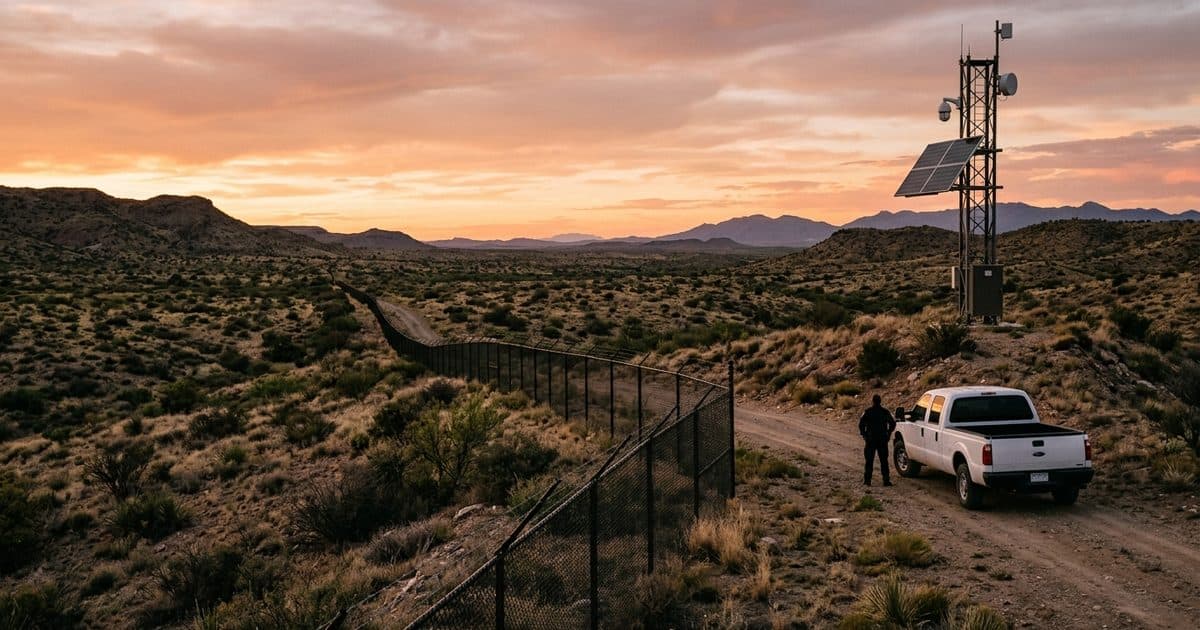
A ground unit stays put. A fixed camera or a mobile surveillance trailer watches one defined area without pause, so it is present at the moment something happens, not only when someone launches a flight. It records continuously, runs detection around the clock and can be connected to a monitoring team that responds in real time.
Put plainly, aerial excels at breadth and flexibility, and ground excels at persistence and immediacy.
The limits of aerial surveillance
Several practical limits apply to any drone program, whatever the platform.
Battery life. A drone flies for a limited time on each battery, then has to land. Continuous coverage requires swapping or recharging, and for true 24/7 watch that means multiple airframes, a dock or a person handling the cycle.
Weather. Wind, rain, fog and cold all limit or prevent flights. Conditions that make a site vulnerable, such as a storm that clears out staff, can also ground the aircraft.
Lighting. Night operations depend on the camera payload and are harder to do well than daytime work.
Operating rules. Aviation rules govern where, when and how drones may fly, and often require trained operators or authorizations, particularly over people, near airports or beyond line of sight. Privacy and local laws can add restrictions. Rules vary, so confirm what applies to your site with counsel before building a plan around aerial assets.
Staffing. Someone has to plan, launch, supervise and review each flight, or the program must be automated in ways that bring their own requirements.
None of this makes drones a poor tool. It means they fit periodic and on-demand tasks better than they fit the job of standing watch.
The limits of ground-based units
Ground units have limits of their own, and being honest about them avoids over-promising.
A camera sees what its line of sight allows. Terrain, structures, vegetation and stockpiles block the view, so a single unit cannot cover a very large area on its own. Mounting height helps, since a higher mast widens the view but reduces the detail available on faces and plates at distance. Our guide on how to mount security cameras explains that trade-off.
Large perimeters usually need several units positioned for overlapping coverage, and coverage should be planned around where people actually approach, not just where the fence runs. Radar-based detection can extend awareness along a long boundary by flagging movement before a camera confirms it. See radar perimeter detection and perimeter intrusion detection systems for how those layers work.
Comparison at a glance
| Factor | Aerial units | Ground-based units |
|---|---|---|
| Coverage pattern | Wide area, short duration | One zone, continuous |
| Best at | Surveys, inspections, checking an alarm location | Watching gates, fences, yards and storage |
| Duration | Limited by battery and weather | All hours, with power designed in |
| Detection | Depends on payload and operator | Continuous, with analytics running |
| Deterrence | Moves on, so presence is intermittent | Visible, fixed presence |
| Voice response | Possible only with specific equipment | Loudspeaker talk-down from a monitoring team |
| Staffing | Pilot or operator for each flight | Monitoring team watches remotely |
| Rules | Aviation, privacy and local rules apply | Mounting, signage and recording laws apply |
When to use which
A few scenarios illustrate how the choice usually lands, described in general terms.
A long boundary on open land. Ground units, positioned at likely approach points and gates, provide continuous watch. Aerial assets help periodically verify the boundary condition or investigate an alert across rough terrain.
A single storage yard with valuable material. Ground units are the primary answer, since the threat is theft or trespass at known points. A drone adds little here because the area is small and the risk is constant.
A large construction or industrial site with changing layout. Mobile ground units can be repositioned as the site changes, while aerial assets can document progress or survey areas that are hard to see from the ground.
A temporary event or incident area. Aerial views help with crowd awareness, while ground units cover entrances, storage and parked vehicles.
A site with no power or internet. Self-powered ground units with cellular connectivity are often the more practical continuous option. Aerial assets still need a pilot, charging and a place to launch.
For perimeter-heavy sites such as borders and remote infrastructure, see border and perimeter security cameras for how layered coverage is typically designed.
Questions to ask before you choose
Before buying either, write down what you need the tool to do, then test the answer against these points.
- Do I need constant watch, or periodic checks?
- Who will review video and act on it, and at what hours?
- What happens when weather is bad or power is out?
- What rules apply to my site, and who confirms them?
- What response follows a detection, such as a voice warning or a call to police?
If the answers include constant watch and a defined response, ground units form the foundation. If the answers include occasional survey or inspection of large areas, aerial assets can be added as needed.
How VDS fits
VDS builds ground-based, solar-powered mobile surveillance trailers. VDS does not sell drones. Each unit has a 5MP PTZ camera with 25x optical zoom and three 8MP wide-angle cameras on a 22 ft telescopic mast (30 ft available), with a 900W bifacial solar array, an 11.8 kWh LiFePO4 battery bank and dual-SIM 4G/5G cellular. No site power, internet or trenching is needed.
AI detects people, vehicles, loitering, objects and license plates. A 24/7 US-based security operations center verifies events, uses live talk-down through the loudspeaker and sends video to police dispatch when needed, so people, yours or your security partner's, handle verified incidents. Most deployments go from signed quote to live monitoring in about a week. See the border and perimeter industry page, review the mobile surveillance unit, or talk to our team at (410) 401-1986.