
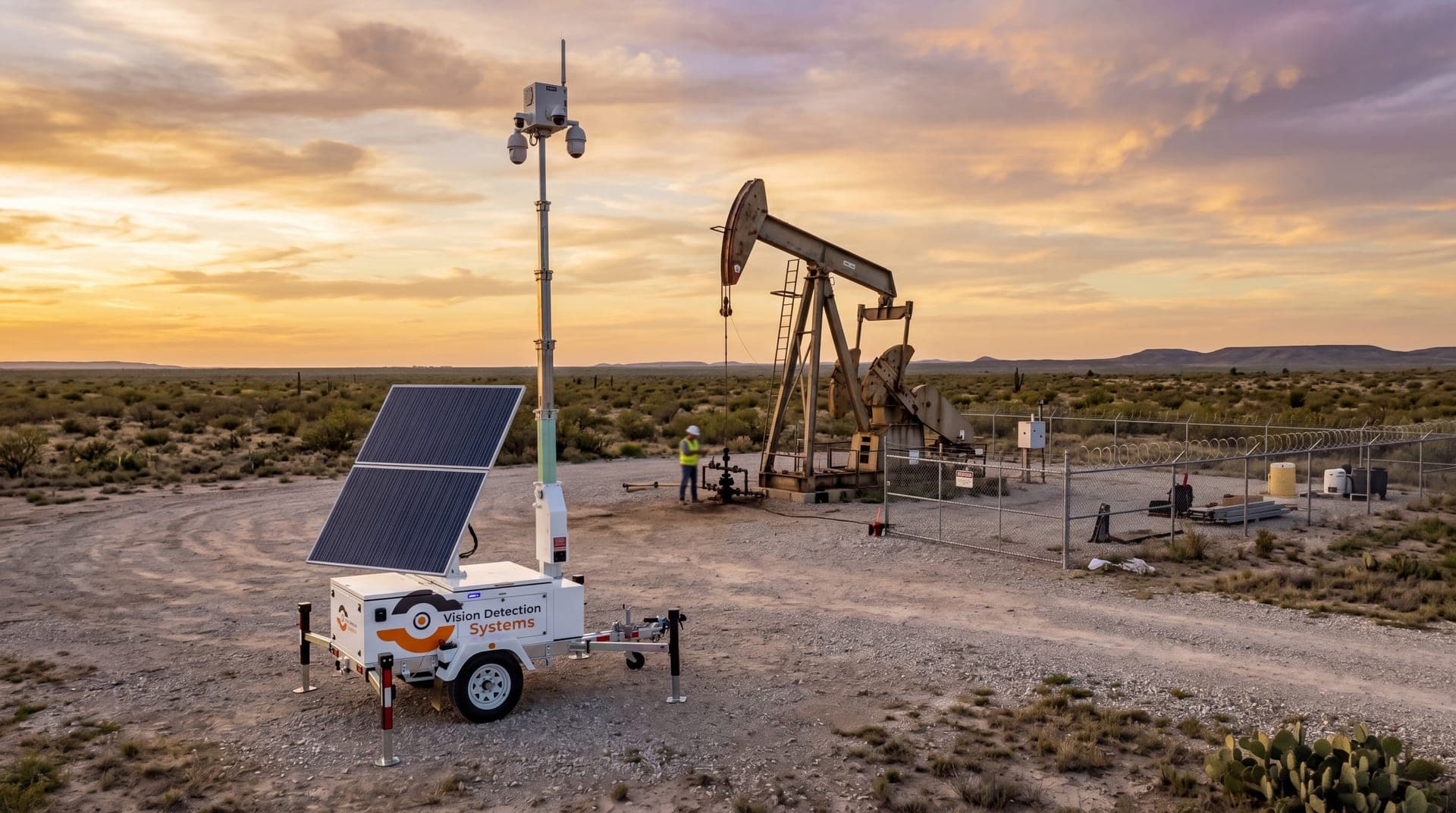
The challenge isn't identifying the threat — it's building a security system that actually works at a site with no permanent power infrastructure, no hardwired internet connection, and no on-site personnel after hours. Most conventional camera systems were designed for buildings with electrical panels and fiber runs. They don't solve the remote site problem. They create it.
This post covers the threat landscape at oil and gas sites, why standard CCTV fails in remote environments, what an effective coverage plan looks like for pipeline and energy infrastructure, and how solar-autonomous mobile surveillance changes the operational calculus.
The Threat Landscape at Remote Oil and Gas Sites
Energy infrastructure theft is organized and persistent. Copper wiring from compressor stations and substations is targeted for scrap value — a single compressor station can yield several hundred pounds of copper in a single theft event. Fuel theft from tank farms is a higher-value play: diesel and crude oil have consistent resale value, and remote sites with infrequent check-ins give thieves hours or days before anyone notices inventory is short.
Beyond theft, energy sites face equipment sabotage (both targeted and opportunistic), trespass by individuals who don't understand the hazards they're walking into, and regulatory exposure when unauthorized access creates environmental incidents. A punctured tank or damaged pipeline section that isn't caught on camera means no evidence trail for the investigation, no footage for insurance, and a much harder path to cost recovery.
The sites most vulnerable to all of these threats share the same profile: remote location, limited staffing, infrequent physical inspection, and no permanent security infrastructure. Wellheads and pipeline access points outside urban corridors are often visited by field crews once a week or less. That's a large window for anyone who knows the inspection schedule.
For operators managing oil and gas security across multiple remote sites, the core challenge is coverage that doesn't require permanent infrastructure — because most of these sites will never have it.
Why Standard CCTV Fails at Remote Energy Sites
A fixed CCTV system requires three things that remote energy sites rarely have: a reliable power source, a hardwired or stable wireless internet connection, and a stable physical installation point. At a wellhead in a remote basin or a pipeline right-of-way access point, none of those are typically available.
The comparison is straightforward:
| Capability | Fixed CCTV | Solar Mobile Surveillance |
|---|---|---|
| Power source | Requires grid connection or generator with fuel maintenance | Solar panels with battery storage — fully autonomous, no grid required |
| Deployment time | Days to weeks — conduit runs, mounting, electrician required | Hours — trailer tows to site, positions, powers on |
| Connectivity | Hardwired or fixed wireless — fails if infrastructure isn't present | 4G/LTE cellular — works anywhere with mobile signal |
| Relocatability | Not relocatable without full reinstallation | Fully relocatable — move as risk shifts between sites |
| Monitoring capability | Passive recording unless monitoring infrastructure is built out | Live remote monitoring with verified escalation workflow |
Fixed cameras at remote sites also create a false sense of coverage. A camera that was installed two years ago and has never been verified — with no one checking whether footage is recording, whether the view is still clear, or whether the storage hasn't overwritten itself — is not a security system. It's documentation that you had a camera. When an incident happens and the footage isn't there, the operational and legal consequences are identical to having no camera at all.
Tip: Solar surveillance trailers at remote oil and gas sites typically require 4–6 hours of direct sunlight per day to maintain continuous overnight operation. For sites in low-sunlight periods or with heavy cloud cover, specify units with oversized battery bank capacity — ideally 72+ hours of autonomous runtime. This ensures continuous coverage through multi-day overcast conditions without any manual intervention.
What a Proper Coverage Plan Looks Like for Oil and Gas Sites
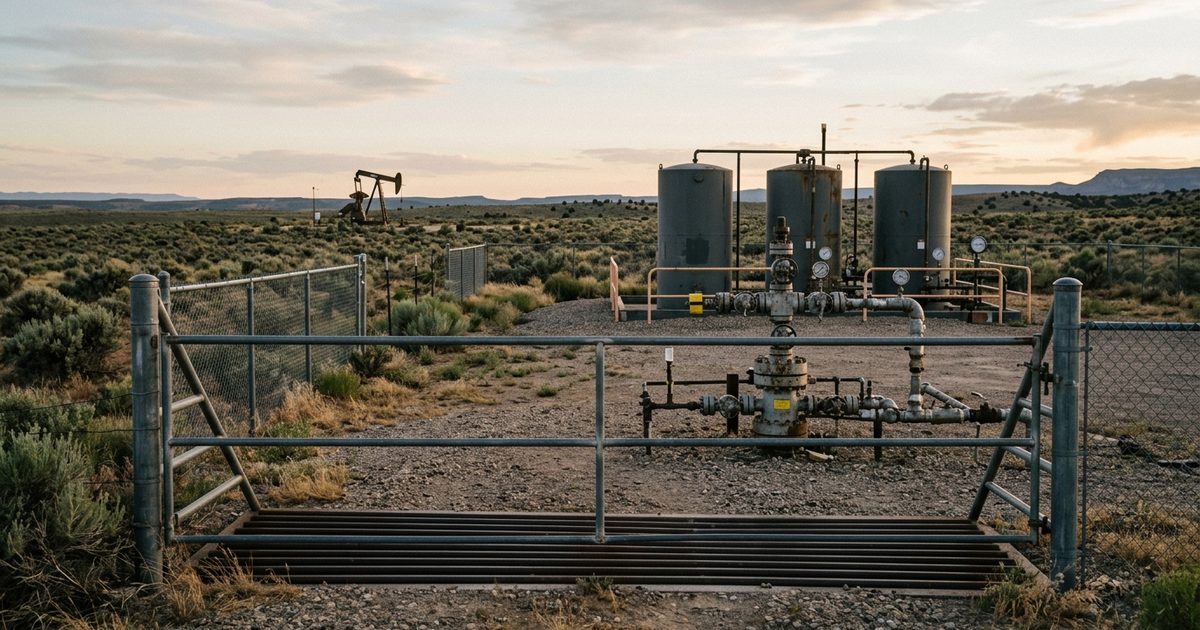
An effective coverage plan for oil and gas infrastructure starts with the threat model, not the equipment list. Before deploying any cameras, map the access points and high-value targets: How does an unauthorized person get onto this site? Where is the highest-value equipment or inventory? Which areas are most likely to see tampering before anyone notices?
For a typical remote wellhead or compressor station, the coverage plan typically includes:
- Site perimeter and access road: The first detection point. Camera coverage of the access road approach gives the earliest possible alert — often before a threat has reached the high-value equipment. License plate recognition at access road chokepoints creates an evidence-ready log of every vehicle that entered the site.
- High-value equipment zones: Compressor units, separators, control panels, and storage tanks. Coverage should produce clear identification-quality images under the lighting conditions present at night — which at a remote site typically means no ambient lighting whatsoever.
- Fuel and chemical storage areas: Tank farm coverage with overlapping camera angles so there's no single-camera failure point.
- Connection and metering points: Where theft is most likely to occur for pipeline infrastructure — monitoring here catches both external threats and potential insider issues.
For pipeline rights-of-way, coverage is different — the perimeter is linear rather than bounded. A Mobile Surveillance Unit deployed along a right-of-way covers a wide-area field of view with PTZ (pan-tilt-zoom) capability and optional thermal imaging for night detection. Units can be repositioned along the right-of-way as inspection priorities shift or after an incident at one section.
Remote Monitoring for Oil and Gas: Verified Response at Unmanned Sites
The value of a camera at a remote site is entirely dependent on what happens when it detects something. A recording that's reviewed three days after an event is useful for insurance and investigation — it does nothing to stop the incident or reduce the damage.
Remote video monitoring connects the site to a monitoring operations center that verifies alerts in real time and executes a defined escalation protocol. When a camera at a compressor station detects movement at 2am, the alert goes to a human operator who verifies it against the site's access schedule. If it's unauthorized, the operator escalates: audio challenge through the unit's speaker system, contact with site management, law enforcement dispatch.
For critical infrastructure security, this verified response model matters for a specific operational reason: false alarms at remote sites are expensive. Dispatching a crew to check out an alert that turns out to be a deer costs time and money. A monitoring workflow with proper detection zone configuration and a human verification step eliminates routine false positives and ensures that escalations are real events — not sensor noise.
Incident reporting from monitored sites also creates the documented security record that insurers and regulators require. Every alert, every verification decision, every escalation action is logged with timestamps. When a claim is filed or a regulatory inquiry is opened, the documentation exists and is organized.
Rapid Deployment for Construction, Turnarounds, and Elevated Risk Periods
Remote oil and gas sites have risk periods that don't match their baseline security posture. Construction and expansion phases, turnaround and maintenance windows, and periods following nearby incidents all represent elevated risk that a static coverage plan doesn't address.
Rapid deployment with a Mobile Surveillance Unit means a site can go from no coverage to full monitored surveillance in hours. No permitting delay, no infrastructure work, no waiting on an electrician. The trailer arrives, positions at the coverage point, connects to cellular, and is live.
This is also the right model for temporary laydown yards and staging areas — high-value equipment and materials that exist at a site for weeks or months during a project phase, then move. A fixed camera system installed at a laydown yard that's gone in 60 days is a cost that doesn't make sense. A mobile unit that covers the yard for the duration of the project, then redeploys to the next site, does.
For copper theft prevention specifically, the deterrence value of a visible surveillance unit is measurable. Thieves assess risk before committing to a target. A monitored surveillance trailer with visible cameras, lighting, and a speaker system presents a much higher risk profile than an unmanned site with no visible security presence — which is exactly what most remote energy sites look like today.
Common Mistakes in Oil and Gas Site Security
- Deploying cameras without confirming cellular signal coverage. Remote sites in rural basins or mountainous terrain often have weak or no cellular signal. Camera hardware that's technically functional produces no value if it can't transmit. Signal strength must be verified at the specific deployment point before the system goes live — not assumed based on carrier coverage maps, which are often optimistic about rural areas.
- Using passive recording systems and assuming footage will be there when needed. Storage devices at remote sites are subject to power fluctuations, temperature extremes, and physical vibration from nearby equipment. Recording systems that aren't actively monitored for uptime frequently fail silently — the light is on, but nothing is being written. A monitoring workflow with regular system health checks catches these failures before they become evidence gaps.
- Single-angle coverage of high-value targets. A single camera covering a compressor unit from one angle creates a blind spot on the opposite side. Any theft or tampering that occurs outside that camera's field of view is unrecorded. Overlapping coverage — at minimum two cameras with intersecting fields of view — eliminates single-point failure in your coverage plan.
- No escalation protocol defined before deployment. Cameras that generate alerts with no defined escalation path don't produce a security outcome — they produce a list of unreviewed notifications. Before any system goes live, define who gets the alert, what their response options are, and what documentation is required. An unmanned remote site needs a protocol that works without on-site personnel, which means monitoring operator authority to escalate to law enforcement must be pre-authorized.
- Treating deployment as permanent when the risk is temporary. Many operators install cameras at a remote site during a construction or expansion phase, then leave them in place indefinitely even after the elevated risk period ends — while leaving other active sites uncovered. A mobile surveillance strategy treats assets as relocatable resources that follow the risk, not fixed infrastructure that stays where it was installed.
For sites where you already have some infrastructure and need targeted expansion, the Solar Surveillance Kit covers pole- and skid-mounted options that use the same solar-autonomous power architecture as the trailer.