
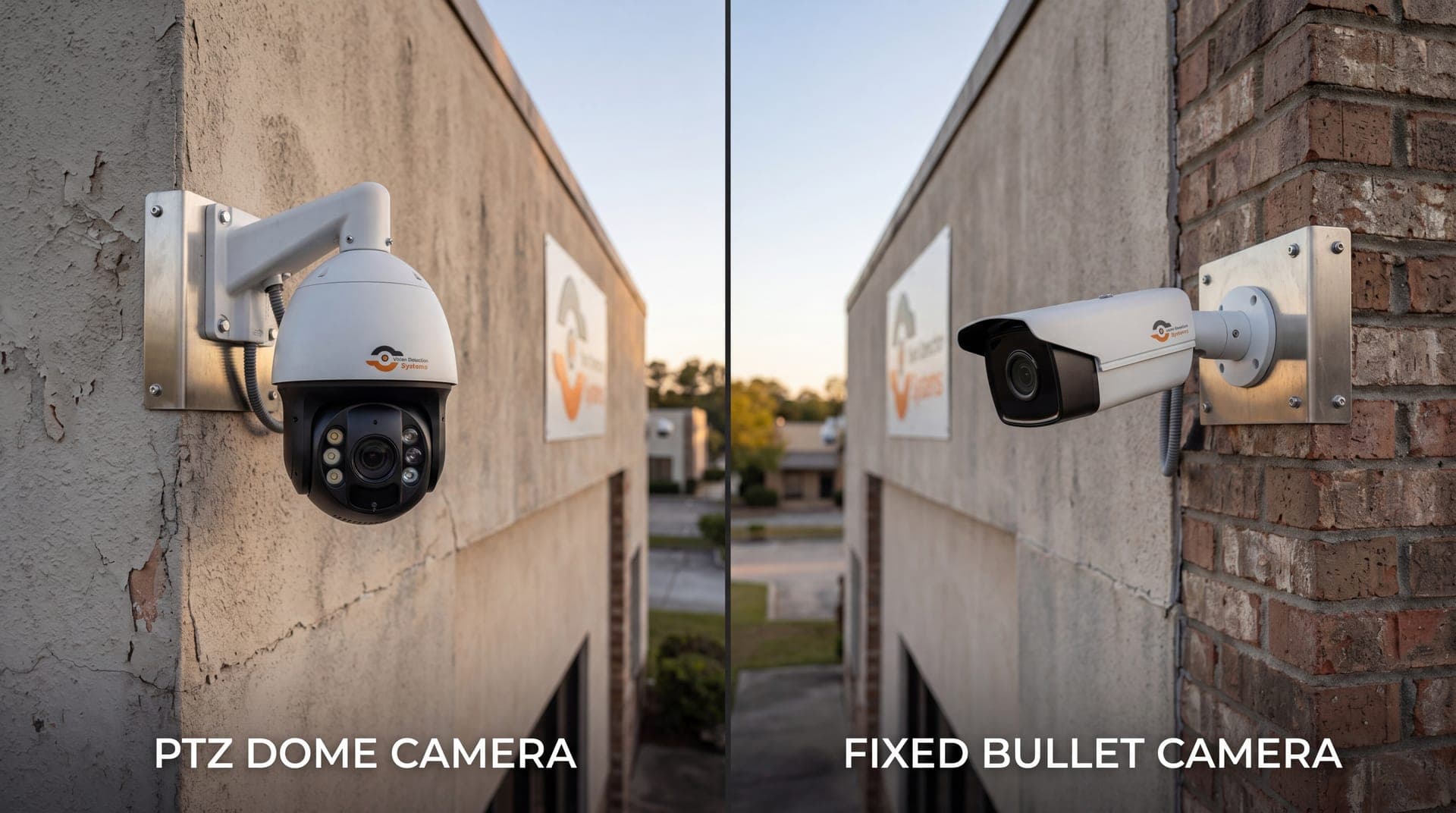
Understanding the genuine strengths and limitations of each type helps you design a camera system that provides real coverage rather than one that looks impressive on paper but leaves critical gaps.
Fixed Cameras: The Foundation of Site Coverage
Fixed cameras maintain a constant, predetermined field of view. Once installed and aimed, they continuously cover their assigned zone without adjustment, operator direction, or automation logic.
This is the fundamental advantage of fixed cameras: consistent, reliable coverage of a defined area regardless of what else is happening on the site. An incident in the fixed camera's field of view will be captured even if no one is actively monitoring the system. There's no possibility of the camera being pointed in the wrong direction when something happens.
Where fixed cameras excel:
- Perimeter entry and exit points
- Material storage areas requiring constant documentation
- Access control lanes and chokepoints
- Interior zones with defined high-value assets
- Any location where you need reliable evidence even without active monitoring
Fixed camera limitations:
- No flexibility after installation—coverage zone changes require physical repositioning or adding new cameras
- Standard fixed cameras have a fixed focal length; getting useful detail at longer distances requires larger lenses (and a narrower field of view)
- Can't be redirected by operators to investigate adjacent areas
For most commercial and construction applications, fixed cameras are the primary coverage tool. The site perimeter, access points, and critical asset zones all benefit from consistent, reliable fixed coverage.
PTZ Cameras: Flexible, Operator-Directed Coverage
PTZ cameras can pan horizontally, tilt vertically, and zoom optically to target any area within a wide range. They're powerful tools in specific applications but are frequently misunderstood as a replacement for fixed cameras rather than a complement to them.
Where PTZ cameras excel:
- Large open areas requiring active monitoring (ports, rail yards, large utility facilities)
- Investigation and assessment when an alert is triggered in a nearby zone
- Sites with staffed monitoring centers where operators can direct cameras in real time
- Applications requiring optical zoom to identify people or vehicles at significant distances
- Verification of activity detected by fixed cameras or analytics
PTZ camera limitations:
- Can only cover one direction at a time—incidents occur where the camera isn't pointing
- Mechanical components (pan/tilt motors, zoom drive) require maintenance and fail over time
- Higher initial cost and higher maintenance cost than equivalent fixed cameras
- Autotracking is useful but not reliable enough to replace operator-directed use in security applications
- Preset patrol patterns leave predictable coverage gaps that experienced adversaries learn to exploit
The core limitation of PTZ cameras for site security is simple: any coverage point they're not currently watching has no coverage. For applications requiring constant documentation of specific zones, a fixed camera is always more reliable.
Side-by-Side Comparison
| Characteristic | Fixed Camera | PTZ Camera |
|---|---|---|
| Coverage consistency | Constant, reliable | Depends on where it's pointing |
| Area coverage | Fixed zone | Wide, flexible—one direction at a time |
| Optical detail at distance | Limited by fixed focal length | High—30x+ optical zoom |
| Equipment cost | $200–$800 | $800–$5,000+ |
| Maintenance requirements | Low (no moving parts) | Higher (motor, gear, zoom mechanism) |
| Active operator value | Low (runs without attention) | High (maximized with operator direction) |
| Evidence quality (unmonitored) | Reliable for covered zone | Depends on where camera was pointing |
| Best application | Perimeter, access control, asset zones | Large open areas, active monitoring sites |
How PTZ and Fixed Cameras Work Together
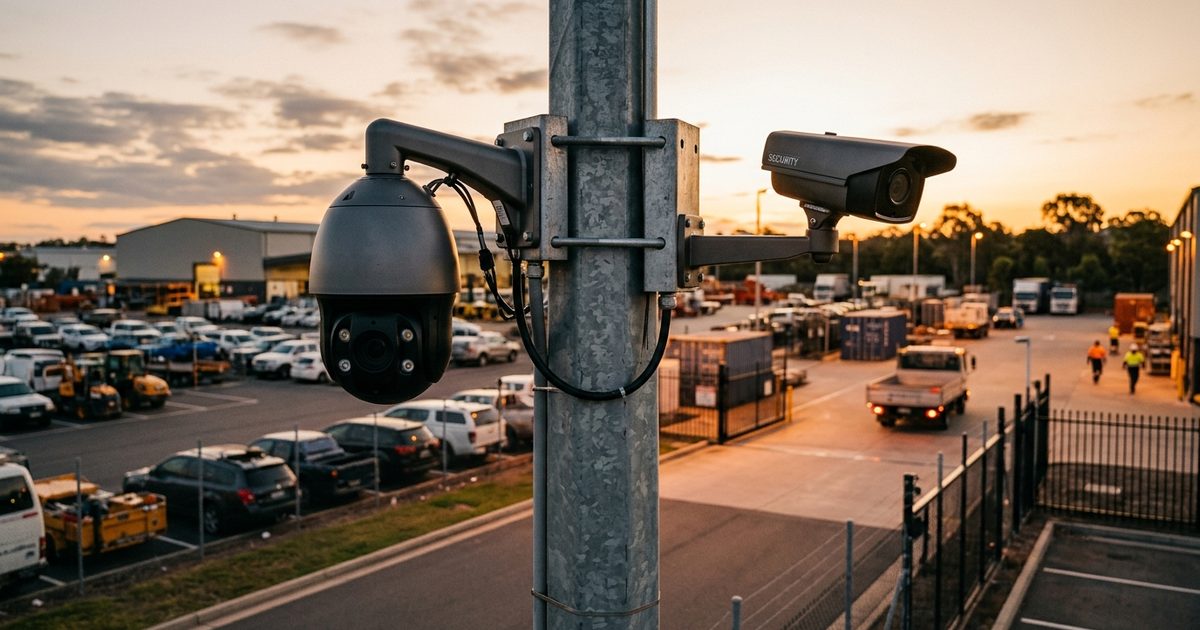
The most effective site security camera systems use fixed cameras as the backbone and PTZ cameras as tactical investigation tools. A typical deployment:
Fixed cameras at all access points capture every vehicle entry and exit. No event at an access point is missed regardless of when it occurs or what the PTZ is doing.
Fixed cameras at critical asset zones provide constant documentation of material storage, equipment staging, and high-value asset locations. If theft occurs, footage is available from every angle covering those zones.
PTZ camera(s) positioned for wide-area coverage give operators or autotracking systems the ability to zoom in on activity detected by the fixed cameras, track suspects across the site, and assess situations before escalating.
This architecture gives you the reliability of fixed coverage plus the investigative capability of PTZ flexibility—without the blind spots that come from relying on PTZ cameras as primary coverage.
Tip: If you can only afford one PTZ for a site, position it for maximum flexibility to investigate events—not to cover a specific zone as its primary function. Let fixed cameras do the zone coverage.
Power Considerations for Mobile Deployments
For off-grid mobile surveillance deployments, fixed cameras are significantly more power-efficient than PTZ cameras. A fixed camera draws 5–10 watts continuously. A PTZ camera in active use draws 20–50 watts—and when the motors are running, significantly more in brief spikes.
On a solar-powered surveillance trailer designed for 5–9 days of battery autonomy, replacing even one fixed camera with a PTZ camera noticeably reduces autonomy. Most mobile surveillance units deploy fixed cameras for their energy efficiency and reliability advantages in off-grid environments.
For sites that need PTZ capability, a hybrid approach uses a mobile trailer with fixed cameras for perimeter coverage and a separate PTZ unit connected to shore power or a larger solar/battery system.
Vandal-Resistance and Environmental Ratings
Construction sites and outdoor industrial environments demand rugged camera hardware. Both fixed and PTZ cameras should meet IP66 or IP67 ratings (dust-tight, water jet resistant) for outdoor deployment.
PTZ cameras face an additional environmental challenge: their mechanical components introduce more potential failure points than fixed cameras in harsh environments. Dust, vibration, and temperature cycling stress the motor assemblies and precision optics in ways that purely static cameras aren't subject to.
Note: Vandalism is a real risk on construction sites. Fixed cameras in vandal-resistant dome housings (IK10 rated—resistant to 20-joule impacts) are more resistant to physical attack than PTZ cameras with their larger, more exposed external housings.
Making the Right Choice
For most construction, utility, and commercial sites, the practical recommendation is:
- Deploy fixed cameras at all perimeter entry/exit points, material storage zones, equipment staging areas, and access control lanes
- Add one or two PTZ cameras if you have a staffed monitoring operation or large open areas requiring flexible coverage
- Avoid replacing fixed coverage with PTZ cameras to save hardware costs—the coverage gap this creates undermines the system's security value
The VDS team performs site assessments that map both fixed and PTZ camera positions for maximum coverage before any equipment is deployed. Contact us for a site-specific coverage plan and quote.