
Why satellite comes up
Most remote surveillance problems start with the same question: how does video get from the camera to the people who need to see it? Wired internet is rarely available at undeveloped land, offshore sites, mountain terrain, or remote lots. Cellular covers a great deal of the country, but not everywhere.
When both are missing, satellite is one of the few remaining ways to get a data link. That makes it a fallback for coverage gaps rather than a first choice. Before settling on it, check cellular carefully. Coverage maps are approximate, and signal at the mast height, with a proper outdoor antenna, is often better than a phone at ground level suggests. Testing on site beats trusting a map.
How satellite connections work
A satellite terminal, usually a dish or flat panel antenna, communicates with satellites overhead and relays data to the wider internet through ground stations. The terminal needs a clear line of sight to the sky, so trees, buildings, masts and terrain can all interfere.
There are two broad categories, and the differences matter for cameras.
- Geostationary systems. Satellites sit very high above the equator. Coverage is broad, but the distance creates noticeable delay for each round trip of data.
- Low-orbit systems. Satellites orbit much closer to the ground, which reduces delay, but they move across the sky, so the network depends on many satellites and a terminal that tracks them.
Neither type behaves like a wired connection. Both are shared resources, and performance can vary with congestion and conditions.
Latency and bandwidth in general terms
Latency is the delay between sending data and getting a response. For a camera, latency affects how quickly a live view starts, how responsive remote PTZ control feels, and how smoothly two-way audio works. Higher latency makes manual control feel sluggish and can make live talk-down awkward, since delays disrupt conversation.
Bandwidth is how much data the link carries. Video is demanding, especially at high resolution. A satellite plan may cap total data, slow speeds after a threshold, or offer different upload and download rates. Upload is what matters for cameras, and it is often the weaker side.
Because of this, satellite-connected sites usually do not push continuous full-quality streams from every camera. They rely on efficient compression, lower-bitrate streams for live views, and event clips triggered by detection. Our articles on H.264 versus H.265 video compression and event-based versus live video monitoring cover those techniques.
Satellite versus cellular
| Factor | Cellular | Satellite |
|---|---|---|
| Coverage | Wide, but with gaps | Very wide, needs open sky |
| Latency | Generally lower | Generally higher |
| Equipment | Small modem and antenna | Dish or panel terminal |
| Power draw | Typically lower | Often higher |
| Weather sensitivity | Modest | Can degrade in heavy precipitation |
| Data limits | Plan-dependent | Plan-dependent, often tighter for video |
| Best fit | Most remote sites | Sites with no usable cellular |
Dual-SIM cellular, which can switch between two carriers, improves reliability in marginal areas without leaving the cellular approach. Our guide to cellular security cameras on 4G and 5G explains how that works.
Power and mounting
At a solar-powered site, power is a budget. A satellite terminal typically draws more than a cellular modem, which means more battery capacity and solar generation to carry it through the night and through cloudy stretches. That raises the size and cost of the power system. Our article on solar security camera battery life explains how to estimate load.
Mounting is a second concern. The terminal needs a stable base and an unobstructed sky view. On a tall mast, wind movement can affect pointing, and the terminal must be secured against theft and weather. Cabling between the terminal and the cameras adds another failure point.
Cost and contract considerations
Satellite service is typically sold as a monthly plan with a data allowance, a priority tier, or both. Equipment is bought or leased, and a camera site may need a plan that allows continuous use at a fixed location rather than a casual or roaming plan. Terms vary widely, so compare what is included, what happens after the data allowance, and whether the plan can be paused during seasons when a site is idle. Ask for these terms in writing before committing, and confirm who supports the terminal if it fails.
Reliability planning
Any single link can fail, so plan for it.
- Local recording. Cameras should keep recording on the unit even if the link drops, so footage is not lost.
- Buffering and catch-up. Event clips should queue and send when the connection returns.
- Alerts for link loss. Someone should know when a site goes offline, because silence can look like a quiet night.
- A second path. Some designs pair satellite with cellular or the reverse, so one backs up the other.
Our overview of security cameras without internet describes how remote systems handle these situations.
Questions to ask before choosing satellite
- Have you tested cellular at the actual mounting height with an external antenna?
- What upload speed does the satellite plan provide, and what happens after data thresholds?
- How much power does the terminal draw, and is the power system sized for it?
- How will live talk-down and PTZ control feel at the expected latency?
- What is the plan if the link goes down for hours?
A provider who has handled remote and island locations will have practical answers. Our piece on island security and remote surveillance describes the connectivity challenges common to those sites.
How VDS fits
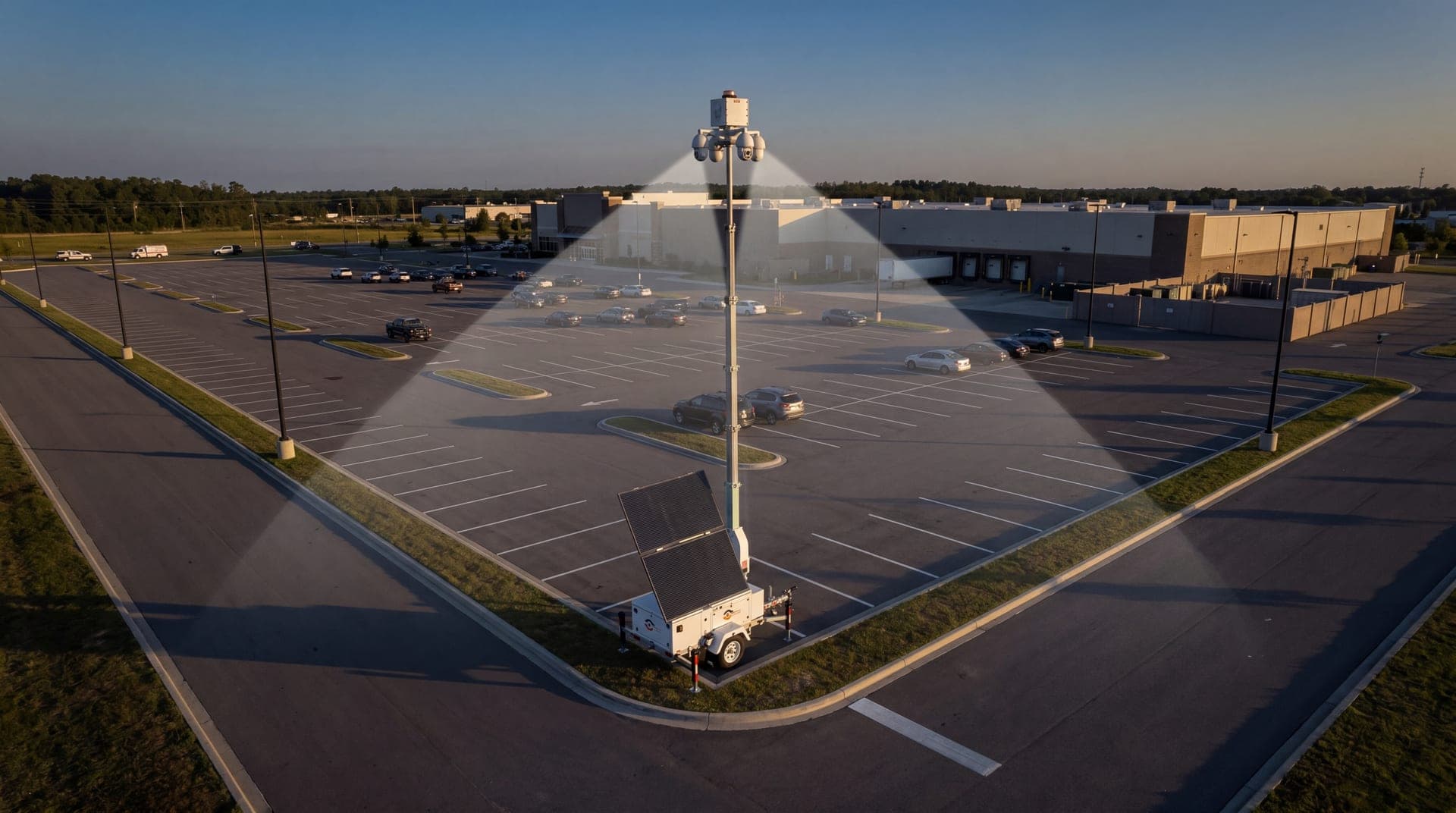
VDS mobile surveillance units are designed around solar power and dual-SIM 4G/5G cellular, with no site power, internet or trenching needed. They carry a 5MP PTZ with 25x optical zoom plus three 8MP wide-angle cameras, and a 24/7 US-based security operations center verifies events and responds with live talk-down before police dispatch with video, so people, yours or your security partner's, handle verified incidents. If you are unsure whether cellular will reach your site, that is a good first conversation to have.
To talk through connectivity at a specific location, contact our team.