
What thieves are after
The common thread is metal. Copper is the main draw, and aluminum conductors and busbars also have scrap value. A solar farm holds a great deal of both in places that look quiet from the road. Thieves look for sections where they can work without being seen and leave before anyone checks.
Targets fall into a few groups:
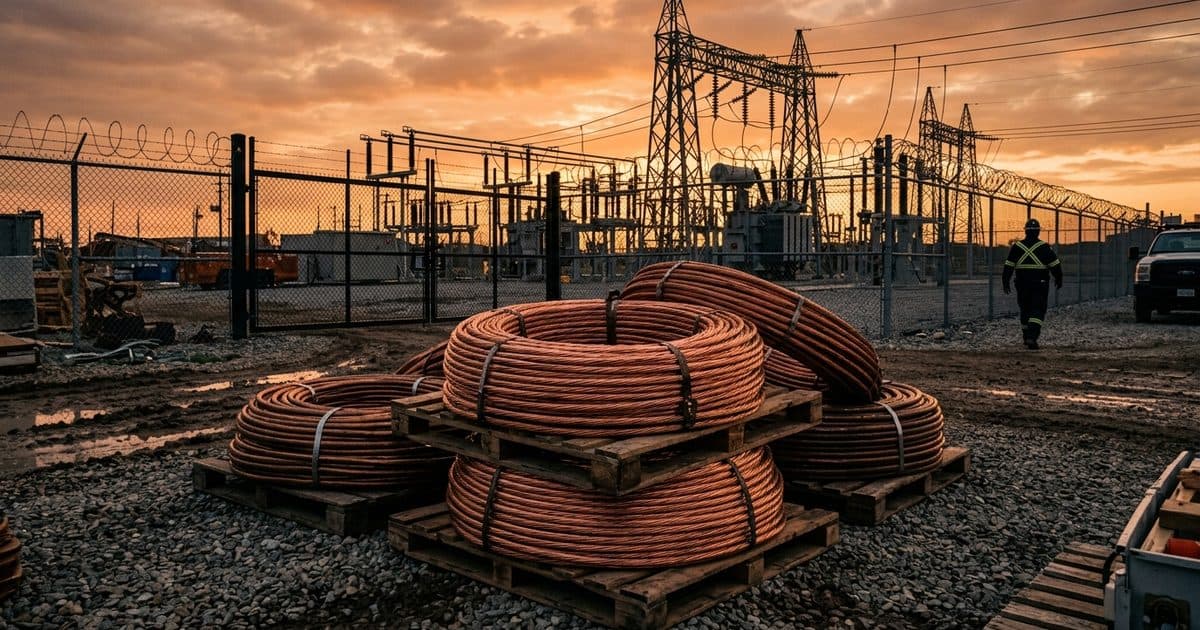
- Cable on spools or in trenches before it is covered, which is quick to remove.
- DC and AC conductors in accessible cable trays, junction points and above-ground runs.
- Combiner boxes and recombiners, which contain conductors, fuses and busbars in a single enclosure.
- Inverters and transformers, which contain copper windings and large amounts of cable at their terminals.
- Grounding conductors, which are often stripped because they are exposed and unattended.
For a general view of why copper theft keeps recurring, see our overview of copper theft in 2026.
The damage is bigger than the metal
The value of the metal taken is usually small next to the cost to repair what was damaged. A section of cable cut out of a circuit means replacement cable, labor, testing and often the loss of generation until the work is complete. An inverter with its terminals stripped may need repair or replacement, and a disturbed combiner box can leave strings disconnected.
There is also a safety dimension. Cutting into circuits that may be energized is dangerous for the thief and for anyone who arrives later. Operators should treat any site where cut cable is found as hazardous until qualified personnel confirm it is safe.
Because the downstream cost is high, the goal is to stop the intrusion at the access point or the pad, not to document it afterward. Our substation-focused article on copper theft prevention applies many of the same principles.
Why solar sites are especially exposed
Several features of a typical solar farm help thieves.
First, size. A site may have miles of fence line and no continuous patrol, so any single point is rarely watched. Second, remoteness. Many sites are away from busy roads, so noise and light from a theft are not noticed. Third, uniformity. Rows of identical equipment make it hard to tell by eye when something is missing, and a site manager may not realize the loss until output drops. Fourth, construction and commissioning overlap, where some equipment is complete and some is partly wired.
Detection that matches the target
Different thefts leave different traces, so layer the detection.
| Method | What it catches | Notes |
|---|---|---|
| Fence and gate monitoring | Entry through the perimeter | Needs verification to avoid weather false alarms |
| AI video analytics | People and vehicles at pads and gates after hours | Works best when after-hours rules are clear |
| Thermal or low-light imaging | Movement at night with little light | Ask providers about detection range and conditions |
| Radar or similar sensors | Movement across wide open ground | Pair with a camera so someone can see what triggered it |
| Output and inverter monitoring | Sudden generation drops | Shows the loss after it happens, not before |
For more on technology choices, see radar perimeter detection and our comparison of infrared versus thermal night vision. Remember that the production data your operations team already sees is useful as a second signal. A sudden drop in one block can confirm a theft, but it should prompt a camera check, not replace one.
Camera placement for equipment pads
Cameras do not need to see every cable run. They need to cover the places a thief must pass through or work around.
- Gates and access roads. Capture every vehicle that enters and leaves.
- Inverter and combiner pads. Cover each pad or cluster from an angle that shows people working at the enclosure.
- Staging and spares storage. Spools, spare equipment and parts are easy to remove.
- Fence sections near roads. The easiest points of entry draw the most attempts.
- Approaches from adjacent land. Edges near public roads and open fields are common ways in.
A camera mounted higher gives a wider view, but facial detail drops with distance, so position units to cover the pad area directly. See solar farm security cameras for more on layout.
Reduce what is easy to take
Some losses are avoidable with simple practice. Bury or cover cable promptly after pulling it rather than leaving it exposed on the ground overnight. Store leftover spools in a locked, lit area inside camera coverage and count them at the end of each shift. Lock combiner and inverter enclosures and check the locks during routine rounds. Keep a short written record of what is installed in each block, so a missing component is noticed on the next visit rather than after output has been lost for weeks. None of this stops a determined crew, but it removes the easy targets and narrows what cameras must watch.
Response matters as much as detection
An alert is only useful if someone acts on it quickly. A good response sequence for a remote solar site looks like this: a detection triggers, a trained operator reviews live video, a loudspeaker challenge tells the person they are being watched, and police are called with video if they stay. Never ask site staff to confront suspects, and warn everyone not to touch cut equipment.
After an incident, preserve the footage and note the time. Operators should coordinate with their insurer and local police about next steps.
How VDS fits
VDS builds solar-powered mobile surveillance units that can be placed near equipment pads and access roads without needing site power, internet or trenching. Each carries a 5MP PTZ camera with 25x optical zoom and three 8MP wide-angle cameras on a 22 ft telescopic mast, with a 30 ft mast available. A 900W bifacial solar array charges an 11.8 kWh LiFePO4 battery bank with reserve for 3-5 cloudy days, and dual-SIM 4G/5G cellular carries video.
AI detection flags people, vehicles and loitering, and a 24/7 US-based security operations center verifies events, uses live talk-down through a loudspeaker, then dispatches police with video. This lets your staff or security partner handle verified incidents. Most deployments go live about a week after a signed quote. Learn more about mobile surveillance units or talk to our team.