
Why the yard deserves most of the attention
Across a solar project, the laydown yard holds the most value in the smallest area. Modules, racking, cable, inverters and electrical components arrive here and wait. The yard also has the most traffic, with delivery trucks, forklifts, crews picking up material and visitors who need to be signed in.
That mix of high value and constant activity creates risk. A tightly managed yard can be protected with a few well-placed controls. A sprawling or disorganized one cannot be protected at any price. Start with the layout. See our utility laydown yard security article for a parallel look at the utility side.
Layer 1: Inventory control
Inventory is a security tool, not only a logistics one. If you do not know what should be there, you cannot tell when something is missing.
- Count and record every delivery on arrival, including pallet or reel numbers and serial numbers where they exist.
- Assign locations in the yard, so each type of material has a place.
- Reconcile stock against issued and installed quantities on a regular schedule, weekly at minimum during heavy deliveries.
- Investigate differences immediately, using gate records and video.
- Keep surplus and returns separate from active stock, since they are often forgotten and easy to take.
Do not hold more than needed. Coordinate delivery timing with installation, so that the yard never becomes a long-term warehouse. Less stock means less exposure.
Layer 2: One gate and a perimeter you can read
A yard with several openings cannot be controlled. Plan for one entrance for vehicles, with a sign-in process, and keep any other openings locked and marked as emergency exits.
Temporary fencing sets a boundary but does not stop a determined thief. Its main value is to define what is inside, create a place to see and record who enters, and make an attempt noticeable. Keep stacks back from the fence so there is room for cameras to see and for anyone cutting through to be seen. At the gate, record every vehicle and driver. Where you control access with plates, see automated gate access and LPR.
Layer 3: Lighting that helps cameras
Darkness lowers the quality of video and raises the confidence of intruders. Good lighting solves both, provided it is installed with the cameras in mind.
- Light the gate and the main stock areas evenly, so there are no dark pockets next to bright ones.
- Aim lights so they do not shine into the lens, which washes out the image.
- Avoid shadows cast by stacked pallets, which can hide a person.
- Plan for power. Many solar sites have no grid at the yard, so use solar or generator-based lighting where needed.
Our security camera lighting guide describes how to match lights to camera positions.
Delivery days and visitors
Delivery days are the busiest and least controlled moments in a yard. Trucks arrive in clusters, drivers wander, and gates stay open for long stretches. Schedule deliveries in fixed windows and tell the monitoring team or site lead when to expect them, so activity at the gate is not mistaken for an intrusion. Assign one person to receive and count each load, keep drivers in a defined area, and close and lock the gate as soon as the last truck leaves. Visitors, inspectors and vendors should sign in like crews and wear identification. A yard that is orderly during the day is easier to read at night, because anything unusual stands out.
Layer 4: Detection and response
Even a well-run yard needs something that notices an intruder at 2 a.m. The standard approach is AI video detection on cameras covering the gate and stock, with each alert checked by a human before anyone is dispatched. Our notes on loitering detection cameras describe how a person lingering near stock can be flagged before they act.
The response matters as much as the detection. A trained operator confirms the event, speaks to the person through a loudspeaker, and calls police with live video if they remain. A 2019 systematic review of 76 studies found that actively monitored camera systems were associated with roughly a 15% reduction in crime, while passive recording-only systems showed no significant effect. Parking lots and similar open areas showed a larger reduction, at about 37%, which is relevant to yards.
Quick reference: what to check each week
| Check | Question to answer | Action if no |
|---|---|---|
| Inventory count | Does the count match records? | Review gate and video records |
| Gate log | Are all entries on the access list? | Update list, brief crews |
| Fence line | Any cuts, gaps or tracks? | Repair and add coverage |
| Lighting | Are all lights working and aimed? | Replace or adjust |
| Cameras | Is each view clear and unobstructed? | Clean, aim, or relocate |
| Alerts | Were alerts handled and logged? | Review the response steps |
Cross-check with our guide to construction site theft prevention for general measures.
Moving the yard as the project moves
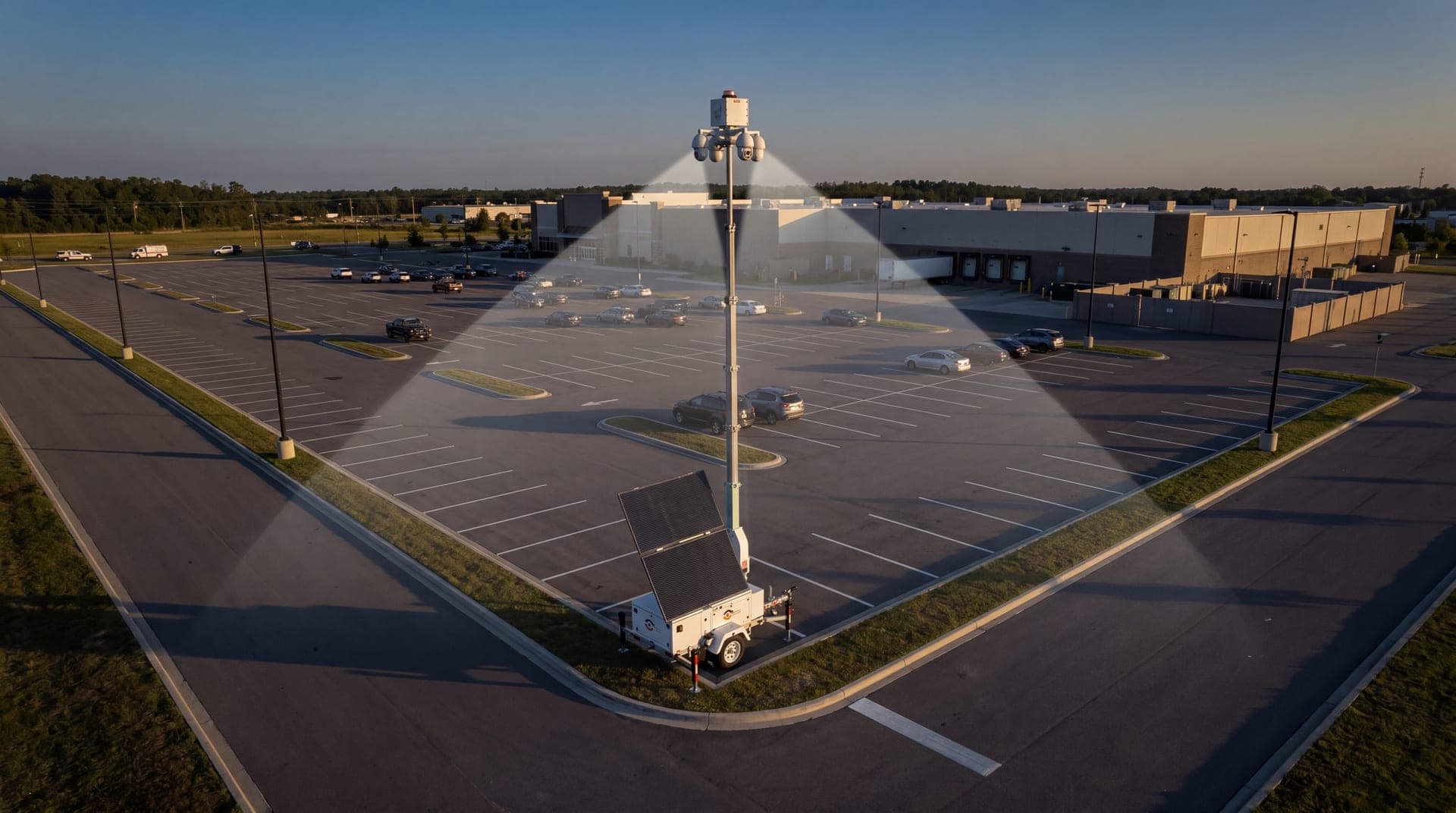
Large solar projects often use more than one yard, and they open and close over time. When a yard is being closed, its stock moves and so does the risk. Count what leaves, count what arrives, and move cameras with the material instead of leaving them watching an empty field. Trailers that need no site power or trenching are practical for this, since they can follow the stock.
How VDS fits
VDS mobile surveillance units cover laydown yards without waiting for power or internet. Each unit has a 5MP PTZ camera with 25x optical zoom and three 8MP wide-angle cameras on a 22 ft telescopic mast, with a 30 ft mast available. A 900W bifacial solar array charges an 11.8 kWh LiFePO4 battery bank with reserve for 3-5 consecutive cloudy days, and dual-SIM 4G/5G cellular carries the video.
AI detection covers people, vehicles, loitering and license plates. A 24/7 US-based security operations center verifies events, uses live talk-down through a loudspeaker, then dispatches police with video, so your team or your security partner handles verified incidents. Setup takes one person under 20 minutes. See the mobile surveillance unit or talk to our team.
Sources
- Piza, E. L., Welsh, B. C., Farrington, D. P., & Thomas, A. L. (2019). CCTV surveillance for crime prevention: A 40-year systematic review with meta-analysis. Criminology & Public Policy, 18(1). onlinelibrary.wiley.com