
Why manual gates cost more than they look
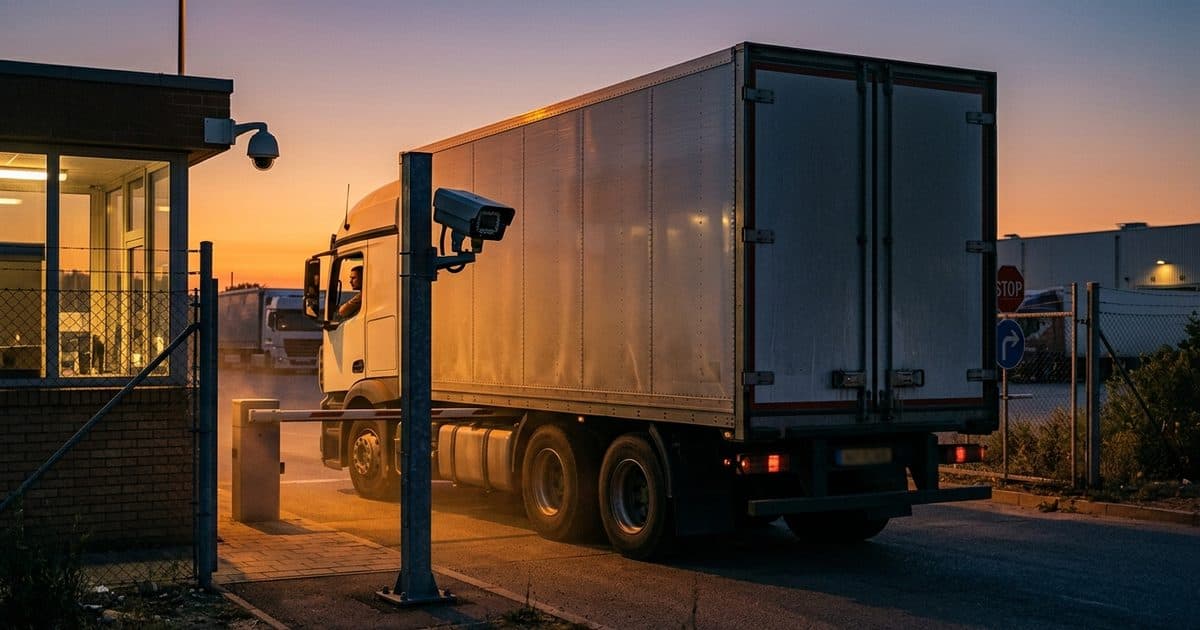
A manual gate check looks cheap on paper: an attendant, a clipboard, maybe a spreadsheet. The hidden cost shows up in dwell time. ATRI's 2024 research found that detention, defined as dwell time beyond two hours at a stop, affects nearly 40% of truckload stops. Every minute a driver waits at your gate counts against the appointment window, and slow gates push facilities toward that two-hour threshold before unloading even starts.
The industry-wide bill is larger than most yard managers assume. ATRI breaks the estimated $15.1 billion 2023 detention cost into $3.6 billion in direct expenses to motor carriers and $11.5 billion in lost productivity. Facilities that consistently detain drivers pay a share of that indirectly: carriers add detention fees, deprioritize slow lanes, or decline the freight altogether.
There is a safety cost too. The same ATRI study found that detained drivers subsequently drive up to 15% faster, and up to 27% faster for refrigerated loads, as they try to recover lost hours. A slow gate does not just frustrate drivers; it exports risk onto public roads. Speeding up the gate is one of the few improvements that helps throughput, carrier relationships, and safety at the same time.
How automated gate access with LPR works
An automated gate replaces the manual read-and-lookup with a camera-driven pipeline. LPR cameras positioned on the approach lane capture the tractor plate, and often the trailer or container ID, before the vehicle reaches the arm. Software matches those reads against the day's expected arrivals from your TMS, yard management system, or appointment schedule. If everything matches, the gate opens. If anything does not, the vehicle is held and a person reviews it. For a deeper look at how the cameras themselves capture plates reliably, see our license plate recognition camera guide.
The core workflow: arrival, read, match, open or escalate, log
- Arrival. The truck enters the approach lane. Loop sensors or video analytics detect the vehicle and trigger capture.
- Read. LPR cameras capture the plate, and optionally the trailer number, container ID, and an overview image of the cab and load.
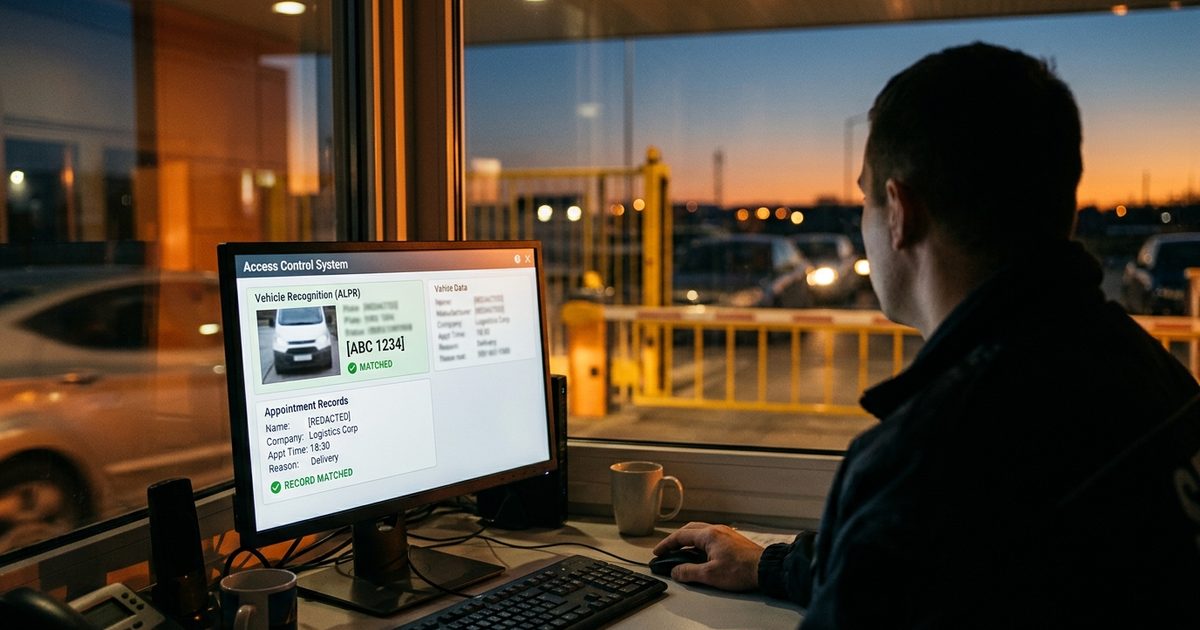
- Match. The system checks the read against expected appointments, carrier records, and any allow or deny lists. This step takes seconds, not the minutes a manual lookup can consume.
- Open or escalate. A clean match lifts the arm automatically or prompts a one-click approval. A mismatch, an unscheduled arrival, or a flagged plate holds the gate and routes the event to a remote operator or gate attendant with the capture images attached.
- Log. Every event, admitted or refused, is recorded with timestamped images. The log becomes your detention defense file, your theft investigation starting point, and your audit trail.
Gate operating models compared
| Gate model | Who handles routine arrivals | How exceptions are handled | Typical audit trail |
|---|---|---|---|
| Manual gate check | Attendant reads plates and paperwork for every truck | Same attendant, while the queue builds behind them | Handwritten or keyed logs, prone to gaps |
| Badge, PIN, or RFID kiosk | Driver self-serves at the kiosk | Often a phone call or a stalled lane | Credential events only, no images |
| LPR with remote verification | System reads and matches automatically | Remote operator or gate staff reviews with images in hand | Timestamped plate reads, photos, and decision records |
What credential verification checks beyond the plate
A plate read alone is identification, not authorization. Credential verification is the matching layer that decides whether this truck should enter this yard right now. Depending on the operation, the checks can include the appointment or booking number tied to the plate, the carrier's identity against the tender, the trailer or container number against the load, the driver's check-in details, and seal numbers on outbound loads. Deny lists matter as much as allow lists: a plate associated with a prior fictitious pickup attempt should stop the gate cold.
The strength of doing this in software is consistency. A tired attendant at hour nine of a shift applies checks unevenly. A matching engine applies the same rules to the first truck of the day and the two-hundredth, and it never forgets to photograph the trailer.
Remote gate operations: handling exceptions without stopping the line
Exceptions are where automated gates either succeed or quietly fail. If every mismatch stalls the lane until someone walks out from the office, you have automated the easy 80% and made the hard 20% worse. Remote gate operations solve this: trained operators at a monitoring center receive the exception with plate images, appointment data, and a live camera view, and they can talk to the driver over an intercom, verify documents, and release or refuse the gate from anywhere. Remote monitoring teams already staffed around the clock for security can absorb gate exception handling on the same camera infrastructure.
This is the force-multiplier model, not a staffing cut. Gate guards and security officers are most valuable when they are inspecting a suspect trailer, walking a seal check, or responding to a verified incident, not reading plates on trucks that were always going to be admitted. Automation hands the routine reads to the cameras so people, yours or your security partner's, handle verified incidents and judgment calls. Overnight and weekend arrivals, which many yards currently turn away or wave through unchecked, get the same verification as a Tuesday morning delivery.
The security case: gates are where cargo theft starts and ends
Every theft that leaves your yard on wheels passes through a gate. Cargo theft losses reached an estimated $725 million in 2025, a record, according to Verisk CargoNet, and fictitious or fraudulent pickups, where a truck presents itself as the legitimate carrier, depend entirely on the gate failing to verify. An LPR gate that matches the actual arriving plate against the carrier assigned to the load takes away the fraudster's main advantage: a busy gate that checks paperwork but not the vehicle itself.
The same records work after the fact. When a trailer goes missing, investigators start with two questions: what left the yard, and when. A gate log with timestamped plate and trailer images answers both in minutes. We cover the broader defensive playbook in our guide to truck yard cargo theft security, and the trend data behind the urgency in our cargo theft statistics roundup.
Implementing gate LPR: placement, lighting, and integration
Gate LPR succeeds or fails on physical details. Cameras need a clean, near-head-on angle on the plate at the speed and distance trucks actually travel in your lane, with infrared or supplemental lighting for night captures. A dedicated trailer-number camera mounted higher covers the second identifier. Most yards want a capture point far enough up the approach lane that the match completes before the truck reaches the arm, so a clean read never requires a stop. Our license plate recognition camera guide covers mounting height, angle, and lane geometry in detail.
Integration effort varies with ambition. A minimal deployment matches reads against a daily appointment file and alerts a gate attendant on mismatches, which requires little IT work. Deeper integrations push gate events into the yard management system so check-in, spotting, and dock assignment all key off the same arrival record. Start minimal, prove the read accuracy in your actual lane conditions, then integrate.
For yards without fixed power or network at the gate, solar-powered mobile surveillance units carrying LPR cameras and cellular backhaul can stand up a monitored gate lane without trenching. VDS deploys these units with 24/7 monitoring behind them, so the same system that reads plates at the gate also watches the fence line, and exception handling routes to operators who are already watching the site. That combination suits leased yards, drop lots, and overflow facilities where permanent gate infrastructure is hard to justify.
What to measure once the gate is automated
Automation is only worth what it changes, so instrument the gate from day one. The metrics that matter most:
- Gate-to-gate turn time. The headline number carriers care about, and your leading indicator for detention exposure before it reaches ATRI's two-hour threshold.
- Exception rate. The share of arrivals escalated to a human. A falling exception rate means your appointment data and carrier compliance are improving; a rising one flags process problems upstream.
- Exception resolution time. How long a held truck waits for a decision. This is the number remote gate operations exist to keep low.
- After-hours verified admissions. Arrivals processed with full verification outside staffed hours, capacity most manual gates simply do not have.
- Log completeness. The percentage of gate events with usable plate and trailer images, which is what your audit trail and theft investigations depend on.
The gate has spent decades classified as a security cost. Read automatically, verified remotely, and logged completely, it becomes something better: the control point where detention, theft exposure, and carrier trust are all decided, and the cheapest place in the yard to improve all three at once.