
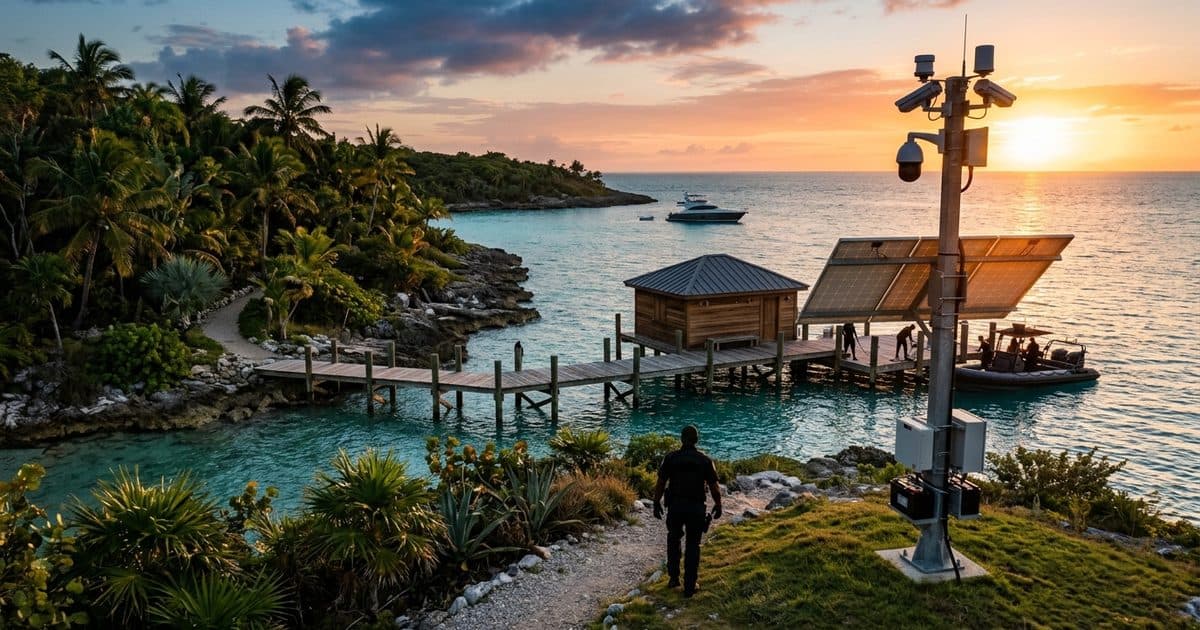
That's exactly why solar-autonomous surveillance fits islands better than any conventional system. A platform built to run without grid power and transmit without hardwired internet doesn't treat the island as a hard case — it treats it as the design center. This post covers the risks that make islands distinct, why standard camera systems can't reach them, how to build coverage across a dock, a compound, and a shoreline with no infrastructure between them, and how remote monitoring closes the response-time gap that defines island security.
Why Islands Are a Distinct Security Problem
Every remote site shares some of an island's challenges, but islands combine all of them at once, and add one the mainland never faces: the water itself is both the wall and the weakness. Access is naturally limited to boats and aircraft, which sounds like security — until you consider that it also means help arrives the same slow way. The barrier that keeps casual intruders out also keeps responders far away.
The specific risk profile follows from that. Docks and landing points are the funnels through which anyone — invited or not — must arrive, which makes them the single most important thing to watch. Seasonal and vacation properties sit unoccupied for months, advertising their vacancy to anyone passing by water, and theft from an empty island house can go undiscovered until the next visit. Resorts and private compounds have valuable, dispersed assets and a shoreline far too long for staff to watch. And across all of it runs the response-time problem: an incident that a mainland property would resolve with a five-minute police response can, on an island, unfold completely before anyone with authority can cross the water.
The consequence is that islands can't rely on response as their primary security layer the way mainland sites quietly do. They have to lead with deterrence and detection, and make sure that when something is detected, the verification and the call for help happen instantly — not after someone finally reaches the island and sees the damage.
Why Standard Surveillance Can't Reach an Island
Conventional CCTV and even most "smart" consumer cameras assume the two things an island doesn't have: a power outlet and an internet connection. That single assumption is why they don't work here.
| Requirement | Fixed / Consumer CCTV | Solar-Autonomous Surveillance |
|---|---|---|
| Power | Needs grid power or a generator with a fuel-resupply problem | Solar generation with battery storage — self-powered, no grid |
| Connectivity | Needs hardwired internet or reliable Wi-Fi | 4G/LTE cellular, or satellite where there's no cell signal |
| Installation | Requires wiring runs between camera positions | Independent positions — no cabling across the island |
| Maintenance | Frequent on-site visits — expensive and slow by boat | Remotely monitored health, minimal physical intervention |
| Response | Passive recording; no one watching in real time | Live remote monitoring with verified escalation |
Two island realities make the case even sharper than at an ordinary remote site. First, generators — the usual off-grid fallback — are a liability on an island, because they depend on a fuel supply chain that has to cross water, and they fail silently when the fuel runs out or the unit faults between visits. Solar generation with adequate battery storage removes that dependency entirely. Second, maintenance is genuinely expensive: every truck-roll is a boat trip. A system that reports its own health remotely and rarely needs hands on it is worth far more on an island than the same system on the mainland, where a technician can drive over in an afternoon.
Tip: Size island battery storage for the worst case, not the average. On the mainland you can accept a marginal solar budget because a technician can intervene. On an island, specify oversized battery capacity — ideally 72+ hours of autonomous runtime — so the system rides through multi-day overcast and storm conditions without anyone needing to make the crossing. The cost of extra battery capacity is trivial next to the cost of an emergency boat trip to a dead camera during the exact storm when you most need coverage.
Building Coverage Across an Island
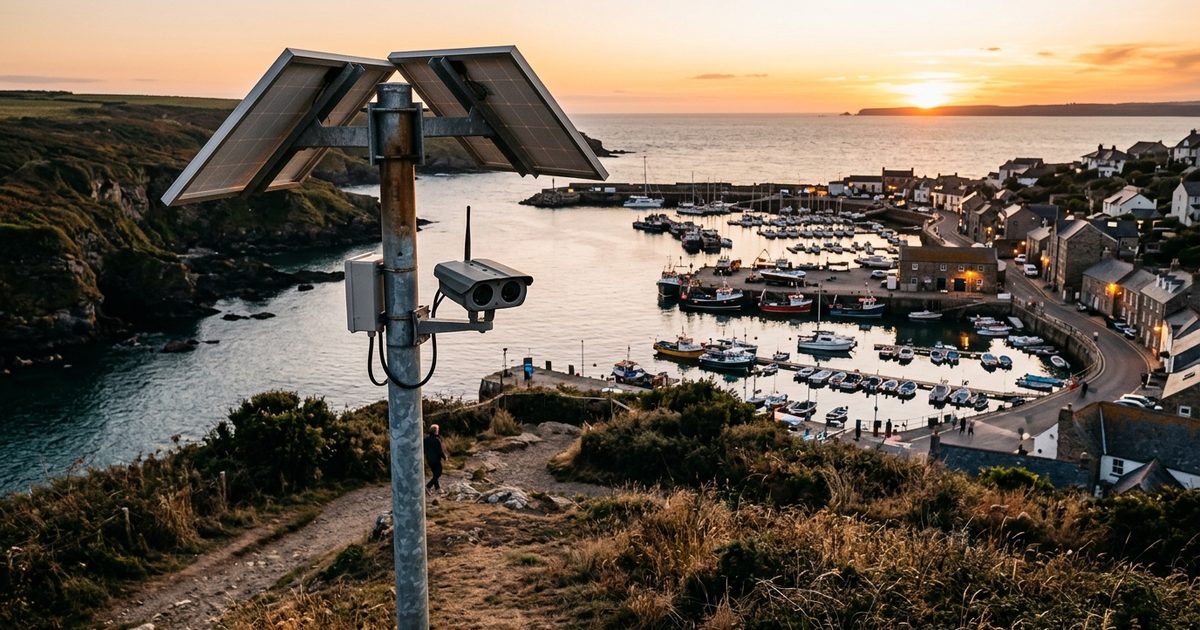
You don't secure an island by blanketing it — you secure the points that matter and tie them into one view. For most private islands, resort islands, and remote waterfront compounds, that means a small number of well-chosen positions:
- The dock or landing: The one place everyone must pass through. A Mobile Surveillance Unit or fixed solar position here, with object detection to flag arrivals and clear identification-quality imaging, is the highest-value camera on the island. Nothing arrives without crossing this frame.
- The compound or main structures: Homes, resort buildings, equipment sheds, and fuel or utility stores. Overlapping coverage with no single-camera blind spot, and loitering detection to catch someone moving around structures during off-season vacancy.
- Vulnerable shoreline and secondary landings: The beaches and coves where a boat could put in away from the main dock. These don't need continuous coverage so much as detection — thermal and analytics that pick up a nighttime landing where a standard camera would see only darkness.
- Lighting where it deters: A dark island signals vacancy and opportunity. Solar lighting at the dock and compound, paired with visible cameras, establishes the presence that turns a soft target into one intruders skip.
Because each position is solar-powered and cellular- or satellite-connected, there is no wiring to run between them. You can place a unit at a dock a mile from the main house without trenching a foot of cable, and add or move positions as the island's use changes across seasons. The Solar Surveillance Kit covers the pole- and skid-mounted options for semi-permanent positions at a compound or landing.
Remote Monitoring: Buying Back the Distance
On an island, remote monitoring isn't an upgrade — it's the layer that makes the whole system work, because it's the only thing that responds at the speed of the threat rather than the speed of a boat.
Remote video monitoring ties every island position into a monitoring operations center where operators verify alerts in real time. When a camera detects a boat approaching a dock at 2am or movement around an unoccupied house, an operator confirms it against what should be there and escalates on a defined protocol: a live audio challenge through the unit's speaker, a call to the owner or resort manager, and coordination with marine patrol or law enforcement — with verified, time-stamped footage attached. The intruder who expected an empty, unwatched island instead meets an immediate, credible response.
That real-time verification does something distance otherwise makes impossible: it separates the deer, the drifting boat, and the returning caretaker from the genuine threat, so the expensive, slow act of dispatching someone across the water only happens for real events. Every alert and action is logged, giving owners and operators a documented security record for insurance, for law enforcement, and for their own peace of mind about a property they can't physically watch.
Common Mistakes in Island and Off-Grid Security
- Relying on a generator as the power plan. Generators fail silently when fuel runs low or a fault trips between visits, and refueling means a boat trip. On an island, a generator-dependent camera system is one missed resupply away from being dark. Solar generation with oversized battery storage removes the single point of failure.
- Assuming cellular coverage from a mainland map. Island cell signal is frequently weak or absent, and carrier maps are optimistic about it. Verify signal at the exact position during planning, and where there's no cell service, plan for satellite transmission rather than discovering the gap after deployment.
- Trying to cover the whole island. A shoreline is too long to watch end to end. Coverage should concentrate on the dock, the compound, and known secondary landings — the points an intruder actually uses — not spread thin across empty beach.
- Buying cameras without a response plan. A recording no one watches in real time does nothing to protect an unoccupied island property; it just documents the loss for the next visit. Detection has to be tied to live verification and a defined escalation, or the distance that protects the island also renders its cameras pointless.
- Under-sizing for maintenance reality. Every service call to an island is a boat trip. Specifying hardware and battery capacity for minimal intervention — and choosing a system that reports its own health remotely — costs far less over time than a cheaper system that needs frequent hands-on attention across the water.
Islands sit at one end of a spectrum of hard-to-reach sites. The same solar-autonomous, remotely monitored approach secures open beaches and coastal waterfront and extends inland to remote borders and unfenced perimeters — anywhere the infrastructure runs out but the risk doesn't.