
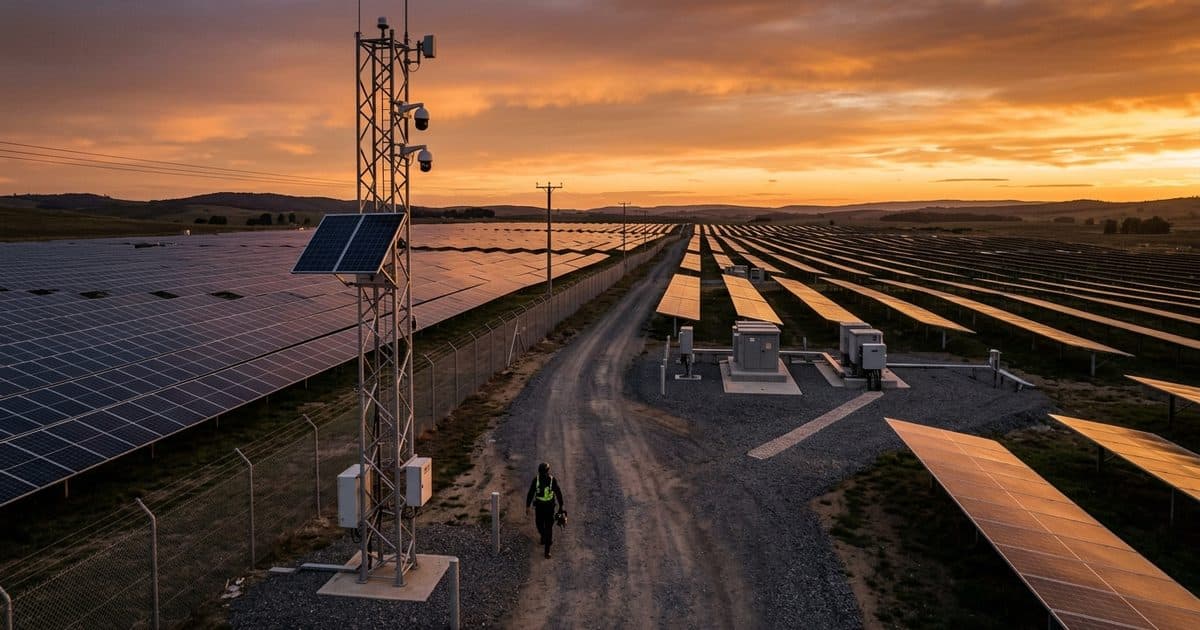
How to use this template
Work through the sections in order and write your answers directly into your own document. Keep each answer to a few lines. A plan nobody reads protects nothing, so aim for something a site superintendent can scan in ten minutes.
You can adapt the template for a general site using our construction site security plan guide, and for a deeper risk walk-through use the security site risk assessment template. This version is shaped around the features of wind and solar projects: large footprints, remote locations, bulk material and many subcontractors.
Section 1: Project profile
Fill in the basics so anyone picking up the plan understands the setting.
- Project name, owner, EPC or general contractor, and construction manager.
- Technology and size: solar array, wind turbine count, or both.
- Site address or coordinates for each gate and laydown area.
- Planned start, major milestones and energization date.
- Nearest police and fire contact, and the response time you expect.
- Cellular coverage at gates and laydown areas, noted as good, weak or none.
- Who has authority to act on an alert at night.
Section 2: Asset inventory by phase
List what is on site at each stage, where it is stored, and what it is worth to the project, in plain terms such as high, medium or low. Include modules, cable and conductor, inverters, combiner boxes, transformers, turbine components, tools, fuel and vehicles. Note which items would delay the schedule if lost, since schedule impact often matters more than the replacement value.
Wind sites tend to have a few very large and heavy components at widely spaced pads, along with cable, rebar and anchor material. Solar sites have bulk, repeating material across a large area. See wind farm security cameras and solar farm security cameras for context on each.
Section 3: Risk scoring table
This is the center of the plan. For each risk, score likelihood and impact from 1 (low) to 5 (high). Multiply to get a priority score. Anything scoring 15 or more gets a named control and an owner first. The score columns are blank for you to fill in.
| Risk | Where | Likelihood (1-5) | Impact (1-5) | Score | Priority action |
|---|---|---|---|---|---|
| Module or component theft | Laydown, staging | ||||
| Cable and conductor theft | Cable storage, pads | ||||
| Fuel theft | Fuel tanks, equipment parking | ||||
| Tool and small equipment theft | Containers, work areas | ||||
| Vehicle or heavy equipment theft | Parking, access roads | ||||
| Vandalism or damage | Arrays, turbine pads | ||||
| Unauthorized entry by the public | Perimeter, gates | ||||
| Contractor access violations | Gates, restricted areas | ||||
| Inventory loss without a clear cause | Laydown yard |
As a guide, likelihood is higher where material sits near a road, where the site has been empty at night, or where nearby sites have had losses. Impact is higher where the item is hard to replace, where its loss would stop a crew, or where a theft could create a safety hazard such as cut energized cable. Score each risk as it stands today, before any new control, then re-score after the control is in place to see whether it helped.
Add rows for anything specific to your project. Score honestly: the point is to compare risks against each other, not to produce low numbers.
Section 4: Controls and owners
For each high-scoring risk, write one line that says what control applies and who is responsible. Use categories so nothing is skipped.
- Layout. Consolidate staging, keep stock away from fence lines, and limit entry points.
- Access. Gate, sign-in, access list and vehicle identification.
- Lighting. Staging and gate areas lit to support cameras.
- Detection. Cameras with AI detection covering gates, staging and equipment pads.
- Response. A verified-alert process, with talk-down and police escalation.
- Inventory. Counts on receipt, weekly reconciliation and serial numbers recorded.
Section 5: Monitoring and response
Write down exactly what happens when an alert is raised after hours. Who sees it first? What do they check? Who is called, and in what order? Use the security incident escalation matrix to set levels from a routine entry to an active theft. Spell out that site staff do not confront intruders.
Recording alone is a weak control. A 2019 systematic review of 76 studies found that actively monitored systems were associated with roughly a 15% reduction in crime, while passive recording-only systems showed no significant effect. Plans should therefore name who is watching, not only what is recording. See remote monitoring for how that works.
Section 6: Contractors and communication
Record how every subcontractor is briefed on access rules, camera coverage and reporting. Include a start and end date for each crew's access. Post signage at entrances, and confirm local notice requirements with counsel since rules vary by state.
Section 7: Review schedule and incident log
Set a date to review the plan at each phase change, and after any incident. Keep an incident log with date, time, location, what happened, who responded and what changed. Patterns in the log show where to move cameras and where controls are weak.
How VDS fits
Once the plan identifies your highest-scoring areas, mobile surveillance units can cover them without waiting for site power or wired internet. VDS units carry a 5MP PTZ with 25x optical zoom and three 8MP wide-angle cameras on a 22 ft telescopic mast, with a 30 ft mast available. A 900W bifacial solar array charges an 11.8 kWh LiFePO4 battery bank with reserve for 3-5 consecutive cloudy days, and dual-SIM 4G/5G cellular carries the video.
AI detection covers people, vehicles and loitering, and a 24/7 US-based security operations center verifies events, uses live talk-down through a loudspeaker, and dispatches police with video. That way your team or your security partner handles verified incidents. Most deployments go live about a week after a signed quote. Talk to our team to match units to your plan.
Sources
- Piza, E. L., Welsh, B. C., Farrington, D. P., & Thomas, A. L. (2019). CCTV surveillance for crime prevention: A 40-year systematic review with meta-analysis. Criminology & Public Policy, 18(1). onlinelibrary.wiley.com