
Why small stations are different
A treatment plant has staff, lighting and a defined perimeter. A lift station may have a fence, a panel, a wet well hatch and a generator receptacle, and nothing else. Technicians visit on a schedule, which may be weekly, monthly or only on an alarm.
That creates three conditions that matter for security.
- Low visibility. Few people pass by, and those who do usually do not know what normal looks like.
- Long detection time. Without a system, the first notice is often a technician's visit or a service failure.
- Slow response. The nearest responder may be a drive away, and the site may be hard to find at night.
What actually goes wrong
The common problems are familiar, and none require sophistication.
- Metal theft. Copper wiring, panels and other metal items are taken for scrap. Our article on cell tower security and copper theft describes a similar pattern at another kind of unmanned site.
- Vandalism. Graffiti, broken locks, damaged enclosures and cut conductors. General vandalism prevention approaches, such as lighting and quick repair, apply here too.
- Tampering. Opening a hatch, interfering with controls or disabling alarms.
- Illegal entry. Trespassers who treat the site as a shelter or gathering spot.
- Dumping and misuse. Material left in or near the station.
Patterns tend to repeat. A station that was hit once and repaired quietly is often hit again, because the same weakness remains and word gets around. Keep a simple log of every incident at every station, including minor ones, and look at it for repeats by site, time of day and day of week. Even a spreadsheet will show which stations need attention first.
The consequence side is what separates these sites from ordinary property. A failed lift station may cause an overflow or loss of service, and a disabled pump may affect pressure. The cost of the event is often larger than the cost of the equipment.
Harden what matters most
Fencing alone is a weak defense at a small site, since it is easy to cut or climb and nobody is watching. Focus on the items whose loss or tampering causes the greatest harm.
- The control panel. Use a robust enclosure, a good lock and an alarm on door opening.
- The wet well hatch or equivalent opening. Lock it and alarm it.
- Wiring and conductors. Reduce accessible runs of exposed metal where possible, and mark equipment so that stolen items can be identified later.
- Lighting. Use lighting that is on when needed, and make sure the site can be seen from the road.
- Signage. Post clear warnings with a contact number.
Make the site report on itself
A useful test is to ask what the site would tell you if someone started removing wire at 2 a.m. today. If the honest answer is nothing until the next visit, the site is not reporting on itself.
At an unmanned site, the system must raise the alarm without a person present. That means a communications path that works, a power source that does not depend on a single point of failure, and a monitored endpoint that someone reads.
- Door and hatch sensors tell you that something opened.
- Camera analytics tell you that a person or vehicle is present.
- Tamper detection tells you that a camera or sensor has been blocked or disabled. See camera tamper detection.
- Communications monitoring tells you that a link has gone down, which should itself be treated as an event.
Verification is the key step. An alarm alone sends a technician on a drive, while video lets a reviewer see whether it is a person, an animal or weather.
Power and connectivity at remote sites
Many small stations have electrical service for the pumps but no easy place to add a camera, or they sit where wired internet is unavailable. Solar-powered and cellular systems avoid trenching and utility work. Our guides to security cameras without Wi-Fi or power and cellular security cameras on 4G and 5G explain the trade-offs. Check cellular signal at the actual location before planning, since coverage varies. Also ask what happens to alarms during a power or link outage, and whether the site can queue events and send them once the link returns.
Quick-reference table
| Threat | Typical sign | Control that helps | Verification need |
|---|---|---|---|
| Metal theft | Missing wire or panels | Alarmed enclosure, video, lighting | Video of the person or vehicle |
| Vandalism | Damage, graffiti | Lighting, signage, video | Time and description of event |
| Tamper | Opened hatch, altered controls | Door and hatch alarms | Confirm cause before dispatch |
| Trespass | Signs of occupancy | Detection and talk-down | Is the person authorized staff? |
Where a mobile unit fits
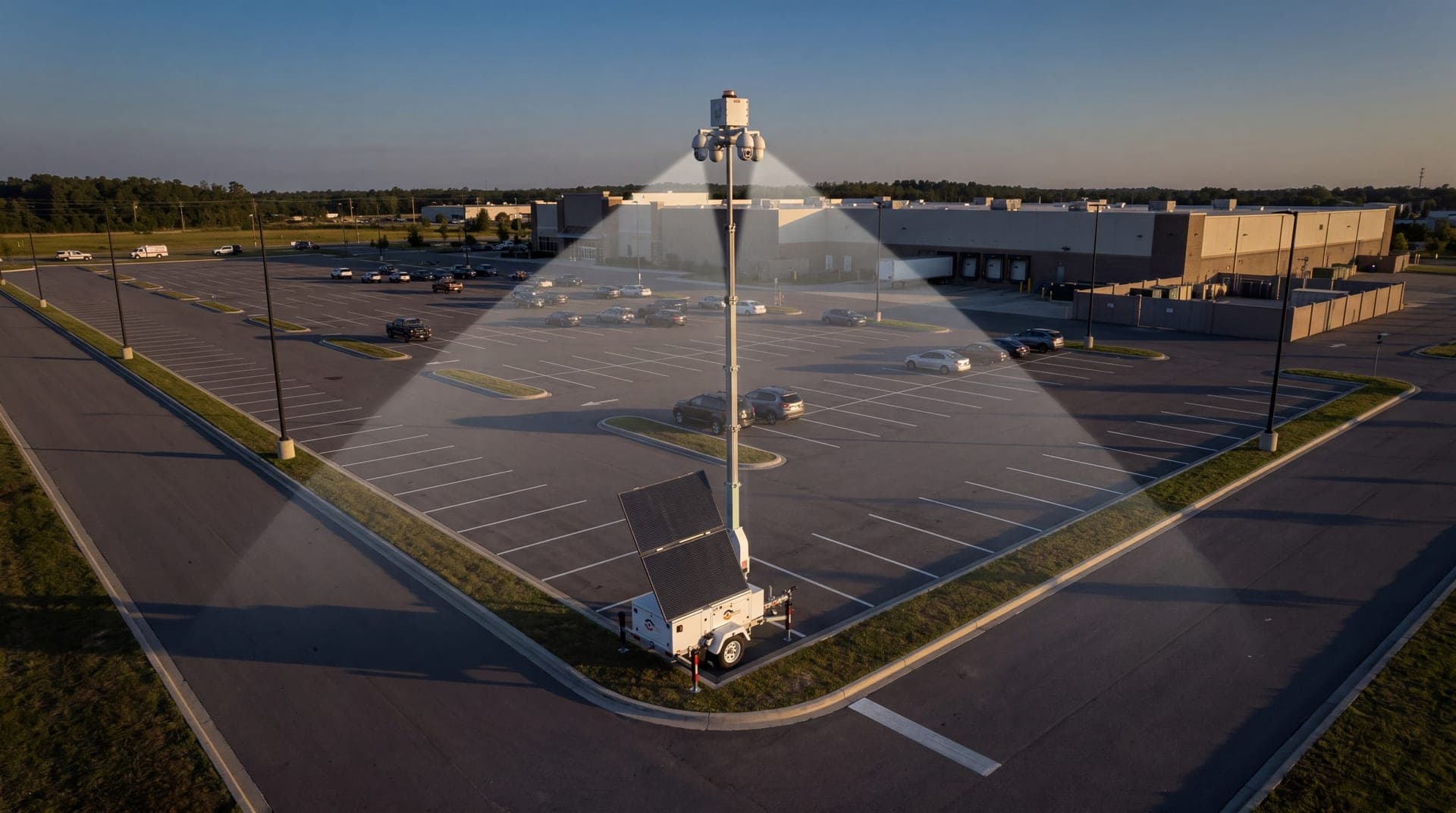
A VDS mobile unit works well when a station has no power or connectivity for a fixed system, or while permanent upgrades are being designed. It is a solar-powered trailer with a 5MP PTZ camera with 25x optical zoom and three 8MP wide-angle cameras on a 22 ft telescopic mast. AI detection flags people, vehicles and loitering, and a 24/7 US-based security operations center verifies events and speaks to intruders through a loudspeaker, then dispatches police with video if needed.
It needs no site power, internet or trenching, and on-site setup takes one person under 20 minutes. Most deployments go from signed quote to live monitoring in about a week. The hardware is NDAA Section 889 compliant. Read about the water and wastewater industry, look at the mobile surveillance unit, or talk to our team about particular stations.
Start with a short list
Utilities with many stations rarely have the budget or the time to treat them all the same way. You do not need to secure every station at once. Rank them by consequence of failure, visit frequency and past incidents, then start with the few where a long gap before detection would hurt most.
Write down what a technician should do on arrival after an alarm. Approach with care, look before entering, photograph anything unusual and never assume the site is empty. A short checklist for the first five minutes keeps staff safe and preserves evidence for the police and for insurance.