
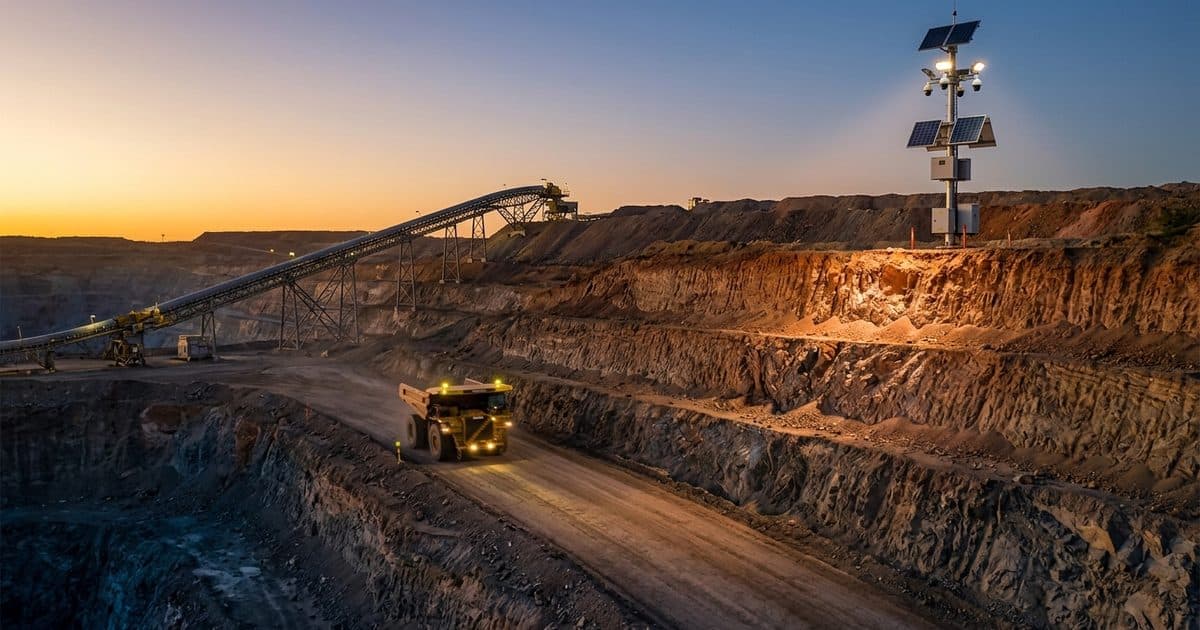
Why mine and quarry sites are exposed
A working mine is busy by day and nearly empty at night. That contrast is the core of the security problem. Heavy equipment, fuel tanks, spare parts and tools sit in open yards, and the perimeter may run for miles over rough terrain. Fencing helps, but it cannot stop someone with bolt cutters and a truck.
Remoteness adds delay. If something happens at 2 a.m., the nearest help may be far away, and the people who could respond may be asleep at home. By the time someone notices a missing generator or a drained tank, the thieves are long gone.
The goal is to shorten the gap between something happening and someone knowing about it. Detection and verification do that. Recording alone does not.
What gets targeted
The mix differs between a surface mine, an underground operation and a small aggregate quarry, but certain items come up repeatedly:
- Diesel and other fuel, which is easy to siphon and hard to account for. See our guide to diesel fuel theft prevention.
- Batteries, catalytic converters, cable and other metal that scrap dealers buy.
- Tools, spare parts and attachments stored in containers and workshops.
- Smaller machines and trailers that can be loaded and driven away.
Quarries and aggregate operations face their own version of this problem, covered in more depth in our article on quarry equipment theft security. Many of the same lessons apply to larger mines.
Not every incident is theft. Trespass by off-road riders, curious visitors or people looking for scrap is also common and creates a safety and liability risk, especially around pits, stockpiles and water.
Cover the haul road and the gate
Mines have a natural choke point, which is the road in. Anything that leaves with stolen property must travel it, and anyone arriving outside shift hours is worth noticing.
A camera at the main gate and at key junctions can detect vehicles and people and log activity. Add a second view of the approach so that a monitoring team can see what is coming before it reaches the gate. License plate capture is useful where the road geometry allows it, but it depends on camera angle, shutter speed and lighting. Our LPR camera settings guide covers the setup details.
Internal haul roads are a different matter. They are active by day and need zone-based detection so that normal truck traffic does not flood the alert queue. Set the system to alert on after-hours movement or on activity in restricted areas, not on every passing vehicle.
Fuel, equipment and maintenance yards
The highest-value clusters on most sites are the fuel storage area, the equipment park and the maintenance shop. A single camera view that includes the tank and its approach is usually more useful than a camera aimed at the sky or the horizon.
Think about the thieves' path. They need to reach the tank, run a hose or load a vehicle, and leave. A camera that sees the access point and the vehicle together gives you a timeline. Our piece on equipment rental yard security describes how to organize camera views around a yard full of machines, which applies directly to a mine equipment park.
Night imaging deserves attention. Infrared works well at moderate range and shows detail. Thermal highlights people and vehicles against a cool background and handles darkness and dust well in some conditions. Read our overview of thermal security cameras to see where each fits.
Power, data and harsh conditions
Mine perimeters rarely have utility power or a wired network, and trenching across rock is rarely worth the cost. Solar-powered cellular units remove that dependency. Our guide to security cameras without WiFi or power explains what to check, including battery reserve and cellular coverage.
Mines add conditions that general-purpose security cameras are not built for. Dust coats lenses and solar panels. Vibration from blasting and heavy traffic loosens mounts. Temperature swings are large. Ask any provider how the unit handles these conditions and what a routine maintenance visit involves. Build a cleaning schedule for lenses and panels into your site routine.
Also check for dead zones in cellular coverage, which are common in pits and valleys. A unit placed on a ridge or berm may see better and connect better than one at the bottom of a cut.
After-hours monitoring that works
Most losses at mining sites happen when nobody is there, so the monitoring model matters as much as the camera. For a closer look at the approach, see our guide to after-hours security.
A workable setup follows a simple chain:
- Detection flags a person or vehicle in a defined zone outside operating hours.
- A trained operator verifies the event on live video.
- If it is real, the operator speaks to the intruder through a loudspeaker.
- If the person does not leave, the operator escalates to your security partner, site supervisor or police with video.
This keeps your own people from being woken by every false trigger. Local rules on audio, recording and dispatch vary by state, so confirm requirements with counsel.
Quick reference
| Area | Typical risk | Camera approach |
|---|---|---|
| Main entry gate | Unauthorized vehicles, theft exit | Vehicle detection and plate view |
| Fuel storage | Siphoning, tank tampering | View of tank, hose area and approach |
| Equipment park | Equipment and parts theft | Wide coverage plus PTZ for identification |
| Maintenance shop | Tool and part theft | Door and yard coverage |
| Remote perimeter | Trespass, off-road access | Relocatable unit at problem points |
How VDS fits
VDS makes solar-powered mobile surveillance trailers that need no site power, internet or trenching. A unit carries a 5MP PTZ camera with 25x optical zoom and three 8MP wide-angle cameras on a 22 ft telescopic mast (30 ft available). A 900W bifacial solar array charges an 11.8 kWh LiFePO4 battery bank with reserve for 3 to 5 consecutive cloudy days, and dual-SIM 4G/5G cellular carries video.
AI detects people, vehicles, loitering, objects and license plates. Our 24/7 US-based security operations center verifies events, responds with live talk-down through a loudspeaker, then dispatches police with video. Most deployments go from signed quote to live monitoring in about a week, and on-site setup takes one person under 20 minutes. Learn about the mobile surveillance unit or talk to our team.