
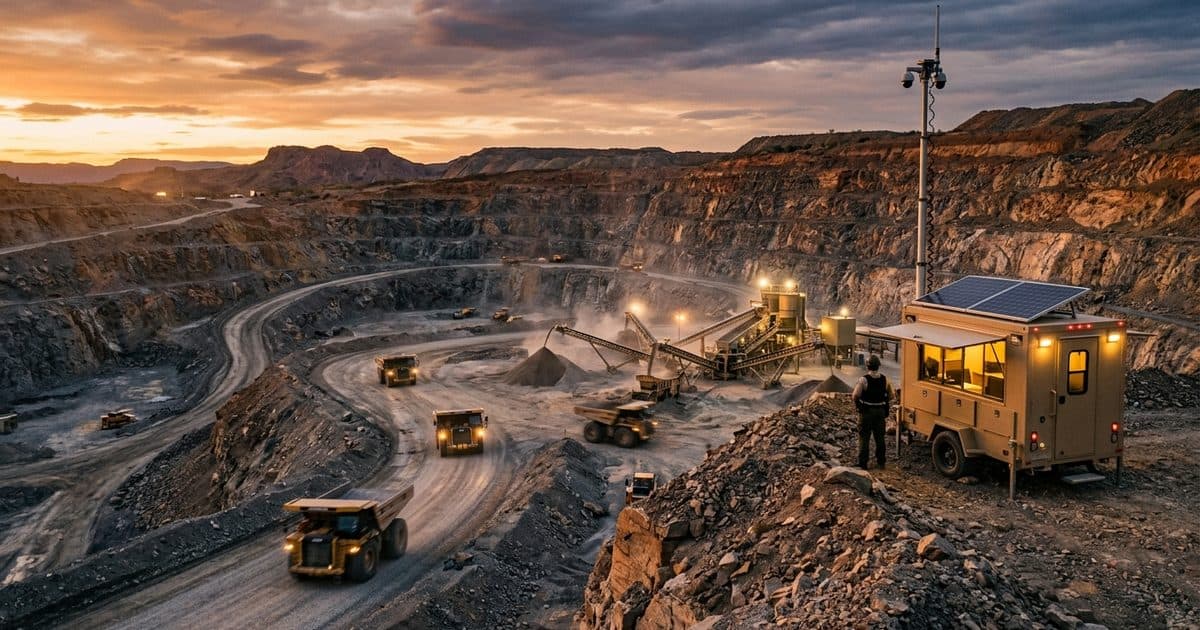
A working pit is a hard site to secure by design. It's large, it's remote even when it sits close to town, and it's fully staffed for one shift and completely empty for the other two. Haul trucks, loaders, and crushers worth hundreds of thousands of dollars sit fueled and idle overnight next to bulk diesel tanks. There's rarely a continuous fence line — haul roads, stockpiles, and open high-walls make one impractical — and there's almost never anyone on site once the last truck rolls out. That combination of high-value idle assets, wide open ground, and zero staffing is exactly what makes aggregate pits and quarries a recurring target, and exactly what a fixed camera system installed at the scale house was never built to solve. This post covers what actually gets stolen at a quarry, why fixed CCTV leaves the pit exposed, what a coverage plan built for a working pit looks like, and how live remote monitoring turns detection into a response instead of a police report the next morning.
The Threat Landscape at Aggregate Pits and Quarries
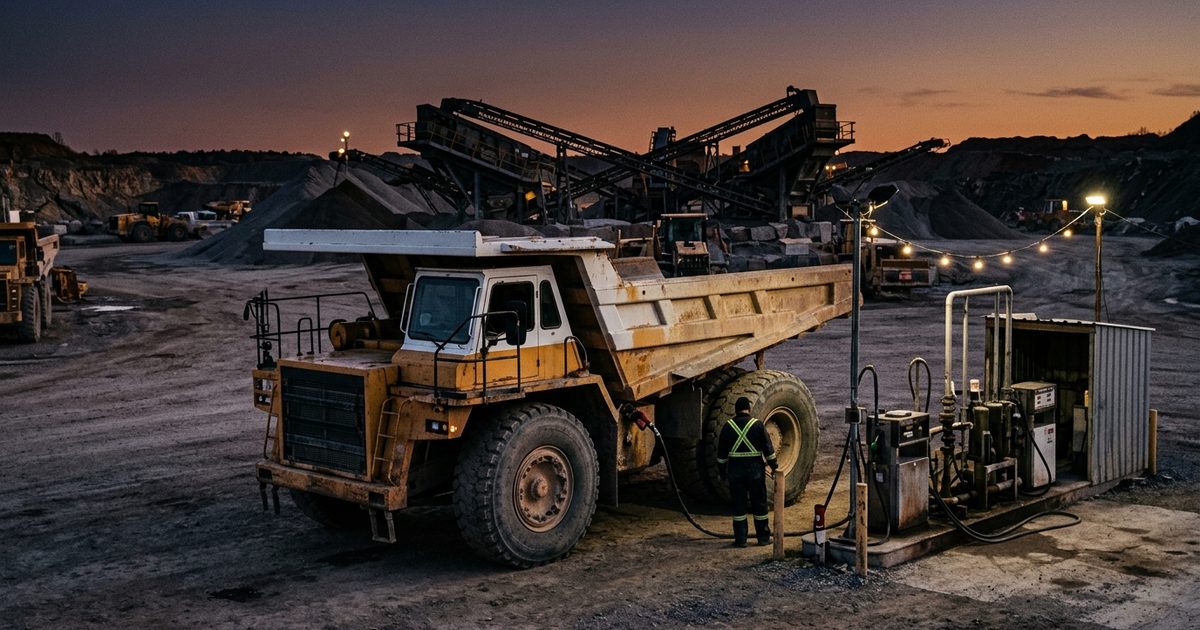
Diesel is the most common loss, and it's the most expensive one to ignore. A pit full of haul trucks, loaders, and support equipment represents thousands of gallons of fuel sitting in tanks and machine reservoirs overnight, with no lighting, no fence that matters, and no one watching until the morning start-up. A crew that knows the shift schedule can siphon a truck's tank or hit the bulk tank directly and be gone in the time it takes to fill a few containers.
Equipment and parts theft is close behind. Idle excavators, loaders, and attachments left in the laydown yard overnight get stripped for copper wiring, batteries, hydraulic hoses, and high-value attachments — components that are quick to remove, easy to resell, and expensive and slow to replace when a machine goes down mid-production because of it. Scrap material and stockpiled aggregate walk off the same way, especially at sites where trucks can enter and leave without anyone logging a plate.
Beyond direct theft, an idle pit carries real liability exposure. Flooded quarry pits, sheer high-walls, and stacked stockpiles are exactly the kind of attractive nuisance that draws trespassers — kids looking to swim, off-roaders, or joyriders who climb into an unlocked haul truck or loader and drive it for fun. Add explosives magazine storage on sites that handle blasting, and the security requirement stops being optional and becomes a compliance and insurance issue. None of this is opportunistic in the way a smash-and-grab is — it's methodical, it happens in the same unstaffed hours every time, and it keeps happening as long as the pit stays dark and unwatched overnight.
Why Fixed CCTV Fails on a Working Pit
Operators who've already installed cameras are often the most frustrated by continued losses, and the reason is structural. Fixed CCTV gets installed where power and conduit already exist — usually the scale house and the main office — and everything past that point, which on a quarry is most of the site, goes uncovered. Running power and cable to a fuel island a half-mile from the office, or to a laydown yard that moves every few months as the working face advances, is expensive enough that it rarely happens, and even when it does, the coverage is frozen in place while the pit itself keeps changing.
| Capability | Fixed CCTV | Solar Mobile Surveillance |
|---|---|---|
| Coverage | Clustered near the scale house/office; fuel island and laydown yard thinly covered or dark | Elevated wide-area coverage positioned at the entrance, yard, or fuel island |
| Power & wiring | Requires trenching and grid power to extend across the pit | Solar and cellular — deploys anywhere, no utility work |
| Night visibility | Limited without added pit lighting | Thermal detection and mobile lighting for zero-light conditions |
| Response | Passive recording, reviewed after fuel or a part is already gone | Live SOC verification and audio warning in real time |
| Follows the pit | Fixed; the working face and laydown yard move, the cameras don't | Relocatable as extraction advances or risk shifts |
The deepest gap is response, not coverage. A recording that shows a tank being siphoned at 3am is useful for a police report; it does nothing to stop the loss while it's happening. What actually changes outcomes on a pit is a system that detects the movement as it occurs, has it verified by a person, and puts an audible warning on site before the job is finished — something a static camera pointed at the scale house was never designed to do.
Tip: Site coverage at the fuel island and equipment laydown yard first, not the office. Those are the two locations where the highest-value, easiest-to-move losses actually occur, and they're almost always the two locations a legacy fixed-camera install skipped because running power there was too expensive. A relocatable unit solves the power problem and the coverage problem at the same time.
What a Coverage Plan Looks Like for a Quarry
An effective plan is weighted toward where the value and the after-hours risk concentrate, not toward wherever conduit already runs. For a typical aggregate pit or quarry, that means:
- The pit entrance and scale house, with LPR: The one chokepoint every haul truck, contractor, and visitor passes through. License plate recognition ties every entry and exit to a plate and a timestamp, flags hotlisted or unauthorized vehicles, and gives investigators a starting point instead of a blank slate.
- Equipment and attachment laydown yards: Idle excavators, loaders, and attachments parked overnight, covered by object detection that classifies people versus vehicles and flags anyone approaching a machine after hours.
- Diesel fuel islands and tank farms: The single highest-frequency loss on most sites, protected with dedicated camera coverage and loitering detection that flags anyone lingering near a tank or fuel truck when the pit should be empty.
- Stockpile, scrap yard, and haul road approaches: Secondary but real exposure, especially at sites where material or scrap has resale value and no plate record exists for who's driving it out.
- Explosives magazine perimeter: A dedicated, tightly monitored zone on any site handling blasting, where any unauthorized approach needs to trigger an immediate alert.
A visible Mobile Surveillance Unit parked at the entrance or laydown yard, paired with a lighting trailer on the fuel island, changes how the site reads to anyone scoping it out — and because it runs on solar with no grid dependency, it goes exactly where this quarter's risk actually is instead of where a fixed install happened to land years ago. The same relocatable model applies across mining, oil & gas, and construction sites facing the same idle-equipment exposure — aggregates and quarries carry the added wrinkle of continuous diesel consumption and a scale house that has to double as an access control point.
Live Monitoring: The Night Watchman, Replaced
Staffing a quarry overnight is expensive and, in practice, doesn't cover much ground — one person can't watch a fuel island, a laydown yard, and a pit entrance at the same time, and a camera system with no one reviewing it in real time doesn't do that job either.
Remote video monitoring closes that gap by routing every alert to a live SOC operator the instant it fires. When a camera flags movement near the fuel island at 2am, the operator verifies it isn't a legitimate late-shift crew, then responds: a real-time audio warning through the unit's speaker — enough on its own to send most trespassers and opportunistic thieves off the property — followed by escalation to law enforcement with time-stamped footage and the entrance LPR record of who drove onto the site. Someone counting on an empty pit with no one watching instead gets an immediate, human response before they've finished the job.
That model beats a night watchman on both coverage and documentation. It covers the whole pit simultaneously instead of wherever one person happens to be standing, and every incident produces a complete record — the alert, the verification, the audio warning, the plate, the escalation — which matters when an operator is filing an insurance claim, supporting a police investigation, or documenting a liability incident at a pit with attractive-nuisance exposure. Multi-pit operators get the same standard of coverage across every site from a single SOC, without staffing each one separately, and can pull incident history for case studies or insurer reviews on request.
Deployment That Moves With the Pit
A quarry's working face doesn't stay in one place, and neither does the equipment laydown yard or the highest-risk stockpile — extraction advances, haul roads shift, and a fixed camera system installed at today's layout is covering yesterday's pit within a year or two.
A relocatable solar-autonomous unit is built for that reality. It covers the current laydown yard, moves to the fuel island after a theft, or drops onto a newly opened pit face while a permanent security plan is still being scoped — no trenching, no conduit, no waiting on a utility crew. Coverage becomes something an operator repositions as the pit changes, not infrastructure that's frozen in place from the day it went in.
Common Mistakes in Quarry and Aggregate Pit Security
- Covering the scale house and stopping there. The highest-value losses happen at the fuel island and laydown yard, not the office. Weight coverage toward diesel, idle equipment, and stockpiles — not just the entrance.
- Skipping LPR at the pit entrance. The scale house is the one chokepoint every vehicle passes through. Without a plate-and-time record, an investigation into a fuel or equipment loss starts with nothing to go on.
- Recording without responding. Footage that only gets reviewed after diesel or a part is already gone prevents nothing. Detection needs to be tied to live verification and a real-time audio warning to actually change the outcome.
- Underestimating attractive nuisance liability. Flooded pits, high-walls, and open stockpiles draw trespassers regardless of intent to steal anything, and an unmonitored site with no response plan is a real liability exposure, not just a theft risk.
- Treating the security plan as fixed while the pit isn't. The working face, the laydown yard, and the highest-risk stockpile all move as extraction advances. A camera system installed once for the current layout falls behind fast; a relocatable strategy keeps coverage where the pit actually is.
Aggregate pits and quarries sit in the same category as equipment rental yards and other high-value, low-staffed sites where idle assets and an unmonitored perimeter combine into predictable, preventable losses. The fix isn't more cameras pointed at the office — it's coverage that goes where the diesel, the equipment, and the risk actually are, backed by a live operator who responds the moment something moves. Talk to our team about your pit layout, or contact us with questions about a specific site.