
How livestock theft typically happens
Thieves need three things: a way in, a way to load animals, and time. Rural properties often offer all three. Fence lines run for miles, pastures sit far from the house, and nobody checks the back forty every night.
A common pattern is simple. A vehicle with a stock trailer drives to a gate or a pen near a road, loads animals, and leaves. The whole event can take a short time when animals are already used to coming to feed. Theft may also happen in stages, with someone scouting the property first by driving past, parking near a gate or flying a drone.
Because the details vary by region and operation, treat this as a framework and adapt it to how your own ranch is laid out.
Secure the gates and the roads
Gates are the choke point. Almost every vehicle-based theft has to use a gate or cut a fence.
- Use heavy, hard-to-cut chains and locks on gates that open to public roads, and keep gate hardware in good repair.
- Reduce the number of unlocked entrances. Every extra gate is another place to watch.
- Keep brush and fence lines clear enough that you can see tampering during routine checks.
- Look for signs of scouting, such as new tracks, cut wires, tire marks or items left at gates.
A camera at each main gate gives you vehicle information and timing. If you want details on plates, setup values are published in our license plate recognition camera guide, but note that a plate reader needs a tight angle and a place where vehicles slow down. A gate approach is often a good spot.
Watch loading areas and trailers
Your own working pens, chutes and loading areas are the most attractive part of the property to a thief, because they are built for moving animals onto trailers. They also tend to sit near a road for your own convenience.
Cover these with a fixed view or a PTZ camera so you can see vehicles, people and animals at once. Keep your own trailers locked, with hitch locks and wheel locks, and park them in view of a camera rather than out of sight behind a barn.
If you also store equipment, fuel and feed on site, the same coverage helps there. Our guide to farm equipment theft prevention covers that side in detail.
Keep records that help investigators
If animals go missing, the first questions are what, how many, when and how. Good records speed up every step.
| Record | Why it matters |
|---|---|
| Current head counts by pasture | Shows when animals were last confirmed present |
| Brands, tags, ear tags and photos | Helps identify animals if found |
| Dated notes from routine checks | Narrows the time window |
| Gate and road video | Shows vehicles, people and timing |
| Vet and sale paperwork | Supports proof of ownership |
Report promptly to your local sheriff and any state or industry agency that handles livestock matters. Procedures and requirements vary by state, so confirm with them.
Cover remote pastures without power or internet
The hardest part of livestock security is the far pasture. There is no outlet, no wired network and often a long, rough drive. Running cable is impractical, and a small camera on a pole may lack power, range or monitoring.
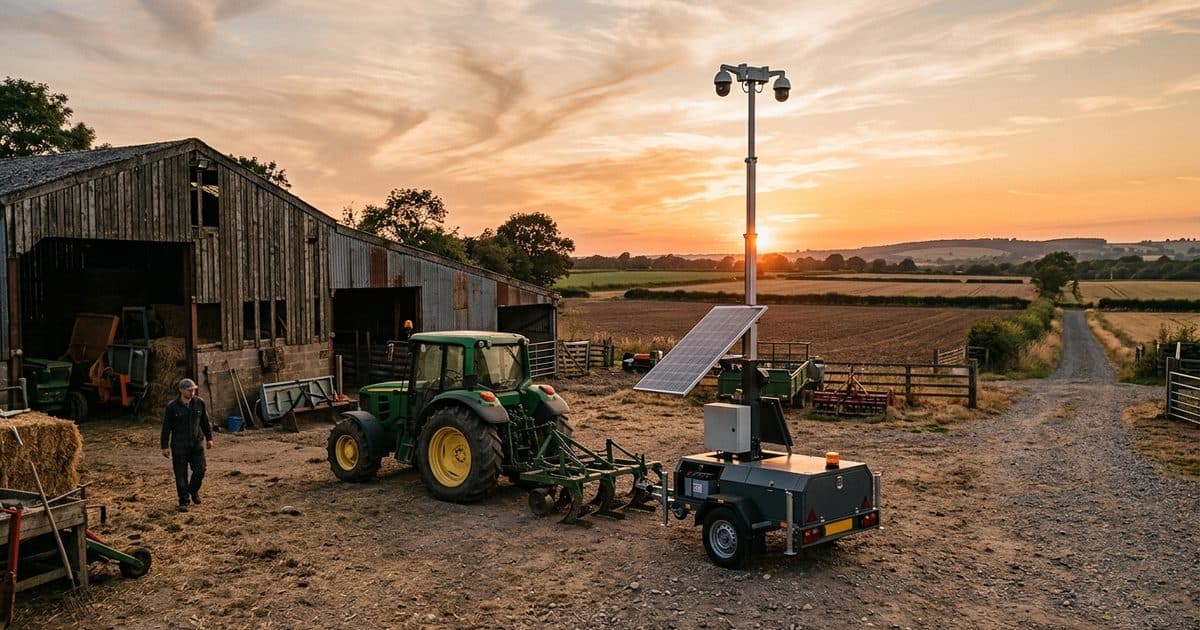
A solar-powered trailer with cellular connectivity is a practical option. It carries its own battery and panels, so it can sit at a gate, at a water source or on a rise with a view across the field. Coverage depends on the cellular signal at the spot, so test signal strength before choosing a location. Our guides to cellular security cameras and security cameras without internet explain the tradeoffs.
Since herds rotate and risk changes seasonally, a mobile unit can be moved to the pasture that is most exposed instead of being tied to one fixed spot.
Choose monitoring over recording alone
A camera that only records tells you what happened after the animals are gone. The research on public-area cameras shows the difference. A 2019 systematic review found that actively monitored systems were associated with about a 15% reduction in crime, while passive recording-only systems showed no significant effect.
On a ranch, active monitoring means someone verifies an alert at night, speaks through a loudspeaker to tell the people they are being watched, and calls law enforcement with video if they stay. That is a very different outcome from finding the footage the next morning. Our article on live talk-down audio explains how that works.
Build neighbor and community awareness
Rural theft is often a regional problem, and the best early warning may come from the people around you. Share vehicle descriptions, plate numbers and times with neighbors and local contacts when something unusual happens. Agree on a simple way to alert each other, such as a phone tree or group message.
Ask neighbors to report unfamiliar trucks and trailers parked near gates or on shoulders, especially at odd hours. Let your local sheriff know when you add cameras, so deputies understand what video may be available. Good relationships make it easier to get a fast response and to compare notes across properties.
How VDS fits
VDS builds solar-powered mobile surveillance units for remote locations. Each unit has a 5MP PTZ camera with 25x optical zoom and three 8MP wide-angle cameras on a 22 ft telescopic mast, with a 900W bifacial solar array charging an 11.8 kWh LiFePO4 battery bank that holds reserve for 3 to 5 consecutive cloudy days. Dual-SIM 4G/5G cellular carries the video, so no site power, internet or trenching is needed.
AI detection covers people, vehicles, loitering, objects and license plates. The 24/7 US-based security operations center verifies events, uses live talk-down, and dispatches police with video, so you and your security partner deal with verified incidents. See the mobile surveillance unit page or talk to our team, or call (410) 401-1986.
Sources
- Piza, E. L., Welsh, B. C., Farrington, D. P., & Thomas, A. L. (2019). CCTV surveillance for crime prevention: A 40-year systematic review with meta-analysis. Criminology & Public Policy, 18(1). onlinelibrary.wiley.com