
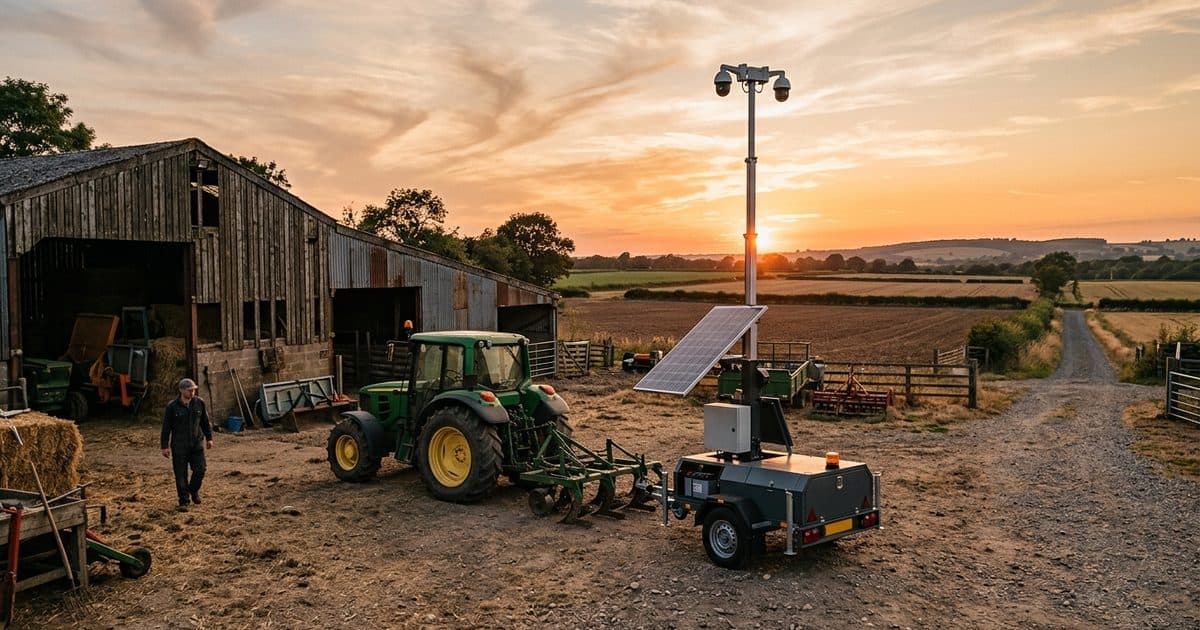
Why is farm equipment such an easy target?
Remote acreage combines almost every condition a thief looks for. Valuable machines sit outdoors or in unlocked outbuildings, often out of sight of any occupied house. There are no streetlights, no foot traffic, and frequently no grid power or internet service to run conventional security systems. And when something does happen, the responding deputy may be covering hundreds of square miles, which means long drive times even for a confirmed call.
Timing works in the thief's favor too. Roughly 80 percent of equipment theft occurs outside working hours, an estimate long cited in National Equipment Register and NICB reporting. On a farm, "outside working hours" can stretch further than it does at a jobsite: a planter staged in a back field on Saturday evening may sit unwatched until Monday morning, and a machine shed at a leased parcel might go days between visits during slow parts of the season.
The market side is just as forgiving. Tractors, implements, and attachments generally are not titled the way road vehicles are, product identification numbers are inconsistent across manufacturers, and a compact tractor on a gooseneck trailer looks unremarkable on any rural highway. Stolen machines are resold intact, parted out, or moved out of state before anyone notices they are gone.
What thieves take from farms
Machinery, implements, and attachments
Compact tractors, skid steers, utility vehicles, and zero-turn mowers top the loss lists because they load quickly and resell easily. Implements and attachments are even lower risk for the thief: bale spears, augers, blades, and hydraulic attachments have no keys, minimal identification, and strong secondhand demand. Losses compound fast when a crew works an area systematically. In one case reported by the National Insurance Crime Bureau, a single suspect was charged in the theft of more than $300,000 in commercial farm equipment and aluminum wire taken across multiple parishes. That is one operator, working rural properties, clearing more value than many farms carry in insurance for mobile equipment.
Diesel and fuel theft
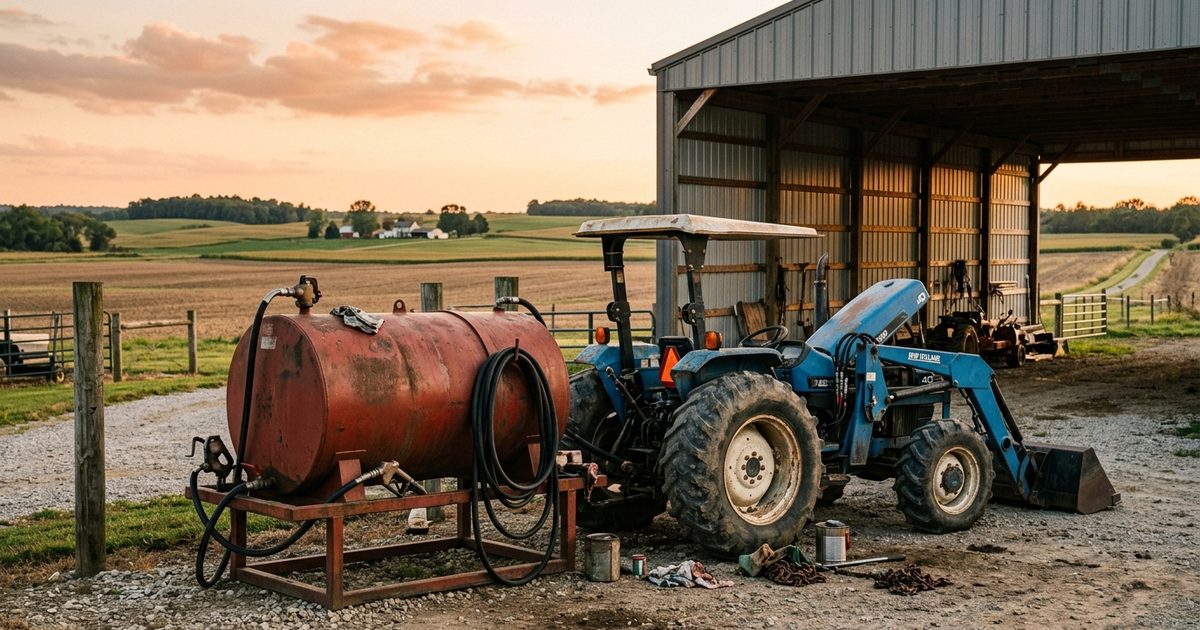
Fuel theft rises with every diesel price spike, and farms present two targets at once: bulk storage tanks in the yard and the large onboard tanks of tractors, combines, and sprayers staged in fields. Siphoning is quiet, fast, and hard to prove after the fact. Practical countermeasures include locking anti-siphon fill caps, positioning bulk tanks inside lit, camera-covered areas rather than at the yard's edge, metering dispensed fuel, and reconciling fuel logs weekly so a slow leak of inventory gets noticed in days rather than months.
Chemicals, wire, and outbuilding contents
Crop protection chemicals concentrate enormous value into a few pallets, and a chemical shed with a hasp lock is not a serious barrier. Anhydrous ammonia adds a safety and liability dimension on top of the dollar loss. Scrap metal is the other quiet drain: copper and aluminum wire stripped from irrigation pivots, well pumps, and barn wiring feeds the same scrap market that drives wire theft at construction sites, and the multi-parish NICB case above included aluminum wire alongside the machinery. Barns and outbuildings also hold tools, tack, ATVs, and spare parts that disappear a few items at a time.
When is farm theft risk highest?
Seasonality shapes farm theft in a way that few other industries experience. Planting season brings full chemical sheds and fuel deliveries. Harvest is the peak exposure window: combines, headers, grain carts, and trucks get staged in remote fields overnight to save transport time, exactly when the machines are furthest from the farmstead and the operation is too busy to check on them. After harvest, high-value equipment goes idle in distant sheds for months, where a theft may not be discovered until the next season starts.
Layer onto that the ordinary rhythm of rural life: hunting season puts unfamiliar trucks on back roads without raising eyebrows, and long winter nights give thieves more darkness to work with. A prevention plan should flex with these cycles, concentrating lighting, patrol attention, and camera coverage wherever equipment and inventory are staged that month rather than treating security as fixed to one yard.
Building a layered farm equipment theft prevention plan
No single measure carries the load. Farm insurer Farm Bureau Financial Services recommends surveillance, lighting, and access control among its core farm security measures, and the layers below build on that foundation:
- Control access. Lock gates on every field entrance, not just the main drive. Cable or chain secondary entrances, and post the property so trespass is enforceable.
- Light the yard. Motion-activated lighting around fuel tanks, chemical storage, and equipment parking removes the darkness thieves depend on and costs little to run on solar fixtures.
- Remove keys and disable machines. Never leave keys in equipment, even in a back field. Hidden battery disconnects and fuel shutoffs turn a two-minute theft into a noisy, time-consuming project.
- Record and mark identification. Photograph every machine, log serial and product identification numbers, and add owner-applied numbers in a hidden second location. Documentation is what turns a recovery into a return: in one Ohio case, NICB agents recovered roughly $185,000 in stolen farm and construction equipment even after thieves had removed the identification numbers, and records are what let investigators match machines back to owners.
- Secure fuel and chemicals. Locking fill caps, metered dispensing, reconciled logs, and a properly secured chemical building close off the two easiest repeat targets on the property.
- Coordinate with your sheriff and neighbors. Share equipment lists and staging plans with the sheriff's office before harvest, and set up a simple neighbor phone tree for unfamiliar vehicles. Rural deputies consistently say they would rather get ten heads-up calls than one after-the-fact report.
Why GPS trackers and unmonitored cameras fall short
GPS trackers are worth installing, but be honest about what they do: they help after the equipment rolls. A tracker does not stop the trailer from leaving the field, and by the time an alert fires and someone maps the signal, the machine may be an hour down the highway or parked in a metal building that blocks the signal. Experienced thieves search for trackers and cut them out. Against a recovery baseline long estimated at 21 to 23 percent, tracking improves your odds without changing the fundamental problem, which is that the theft already happened.
Unmonitored cameras have the mirror-image weakness. A recording camera on a barn documents the theft beautifully, and the footage gets reviewed Monday morning after the skid steer is gone. Motion alerts pushed to a farmer's phone are better, but a raw alert at 2 a.m. forces an impossible choice: drive out alone to confront an unknown number of people, or call the sheriff about an alarm nobody has verified, which lands at the bottom of the dispatch queue. Remote video monitoring resolves that gap by putting a trained operator on the live feed the moment motion triggers, so what reaches dispatch is a verified crime in progress with descriptions, not a maybe.
Verified video monitoring on remote acreage
The historical barrier to camera coverage on farmland was infrastructure: no power at the field edge, no internet within miles. Solar-powered mobile surveillance units remove both constraints by generating their own power, banking it in onboard batteries for nights and cloudy stretches, and transmitting over cellular networks. Modern units run through multi-day weather without grid support, and our guide to solar security camera battery life covers how to size a system for winter light conditions. Because the units are towable, coverage can follow the risk: the equipment staging field during harvest, the fuel and chemical yard in spring, the machine shed lot over winter.
The response model is where verified video earns its keep in rural areas. When an operator confirms an intrusion, live audio warnings often end the attempt on the spot, since thieves who counted on solitude rarely stay once they are addressed by name-the-vehicle detail. When someone persists, the operator calls the sheriff's office with a real-time account of people, vehicles, and direction of travel. That verification works as a force multiplier for stretched rural agencies, so people, whether your own family and crew or your security partner's responders, handle verified incidents instead of chasing false alarms across the county.
Vision Detection Systems builds its mobile surveillance units for exactly these off-grid conditions, pairing solar power and cellular connectivity with 24/7 human monitoring, and the same approach protects other spread-out, equipment-heavy operations, from quarries and aggregate sites to equipment rental yards and vineyards.
Start with the layers that cost almost nothing: locked gates, removed keys, recorded serial numbers, and a call to your sheriff's office before harvest staging begins. Then close the response gap with monitored cameras positioned where your equipment, fuel, and chemicals actually sit this season. Prevention beats a 21 to 23 percent recovery rate every time.