
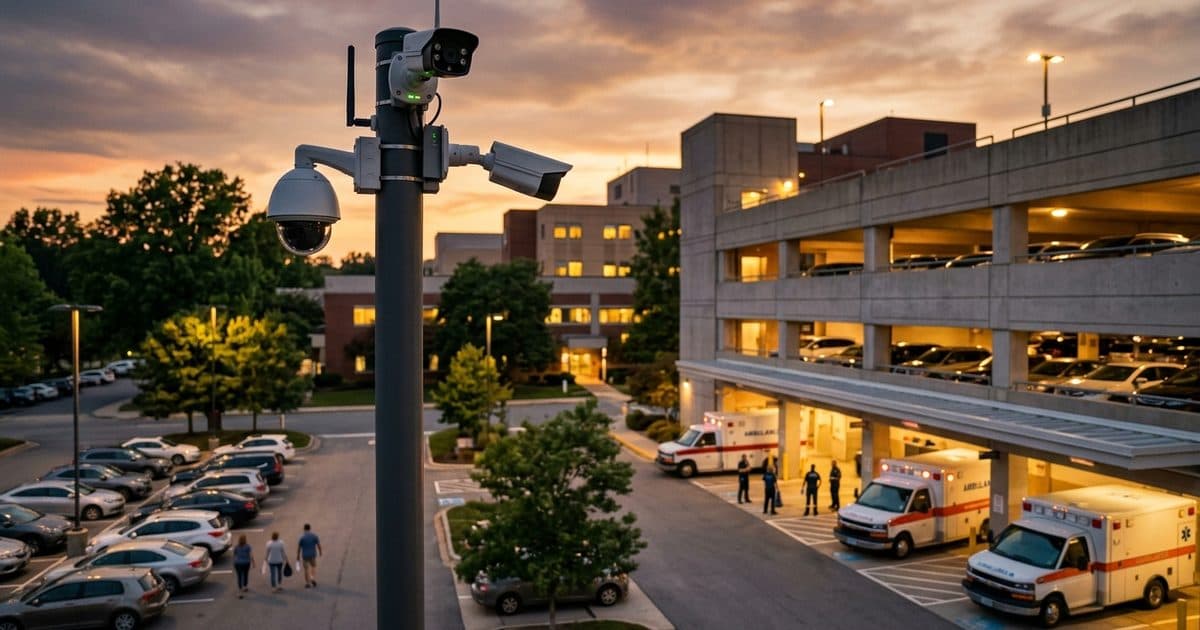
The Healthcare Site Is Not a Typical Site
Most construction sites can set their own rules. A healthcare site cannot. The project often shares a campus, driveways and utilities with an operating hospital, and sometimes shares a building. Ambulance routes, helicopter pads, loading docks and staff parking continue to run while the work goes on.
That changes what security has to accomplish. It must still prevent theft, vandalism and unauthorized entry, but it must also keep construction activity away from patients, protect clinical areas and avoid anything that might interfere with an emergency response. Every measure should be agreed with the facility's operations and security leaders before it is installed.
Controlled Access for the Construction Workforce
Controlled access on a healthcare job usually has more layers than normal. The workforce is larger, the site is closer to sensitive areas, and the owner will often require more documentation.
Common elements include:
- A dedicated worker entrance separate from patient and visitor routes.
- Credentials or badges issued to construction personnel, with a process to deactivate them when a worker leaves.
- Defined delivery windows and routes that avoid emergency access.
- Physical barriers around the work area, including dust and noise controls that the owner may specify separately.
- A visitor procedure for owners, inspectors and design team members.
Requirements for background checks, credentialing and infection control are set by the owner, the facility and local rules, and they vary. Confirm them with the project team and counsel. For structuring the written plan, see the guide to a construction site security plan.
Safety Comes First
On a healthcare campus, a security lapse can become a safety event quickly. An unlocked gate lets a visitor or patient wander into a work zone. An open stairwell gives a trespasser access to an area with exposed hazards. Work in or near mechanical rooms, utility tie-ins and areas tied to medical systems needs particular care.
Video can support site safety in a few ways. It documents who entered an area and when, which is useful for incident review. Analytics can flag people in restricted zones. The platform also includes PPE compliance analytics, as described in the guide to PPE detection cameras, and the article on AI jobsite safety monitoring covers how those tools fit alongside a safety manager's work. They support a safety program and never replace one.
Phased Occupancy and Moving Boundaries
Many healthcare projects open in phases. A new wing may go live while another floor is still being finished, or a renovated unit may take patients while the adjacent area remains a work zone. The boundary between occupied and unoccupied space moves, and each move changes the security picture.
| Project stage | Security priority | What to coordinate |
|---|---|---|
| Early work and demolition | Perimeter, equipment, utilities | Campus traffic routes, emergency access |
| Structure and enclosure | Laydown areas, entrances, crane or hoist | Delivery windows, worker parking |
| Interior build-out | Materials, copper, medical equipment storage | Badge access, restricted floors |
| Phased turnover | Boundary between live and construction areas | Facility security handover and monitoring rules |
| Closeout | Punch-list access, remaining materials | Contractor access end dates |
Treat each turnover as a security event. Review who still needs access, update credentials, and make sure the monitoring plan reflects what part of the building is now live.
Cameras, Audio and Privacy
Cameras on a healthcare project need extra care. Aim them at the construction area, laydown yards and perimeter, and away from patient rooms, windows into clinical spaces and entrances where patients arrive. Rules on recording in and around healthcare facilities vary, and the owner may have its own requirements. Confirm with the owner's compliance team and counsel before deployment.
Audio deserves the same attention. Live talk-down is an effective deterrent in many settings, as covered in the article on live talk-down audio deterrence. On a healthcare campus, agree in advance on where speakers can be pointed, what hours are permitted and what messages are acceptable. A monitoring team can follow those rules, but only if they are written down.
Incident Reporting and Coordination
When something happens near a hospital, several parties may need to know: the contractor, the owner, the facility's security staff and sometimes police. Set up a reporting chain before work begins, with names, phone numbers and the order of calls. The guide to a security camera incident reporting workflow shows how to define it.
Treat video handling carefully too. Decide who may request footage, how long it is retained and how it is shared with police. Patient privacy rules do not necessarily apply to construction video, but the owner may still impose conditions, so ask.
Working With the Facility's Security Team
The hospital's own security staff know the campus better than any contractor. They know which entrances patients use, where emergency vehicles turn, and which areas are sensitive. Bring them into the plan early and agree on who responds to what.
Define the handoffs. If the monitoring team sees an intruder at the construction fence, who calls the facility's security desk, and who calls police? If a facility officer sees a problem at the work zone, who do they call on the construction side? Write the answers down, share them with both teams and test them with a drill before the work reaches the busiest phases.
How VDS Fits
On a healthcare project, VDS mobile surveillance units cover the construction area without relying on the hospital's power or network. Each solar-powered trailer carries a 5MP PTZ with 25x optical zoom and three 8MP wide-angle cameras on a 22 ft telescopic mast. Connectivity runs over dual-SIM 4G/5G cellular, so the unit stays separate from the facility's systems.
AI detection covers people, vehicles, loitering, objects and license plates. A 24/7 US-based security operations center verifies events and can respond with live talk-down, then police dispatch with video, following whatever restrictions the owner sets. That lets people, yours or your security partner's, handle verified incidents. Hardware is NDAA Section 889 compliant, which matters on many facility projects. Most deployments go live in about a week. Read more on the healthcare industry page, review the mobile surveillance unit or talk to our team.