
Read this first
This article describes general categories of funding. It is not a list of open opportunities, and it does not state what any program will pay for in a given year. Each program publishes a notice of funding opportunity, sometimes called a solicitation, that sets the rules for that cycle. Those rules can change from one year to the next, and what was allowable before may not be now. Treat the current notice as the only authority, and contact the program office or your state administering agency with questions.
Federal programs agencies commonly look at
| Program | Administered by | General purpose | Who usually applies |
|---|---|---|---|
| Edward Byrne Memorial Justice Assistance Grant (JAG) | Bureau of Justice Assistance | Flexible support for state and local criminal justice needs, which can include technology and equipment | States, local governments and law enforcement, often through a state administering agency |
| COPS Office grants | Office of Community Oriented Policing Services, U.S. Department of Justice | Community policing priorities, which may include technology depending on the program year | Law enforcement agencies and other eligible public bodies |
| Homeland Security Grant Program | FEMA, often through state administrative agencies | Preparedness and prevention for terrorism and other hazards | States and designated local and regional recipients |
| Nonprofit Security Grant Program | FEMA, typically through state administrative agencies | Physical security improvements for eligible nonprofits at risk | Eligible nonprofit organizations |
Details on each are on the sponsors' own pages. The Bureau of Justice Assistance posts JAG information at bja.ojp.gov, the COPS Office at cops.usdoj.gov, and FEMA's preparedness programs at fema.gov/grants. Current federal opportunities are searchable at grants.gov.
State and local sources
Federal money often reaches agencies through a state administering agency, which may set its own priorities, application windows and forms. States also run their own public safety, school safety, crime prevention and community grant programs. Local sources include city or county capital budgets, special assessments, business improvement districts, community foundations and private donations. Start with your state's administering agency, since it can tell you which funds are available and how federal pass-through money is handled.
What a strong application contains
Programs differ, but most reviewers look for the same core material.
- A needs assessment. Describe the problem in specific terms, such as the location, the kinds of incidents and why current measures fall short.
- Incident data. Use your own records, such as calls for service, reports and documented losses, to support the need. Do not use numbers you cannot trace to a source.
- A project description. Explain what will be installed, where, how it will be used and who will operate it.
- Quotes. Attach written quotes that match the scope. Many programs require competitive quotes or a documented procurement process.
- A budget. Break the costs into the categories the notice allows, and keep ineligible items out of the request.
- A sustainment plan. Show how you will pay for maintenance, monitoring, storage and staff time after the grant ends.
- Policies. Include retention, access, privacy and use policies, since reviewers often ask how the data will be handled.
- Outcomes. State how you will measure whether the project worked.
For help on the evidence side, see our overview of how police security cameras enhance public safety.
Procurement rules
Grant-funded purchases usually have to follow procurement rules, and those rules can be stricter than your normal practice. Expect requirements about competition, documentation, conflicts of interest and the timing of purchases. Buying before an award is issued is often not allowed, and costs incurred outside the grant period may not be reimbursed. Involve your purchasing office or grants administrator early, and keep written records of every step.
NDAA Section 889 and your equipment
Section 889 of the National Defense Authorization Act prohibits federal funds being used on covered telecommunications and video surveillance equipment from certain manufacturers. If any part of a project is paid with federal money, the cameras, recorders and related equipment must comply, and you may be asked to certify that they do. Do not wait until the quote stage to check. Ask every vendor to state compliance in writing and to describe what their certification covers.
Our NDAA compliance page and the NDAA compliant security cameras buyer's guide explain what to ask and how to document the answers.
Common reasons applications fail
- The project does not match the stated purpose of the program.
- The needs statement relies on general claims instead of local data.
- The budget includes costs that the notice does not allow.
- There is no plan for ongoing costs once the grant ends.
- Quotes are missing, do not match the scope or were not obtained as required.
- Equipment does not meet the compliance requirements.
- The application is late or incomplete.
Timing and planning
Grant cycles are slow. Notices are published on the sponsor's schedule, applications take weeks to prepare, and awards can arrive well after the need began. Plan the project so it can survive that gap. Begin gathering incident data and quotes before a notice is released, so that you can respond quickly once one appears. Sign up for alerts on the sponsoring agency pages and on grants.gov, and ask your state administering agency when its next application window is expected.
It also helps to separate what must happen now from what can wait for funding. If a hot spot needs coverage immediately, a short-term rental from existing budget may bridge the gap while the application is pending. Check first whether the grant allows costs incurred before the award, since many do not.
Where VDS fits
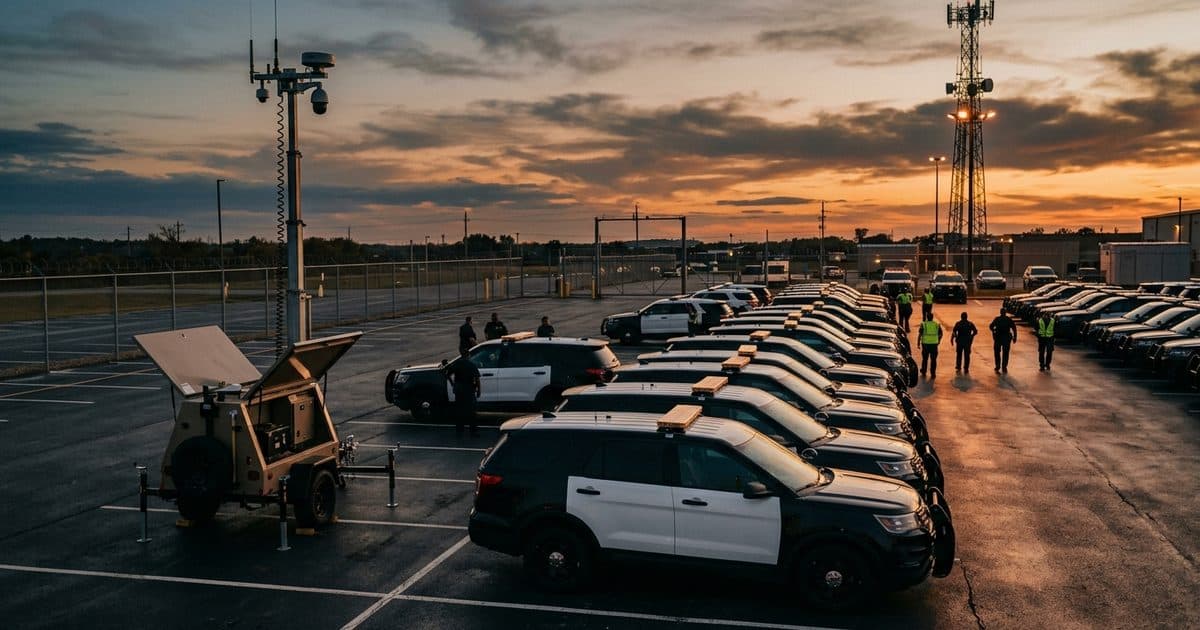
Public safety agencies use mobile surveillance units where fixed infrastructure does not exist or takes too long. VDS units are solar-powered trailers with a 5MP PTZ camera with 25x optical zoom and three 8MP wide-angle cameras on a 22 ft telescopic mast, and dual-SIM 4G/5G cellular, so no site power, internet or trenching is needed. The hardware is NDAA Section 889 compliant.
Our 24/7 US-based security operations center verifies events and can dispatch police with video. Rental, month-to-month and term subscriptions are available, which can matter when a grant has a defined period. We can supply specifications and quotes for your application, but we cannot tell you what a program will fund. See our pages on public safety and mobile surveillance for law enforcement, and then talk to our team about your project.