
Why data center builds are the top theft target of 2026
The money flowing into data center construction has outpaced the security practices protecting it. Spending rose nearly 30% in 2025 to around $41 billion, per Marketplace reporting on Census C30 data, and data centers have now surpassed offices as the largest segment of US office-category construction, according to Data Center Knowledge. That growth keeps pushing projects onto rural and exurban land where power is available and acreage is cheap. Those are exactly the conditions that make a site hard to protect: remote locations, multi-year schedules, rotating subcontractor workforces, and long phases with no permanent fencing, lighting, power, or network.
Thieves have noticed. In one July 2026 operation, the Cook County Sheriff's office recovered $1.3 million in stolen copper and data center gear, as reported by Fortune. Vice has documented $300,000 in copper stolen from an Alabama data center build and a $1 million equipment trailer taken from a Florida project, and WJLA reported three arrests for copper stolen from a data center construction site in Loudoun County, Virginia, the heart of the world's densest data center market. These are not opportunistic grabs. They are organized crews working the build type that stages more valuable, portable material per acre than almost any other.
What makes copper theft so profitable right now
Copper prices set the incentive, and they have never been higher. COMEX copper topped $12,000 per ton for the first time in December 2025, per Bloomberg. A hyperscale data center consumes copper by the mile: feeder runs, grounding grids, busway, and spooled wire staged for electrical crews. A pickup load of stripped wire is worth thousands at a scrap yard, and the loss often is not discovered until the next morning's crew arrives. The same economics driving copper theft at substations apply on the construction side of the meter, with even less permanent security in place.
Timing compounds the exposure. Roughly 80% of jobsite theft happens outside working hours, a long-cited industry estimate, and data center projects sit dark through long overnight and weekend windows. Equipment losses stack on top of material losses: heavy equipment theft costs the industry an estimated $300 million to $1 billion per year with under 25% of stolen machines recovered, a long-cited industry estimate from the most recent public national dataset published by the NICB.
The damage rarely stops at scrap value. Ripped-out feeder wire means re-pulling runs, re-terminating and re-inspecting, and schedule slips on projects where owners measure delay in megawatts of missed capacity and contractual damages. That is why a written construction site security plan for a data center build should treat copper as the primary target from day one, not an afterthought once the first theft happens.
Laydown yard security for data center construction
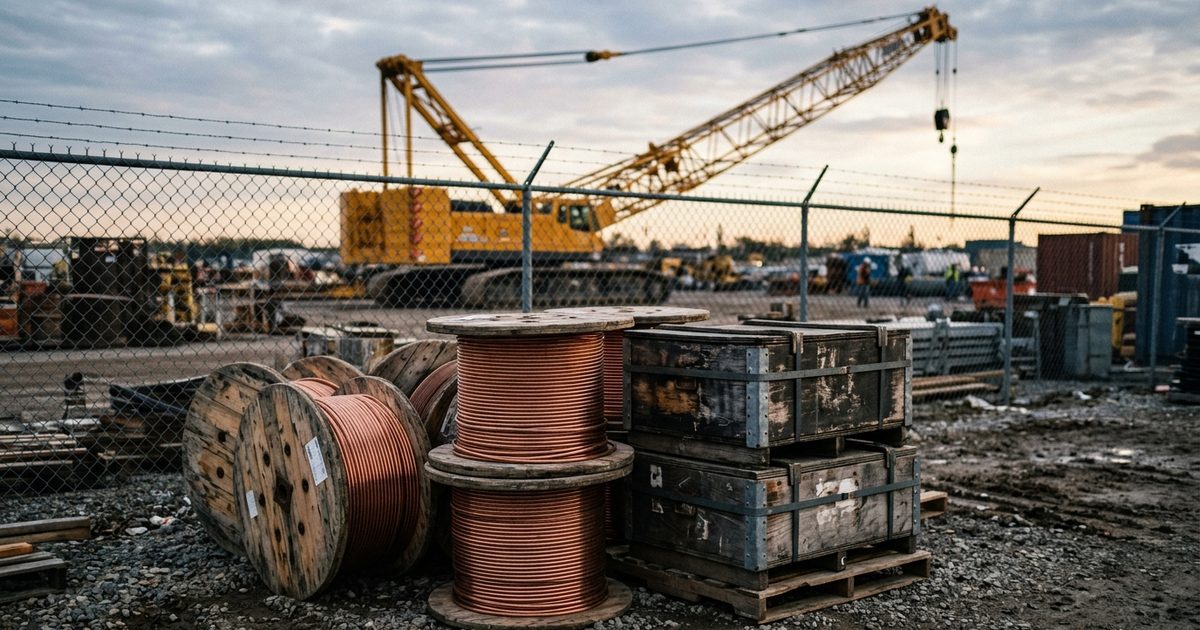
Laydown yards are the highest-value, lowest-visibility zones on most data center sites. A hyperscale campus can stage tens of acres of switchgear, transformers, generators, cable spools, and mechanical equipment months ahead of installation, often at the far edge of the property, outside the fenced work zone, and beyond the reach of whatever lighting exists. Long procurement lead times make the problem worse: equipment that took a year to source sits outdoors waiting for its phase, and a stolen or vandalized transformer cannot be quickly replaced.
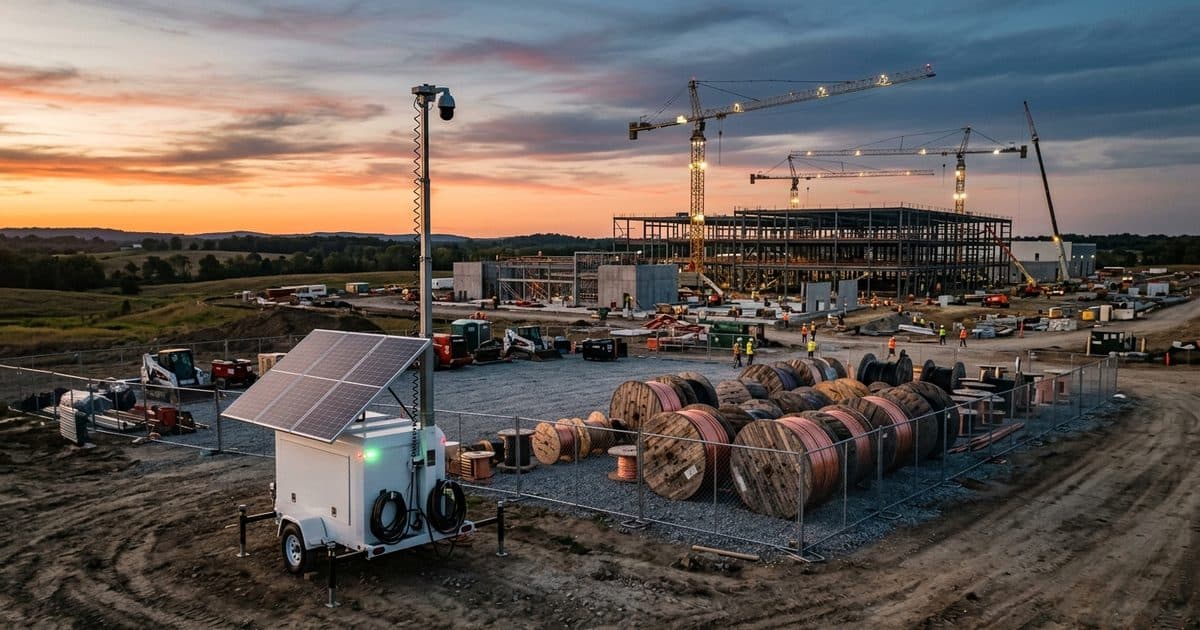
Practical laydown yard security starts with layout. Consolidate high-value staging into as few zones as possible, keep a current inventory with photographed serial numbers, and place camera coverage so every aisle and access route is observed rather than just the yard gate. Elevated, solar-powered mobile surveillance units suit laydown yards well because they need no trenching or power, can see over stacked material, and relocate as the yard is consumed and re-staged through the project.
Visible deterrence matters as much as detection, because organized crews scout targets before they hit them. Marked surveillance units, motion-triggered lighting, and posted monitoring signage tell a scouting crew that this yard is watched and the one two exits down the highway is not. Most theft prevention on large campuses is simply losing the site-selection contest that thieves run before they ever cut a fence.
Access control and LPR at yard chokepoints
Every laydown yard has natural chokepoints where vehicles must pass, and that is where license plate recognition earns its keep. LPR cameras at yard entrances capture every plate around the clock, flag vehicles that arrive outside working hours, and give investigators something far more useful than a grainy figure in a hoodie. On multi-year builds with hundreds of vendor and haul trucks per week, a searchable plate record also helps resolve disputes about which loads actually arrived and when.
Securing each phase, from groundbreaking to commissioning
Data center projects run two to four years, and the theft target changes with each phase. Early on, the exposure is heavy equipment and fuel spread across raw acreage. By fit-out, it is installed copper and switchgear inside a building with dozens of temporary openings. By commissioning, it is server and networking hardware whose value per pallet rivals anything on the site. Security coverage should move with that shift rather than being designed once at mobilization and left static for three years.
| Phase | What's most exposed | Security priority |
|---|---|---|
| Sitework and civil | Heavy equipment, fuel, tools | Perimeter surveillance, equipment corrals, after-hours monitoring |
| Structure and shell | Staged steel, copper spools, laydown yards | Yard consolidation, LPR at chokepoints, relocated camera coverage |
| Electrical rough-in and fit-out | Installed feeder wire, busway, switchgear | Interior-facing coverage of energized-path areas, strict access logs |
| Commissioning | Servers, networking gear, batteries | Delivery verification, chain-of-custody, tightened badge and vehicle control |
The common thread across phases is that permanent infrastructure arrives last. Fencing goes up in stages, permanent power and network may not be live until commissioning, and lighting follows the building rather than the laydown areas. Security that depends on site power and site internet will always lag the risk, which is the core argument for self-powered, cellular-connected surveillance from the first day of sitework. For a broader walkthrough of layered controls, see our complete guide to construction site security systems.
NDAA compliance and hyperscaler procurement requirements
On data center projects, camera choice is a procurement issue, not just a security one. Hyperscale owners routinely flow federal-style supply chain requirements down to general contractors and their vendors, which excludes surveillance equipment from manufacturers on the FCC Covered List, including Hikvision, Dahua, Huawei, ZTE, and Hytera. A contractor who deploys non-compliant cameras on a hyperscale build risks a forced mid-project rip-and-replace, awkward owner audits, and a mark against future bids.
The safe path is to require NDAA-compliant hardware in the security scope from the outset and to ask any surveillance vendor to document their supply chain in writing. VDS builds its surveillance units on NDAA-compliant components; the details are published on our NDAA compliance page. Whatever provider you use, get the compliance statement before mobilization, because retrofitting compliance is far more expensive than specifying it.
How monitored mobile surveillance covers a site with no power or network
The practical answer to a copper-dense site with no permanent infrastructure is surveillance that brings its own. Solar-powered mobile surveillance trailers carry cameras, thermal or low-light optics, LPR, deterrence lighting, and speakers, connected over cellular networks, so coverage can start at groundbreaking and move as the site evolves. When a unit detects after-hours motion, 24/7 remote monitoring operators verify what is actually happening, issue live audio warnings, and escalate confirmed incidents to police with real-time details, so people, yours or your security partner's, handle verified incidents instead of chasing false alarms. Monitored surveillance works as a force multiplier for on-site guard patrols on large campuses, covering the acreage between patrol routes and directing responders to the exact location of a verified event.
That is the model VDS runs for construction clients nationwide: solar-powered units deployed in days, repositioned as phases change, and watched around the clock by a US-based security operations center. For contractors comparing options, the practical steps in our guide to preventing construction site theft apply directly to data center work, just at a larger scale and with more at stake per incident.
Where to start
Treat security as a day-one line item, not a response to the first police report. Map your copper and equipment exposure by phase, consolidate and inventory laydown yards, specify NDAA-compliant monitored surveillance before mobilization, and put LPR on every vehicle chokepoint. The spending boom that makes data center builds so valuable is exactly what makes them targets, and the sites that stay off the theft map are the ones that were watched from groundbreaking.