
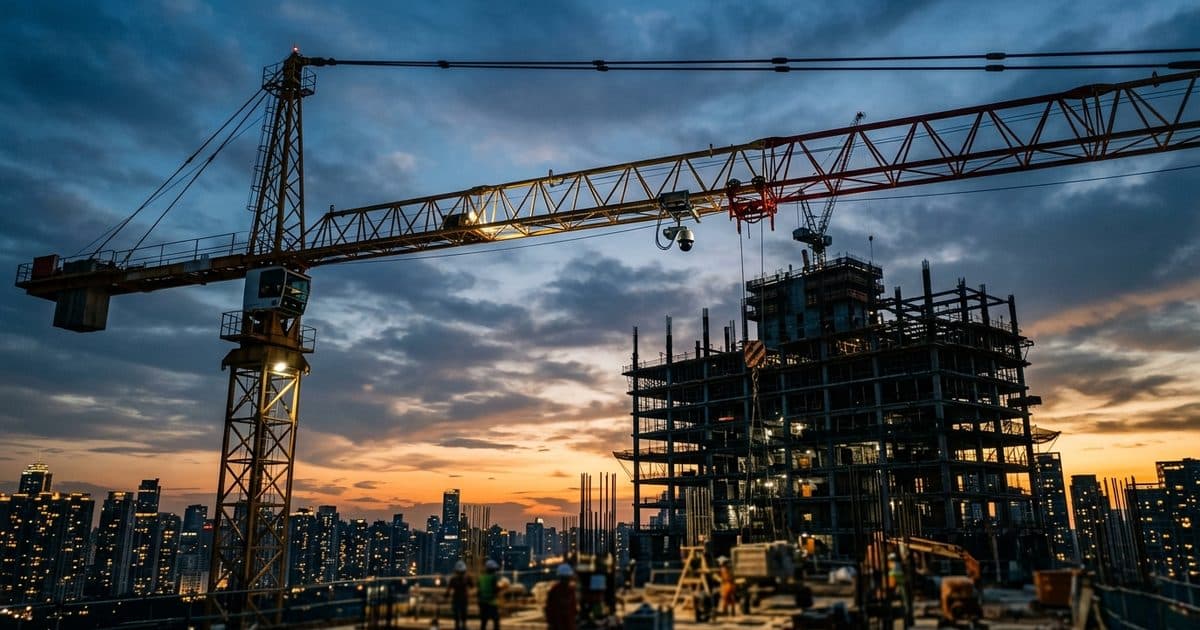
Why crane operations need dedicated camera coverage
The dominant crane hazard is not the crane failing. It is people and loads occupying the same space at the wrong moment. Per the BLS CFOI crane factsheet, over half of fatal crane injuries involved a worker struck by an object or equipment, often the load itself or something it dislodged. Struck-by incidents are fundamentally visibility problems: someone was in the lift path and nobody with the power to stop the lift could see it in time.
The industry has made progress. Comparing across BLS data series, an era comparison that carries some methodological caveats, crane-related fatalities fell from roughly 78 per year in the 1992 to 2010 period to roughly 42 per year in 2011 to 2017, according to BLS CFOI archives. Better standards, better training, and better lift planning drove much of that decline. But construction remains dangerous overall, with 1,075 construction fatalities in 2023 according to the BLS CFOI news release, and on a vertical project the crane touches nearly every trade's work at some point.
Cameras will not replace a lift plan, a qualified signal person, or a competent operator. What they add is information: a view the operator otherwise lacks, a recording of what actually happened, and a set of eyes on the lift zone when the site is empty.
What is a crane camera? Hook, trolley, and boom-tip views
In the narrow sense, a crane camera is a camera mounted on the crane itself, streaming video to a display in the operator's cab. Three mounting points are common on vertical construction.
Hook and trolley cameras
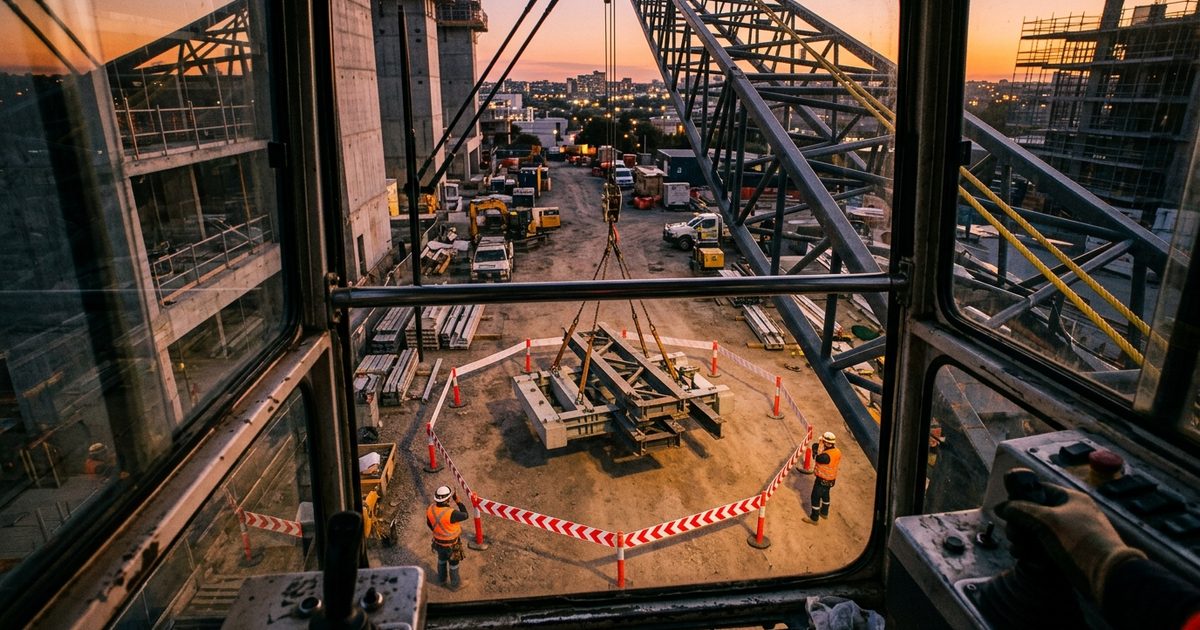
A hook block or trolley camera looks straight down at the load from directly above it. On a tower crane, the camera typically rides the trolley or hangs near the hook, powered by its own battery pack or the crane's circuit, and transmits wirelessly to a cab monitor. The operator sees the load, the rigging, and the landing zone in one frame, from the one angle no human can occupy.
That view matters most during blind lifts. Once a high-rise passes a few floors, the operator often cannot see the pick point, the landing deck, or both, and works entirely from radio calls. The camera does not replace the signal person; it lets the operator cross-check what they are hearing against what is actually below the hook, and it makes the final feet of a landing far less of a guess.
Boom-tip and cab-assist cameras
Mobile and crawler cranes commonly carry a boom-tip camera with zoom, which serves the same purpose from a different geometry: it follows the boom head and looks down the load line. Some setups add winch-view or counterweight cameras so the operator can verify drum spooling and swing-radius clearance without leaving the seat. All of these are operator aids. They feed one person in real time, which is exactly their job, and also their limit: they see the load, not the site.
Elevated fixed cameras: documenting every lift
The second layer sits off the crane entirely. One or two fixed cameras mounted high on an adjacent structure, a dedicated pole, or the building core keep the full lift path in frame: pick zone, swing arc, and landing zone in a single wide view, recorded continuously.
This layer is about documentation more than real-time assistance. When a near miss, a dropped object claim, or a property damage dispute surfaces, the elevated recording answers the questions that follow: where the load traveled, whether the exclusion zone was clear, what the weather and rigging looked like, and when each event happened. Lift logs and witness accounts are stronger with time-stamped video behind them, and disputes with adjacent property owners over swing rights are far easier to resolve with a recorded arc than without one.
The same elevated position often does double duty for progress documentation and stakeholder visibility. Many teams fold lift documentation into the same planning exercise as their live jobsite streaming and time-lapse setup, since both want the same thing: a high, stable vantage point with the crane's working radius in frame.
Getting that vantage point right is a placement problem as much as a hardware problem. Sight lines change as the structure rises, so positions that covered the lift zone at foundation stage can be blocked by level ten. Our guide to construction camera placement covers how to pick mounting positions that survive the project's own growth.
Ground-level monitored units: exclusion zones and laydown yards after hours
The third layer works when the other two are idle. Hook cameras feed an operator who has gone home; fixed cameras record an empty frame. But the crane's footprint stays hazardous and valuable all night: the base and mast, the counterweight radius, the rigging cage, and the laydown yard holding the next week's picks.
Ground-level mobile surveillance units cover that footprint without site power or trenching. A solar-powered unit positioned to see the crane base and laydown yard does three jobs after hours:
- Deters and detects trespass. Tower cranes attract climbers, and exclusion-zone barriers do not stop anyone at 2 a.m. A monitored camera catches the approach, not the aftermath.
- Protects staged material and rigging. Slings, shackles, spreader bars, and staged steel or mechanical modules are expensive to replace and can stall the lift schedule if they disappear or are tampered with.
- Documents overnight site conditions. If a storm moved material, a barrier was displaced, or a load shifted in the yard, the morning crew knows before the first pick rather than discovering it mid-lift.
The monitored part is what separates this layer from a recorder in a box. With human-verified remote monitoring, a detection under the crane at night becomes a live assessment and an escalation, so people, yours or your security partner's, handle verified incidents instead of reviewing footage of them the next day.
How the three layers fit together
Each layer answers a different question, for a different audience, on a different schedule. The gaps only close when all three are planned together.
| Layer | Typical mount | What it sees | Primary job |
|---|---|---|---|
| Hook / trolley / boom-tip camera | On the crane | Load, rigging, landing zone | Real-time operator assistance during lifts |
| Elevated fixed camera | Adjacent structure, pole, or core | Full lift path and swing arc | Continuous lift documentation and dispute evidence |
| Ground-level monitored unit | Mobile surveillance trailer at grade | Crane base, exclusion zone, laydown yard | After-hours deterrence, detection, and site-condition record |
A useful planning check: walk through one lift and one overnight. During the lift, the operator should have a load view, and at least one recording should hold the whole swing arc. Overnight, at least one monitored camera should see the crane base and the laydown yard. If any of those views is missing, that is the gap to fill first.
Struck-by prevention: keeping people out of the lift path
Since struck-by events account for over half of fatal crane injuries in the BLS data, the highest-value use of all this video is keeping workers and suspended loads apart.
Cameras support that in three concrete ways. First, the operator's hook view confirms the landing zone is clear at the moment that matters, not just when the lift was radioed in. Second, elevated recordings let safety managers audit exclusion-zone discipline: reviewing a week of lifts shows whether barriers are respected in practice or only on paper, and which crews or hours need a refresher. Third, analytics are starting to shoulder some of the watching. Modern AI jobsite safety monitoring can flag a person entering a defined zone in a camera's view and surface the event for human review, turning a passive recording into a prompt rather than an archive.
The honest caveat: no camera stops a lift. Prevention still lives in the lift plan, the exclusion-zone controls, and the signal person's authority to halt work. Video makes those controls visible, auditable, and improvable.
Planning lift-zone coverage for high-rise and data-center projects
High-rise and data-center builds are where layered crane coverage earns its keep, for different reasons.
On high-rise work, the defining problem is height. Blind lifts become the norm early, so the hook camera moves from nice-to-have to daily tool, and elevated documentation cameras need mounting plans that account for the building growing past them. Swing arcs over streets and neighboring roofs also raise the documentation stakes.
Data-center projects concentrate value on the ground. Generators, switchgear, chillers, and prefabricated modules staged for crane placement represent enormous inventory sitting in open yards for months, on sites that are often remote and fenced long before they are powered. There, the ground-level monitored layer typically leads the plan, and lift documentation rides on the same infrastructure. Our overview of data-center construction site security goes deeper on protecting that staged equipment through the build.
In both cases, sequence the camera plan with the crane plan. The crane erection date, climbing schedule, and dismantle date define when each layer must be live and when it must move.
Where monitored mobile surveillance fits
Vision Detection Systems supplies the ground layer of this stack. Our solar-powered mobile surveillance units deploy at grade without site power, cover crane bases, exclusion zones, and laydown yards, and connect to 24/7 human-verified remote monitoring so after-hours detections become live escalations instead of morning surprises. Crews and security partners get verified incidents to act on, and project teams get a continuous recorded view of the lift zone from mobilization through crane dismantle. The on-crane and elevated layers remain the domain of your crane supplier and your documentation plan; we make sure the ground around the crane is never unwatched.
Crane cameras are not one product. They are three layers, each closing a blind spot the others cannot: the operator's view of the load, the record of every lift, and the overnight watch on the zone below. Plan all three with the crane schedule, and the most dangerous equipment on site becomes the best-documented.