
One note before the detail: this article is general information, not code or legal advice. Fire watch and fire prevention obligations vary by jurisdiction, adopted code edition, project type, and insurance carrier. Confirm your specific requirements with your authority having jurisdiction (AHJ), your insurer, and qualified fire protection professionals.
What is a construction site fire watch?
A fire watch is a person whose assigned duty is to watch for fires and respond to them in their earliest stage: patrolling designated areas, checking that hot work areas stay clear after welding or cutting ends, keeping extinguishing equipment at hand, and raising the alarm and calling the fire department when needed. On construction projects, fire watch requirements typically come from three directions at once.
First, fire codes and NFPA standards require a fire watch in specific situations, most familiarly for a set period after hot work such as welding, torch cutting, grinding, and roofing torch application, because smoldering ignition can surface long after the torch is off. Second, the AHJ can order a fire watch when protection systems are impaired or when site conditions warrant it. Third, insurers frequently mandate fire watch coverage as a condition of builder's risk coverage on higher-hazard projects, especially large wood-frame structures during the window when framing is exposed and sprinklers are not yet active.
That third driver is why fire watch shows up as a significant line item on many project budgets. It is a labor cost that runs nights, weekends, and holidays, precisely the hours when nobody else is on site. The people staffing those rounds, whether your own employees or a security partner's officers, are doing necessary work that code and carriers require. The question worth asking is not how to eliminate those rounds, but what happens to the site in the minutes and hours between them.
What does NFPA 241 actually require?
NFPA 241, the Standard for Safeguarding Construction, Alteration, and Demolition Operations, requires that projects operate under a documented fire prevention program. In broad terms, the standard calls for a designated fire prevention program manager with authority over fire safety on the site, a written plan covering areas such as hot work permitting, temporary heating, cooking restrictions, smoking policies, housekeeping and debris removal, site security measures, water supply and fire department access, and coordination on when protection systems come online. Specific obligations depend on which edition your jurisdiction has adopted and on local amendments, which is why the plan should be built with your AHJ rather than copied from another project.
Two points in that scope deserve emphasis. NFPA 241 treats site security as part of fire prevention, not as a separate concern, because unsecured sites burn more often (more on that below). And the standard expects the program to cover the full project timeline, including the after-hours periods when ignition sources like charging equipment, temporary heaters, and trespassers are present but workers are not.
A fire prevention program is also increasingly a paperwork reality. Carriers writing builder's risk on frame construction commonly ask to see the written plan, the hot work permit log, and evidence that after-hours provisions exist before binding or renewing coverage. Documentation of what your site looked like overnight, every night, is a useful artifact in that conversation, a point we cover in more depth in our guide to construction site security cameras and insurance.
How big is the construction fire problem?
The same NFPA analysis of 2013 to 2017 fire department data puts numbers on the risk: fires in structures under construction caused an estimated 304 million dollars in direct property damage annually, along with an average of about 4 civilian deaths and 49 civilian injuries per year. Dollar losses understate the operational damage. A significant fire can erase months of schedule, trigger contract penalties, and reset subcontractor sequencing even when insurance ultimately pays the claim.
The distribution of those fires matters for planning. Roughly 75 percent of under-construction fires occurred at residential structures, per the same NFPA report. That tracks with the physics: wood-frame residential construction spends months as exposed lumber with no drywall, no compartmentation, and no active sprinklers, so a small ignition can involve the whole structure quickly. If you build multifamily or single-family at scale, fire risk planning belongs alongside theft planning in your site setup, something we walk through in our piece on residential construction site security.
Can cameras replace a code-mandated fire watch?
No. This deserves a plain answer because it gets blurred in marketing copy: where NFPA 241, your local fire code, an AHJ order, a hot work permit, or your insurance policy requires a human fire watch, cameras do not satisfy that requirement. A fire watch is defined by a person who can physically intervene, use an extinguisher on an incipient fire, clear an area, and meet arriving crews. A camera cannot do any of that, and presenting video monitoring to an AHJ or a carrier as a substitute for a required fire watch invites a compliance problem on top of a safety problem.
Some jurisdictions and carriers are beginning to consider monitoring technology within fire prevention programs, and requirements continue to evolve. But the burden is on you to get any substitution or modification approved in writing by the AHJ and your insurer before you change staffing. Until then, treat cameras as a supplement to human rounds, never an alternative. The honest framing is a force multiplier: continuous detection so that people, yours or your security partner's, respond to verified incidents faster and with better information.
Here is how the two capabilities actually divide the work:
| Capability | Human fire watch | Monitored cameras |
|---|---|---|
| Satisfies code or insurer fire watch mandate | Yes, where required | No |
| Physical intervention (extinguisher, shutoff, clearing area) | Yes | No |
| Continuous coverage of multiple areas at once | No, sequential rounds | Yes |
| Coverage between rounds and after shift ends | Gaps by design | Continuous |
| Time-stamped visual record for insurer and AHJ | Log entries | Recorded video |
| Verified escalation to 911 with live detail | Yes, on scene | Yes, via operators |
How do monitored cameras extend a fire prevention program?
The value of cameras in a fire prevention program comes down to closing time gaps. A fire watch officer walks rounds on an interval; a smoldering ignition in a debris pile does not wait for the next round. Camera coverage over hot work areas, laydown yards, temporary power, and material storage means the site is being watched continuously, including the hours after the fire watch period ends and the site is empty.
Detection is only half of it. With remote video monitoring, trained operators receive analytics-driven alerts, look at the live feed, and verify what is actually happening before anyone is dispatched. For fire risk specifically, that looks like: smoke or glow visible on camera at 2 a.m. triggers an alert, an operator confirms it is not headlight glare or dust, and escalation goes to the fire department and your site contacts with a precise location and a live description rather than an unverified automatic alarm. The same verification workflow handles the human side of fire risk, such as trespassers on site after hours or unauthorized torch work outside permitted hours.
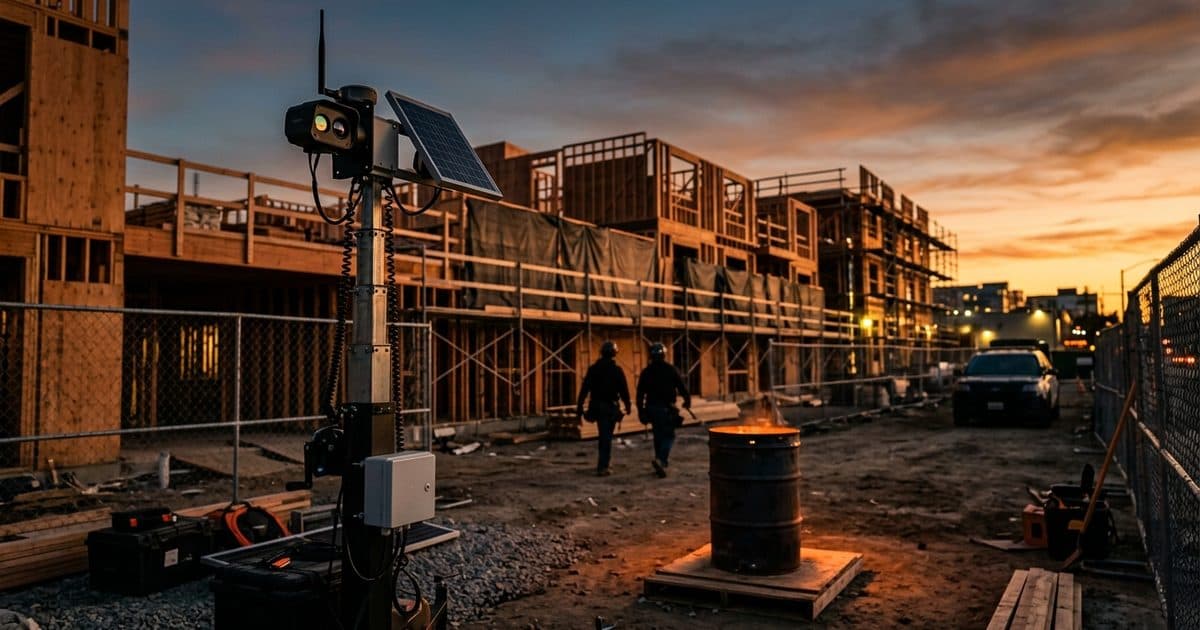
Mobile surveillance trailers fit construction fire prevention particularly well because they need none of the infrastructure the project has not built yet. Solar power and cellular connectivity mean coverage can start at mobilization, before temporary power exists, and units can relocate as the hazard moves, over the framing package during the exposed-lumber months, then over roofing operations when torch work starts. The elevated vantage and low-light imaging matter here too: early smoke, glow, and unauthorized after-hours activity are exactly the things that are hard to see from a ground-level patrol at night and comparatively easy to see from a monitored camera position, and projects with a spec-driven need for dedicated hot-spot sensing can add thermal imaging for those specific locations.
Cameras also generate the documentation layer NFPA 241 programs increasingly need. Continuous recording gives you a defensible record of site conditions overnight, evidence of when hot work actually stopped, and incident video for the carrier if something does happen.
Fire risk and site security are the same problem after dark
Fire prevention and site security are usually budgeted separately, but the data says they overlap. A long-run NFPA analysis of vacant building fires, reported via FireRescue1, found that 57 percent of fires in unsecured vacant buildings were intentionally set, compared with 31 percent in secured properties. Construction sites share the risk profile of vacant buildings for much of their timeline: unoccupied at night, easy to enter, full of combustible material. Keeping trespassers out is fire prevention, not just theft prevention.
The practical takeaway is that the perimeter measures you deploy for theft, fencing, lighting, monitored cameras, and audio talk-down, are pulling double duty against arson and against accidental ignition by trespassers. The same logic applies before and after the active build: a project stalled between phases or a completed-but-unoccupied structure carries elevated arson exposure, which is why we treat vacant property security as a continuation of construction security rather than a separate discipline.
Building fire watch and camera coverage into your site plan
Treat fire coverage as a section of your overall construction site security plan rather than a parallel document. A workable sequence looks like this:
- Map the requirements first. Identify what NFPA 241, your local code, the AHJ, and your builder's risk carrier each require, in writing, including fire watch durations after hot work and any after-hours provisions.
- Staff the mandated fire watch fully. Human rounds where required, with clear logs. If a security partner provides the officers, integrate their rounds and escalation contacts into the fire prevention program document.
- Layer cameras over the gaps. Position monitored cameras to cover hot work zones, combustible storage, temporary heat, and the perimeter, with coverage running continuously between rounds and after the watch period ends.
- Define escalation before you need it. Who gets called for verified smoke, for trespass, for unauthorized hot work, in what order, with 911 escalation criteria agreed in advance.
- Review at each phase change. Framing, roofing, and finish phases each move the hazard; camera positions and watch instructions should move with it.
This is where Vision Detection Systems fits, stated plainly: VDS deploys solar-powered mobile surveillance trailers with 24/7 monitoring from a US-based operations center, positioned as the continuous-coverage layer inside a fire prevention program, not as a substitute for the fire watch your code official or carrier requires. Operators verify smoke, glow, or intrusion on live video and escalate to your people, your security partner's officers, or emergency responders with specifics, so the humans who can actually intervene get there faster and better informed.
The bottom line: fund the fire watch your project legally needs, then close the gaps around it. The fires in NFPA's data mostly start small, in the hours when no one is looking. Making sure something is always looking is the cheapest part of the whole program.