
This guide covers what police security cameras actually do, what four decades of research say about their impact, where they work best, the legal and privacy guardrails, and how agencies can build a camera program that delivers measurable results.
Key takeaways
- Public-area cameras are associated with an average 13% reduction in crime in monitored areas, with the largest effects in parking lots.
- Active monitoring matters. Live-monitored systems show meaningful crime reductions; recording-only systems show no significant effect.
- Cameras work best as part of a strategy—paired with lighting, signage, patrols, and a clear response workflow.
- Recording in public spaces is generally lawful, but long-term aggregated tracking faces growing legal limits. Written policies on use, retention, and access are essential.
- Agencies using federal grant funds must buy NDAA Section 889 compliant hardware.
What are police surveillance cameras in public places?
"Police surveillance cameras" covers several technologies that law enforcement agencies deploy—directly or through partnerships—to watch public spaces:
- Fixed CCTV networks. Pole- or building-mounted cameras on streets, in downtown districts, transit stations, and parks, often feeding a real-time crime center.
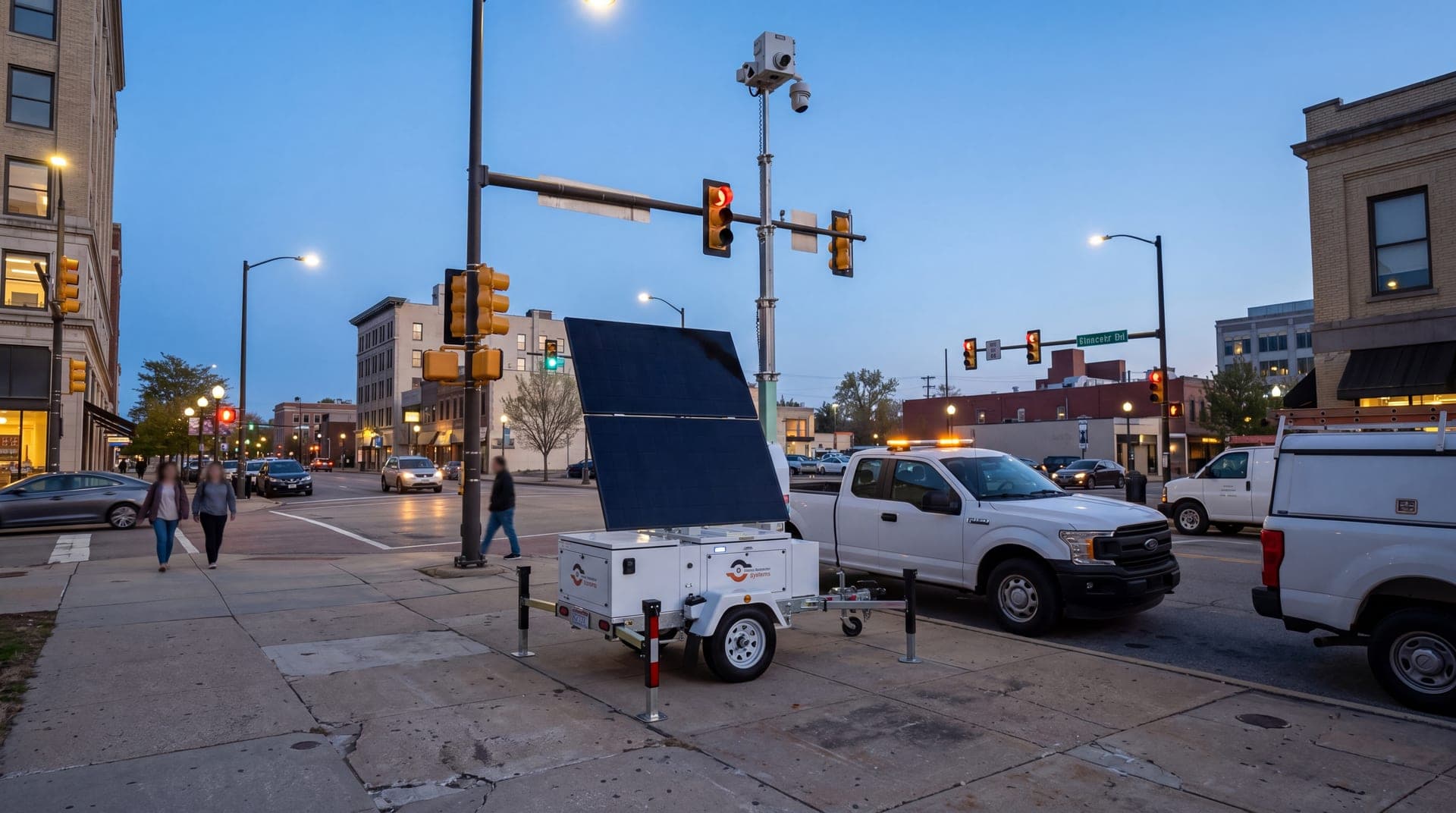
- Mobile surveillance trailers. Self-contained, solar-powered camera trailers with a telescoping mast that can be towed to a hot spot, event, or investigation site and run without site power or network connections.
- License plate recognition (LPR) cameras. Cameras that read and log plates at chokepoints to help locate stolen vehicles and vehicles tied to investigations. See how license plate recognition works.
- AI video analytics. Software that detects people, vehicles, loitering, and other activity in real time, so operators review verified events instead of scrolling through raw footage. Learn more about AI detection.
Body-worn and in-car cameras are also police cameras, but they serve a different purpose—documenting officer interactions. This article focuses on cameras that monitor public places.
7 benefits of surveillance cameras in public places
1. Deterrence of opportunistic crime
Most property crime, vandalism, and vehicle crime is opportunistic: offenders weigh the chance of being seen. A visible camera—especially a tall, lit mast with signage—changes that math. Deterrence is strongest against quick, low-planning offenses such as car break-ins, theft from vehicles, and vandalism.
2. Faster, better-informed police response
A monitored camera turns a vague 911 call into a verified incident with a location, description, direction of travel, and number of people involved. Officers arrive knowing what they're walking into, which improves both outcomes and officer safety. With 24/7 remote video monitoring, operators can confirm activity and relay details to dispatch while the incident is still unfolding.
3. Video evidence for investigations and prosecutions
Footage identifies suspects, confirms or disproves witness accounts, establishes timelines, and supports charging decisions. Evidence quality depends on camera placement, resolution, time-stamping, and chain of custody—see our guide to using security camera footage as evidence.
4. Safer large events and crowds
Parades, festivals, concerts, and sporting events concentrate people into temporary footprints with limited sightlines. Cameras give command posts a live view of entrances, crowd density, and vehicle access points, and they can be removed when the event ends. Our event surveillance playbook covers placement for temporary venues.
5. A force multiplier for limited staff
Many departments are operating below authorized staffing levels. Cameras don't replace officers, but one monitoring operator can watch many locations at once, focusing patrol time on verified incidents rather than routine drive-bys.
6. Rapid coverage for emerging hot spots
Crime patterns shift. Mobile camera trailers let agencies respond to a spike—a string of break-ins at a park, a problem intersection, illegal dumping—within days, then redeploy when the pattern moves. Read how agencies use mobile surveillance trailers for law enforcement.
7. Community reassurance
Residents and business owners in high-incident areas often request cameras. Visible coverage, paired with transparent policies, can improve perceived safety and encourage people to use public spaces again—which itself adds natural surveillance.
What the research says about public safety cameras
Public safety cameras are not a magic fix, and the research is clear about when they work and when they don't.
The 40-year meta-analysis. A 2019 systematic review in Criminology & Public Policy by Eric Piza, Brandon Welsh, David Farrington, and Amanda Thomas analyzed 76 studies spanning 1978–2017. Key findings:
- CCTV was associated with roughly a 13% reduction in crime in target areas compared with control areas.
- Parking lots saw the largest effect—about a 37% reduction—and residential areas saw about 12%.
- Actively monitored systems were associated with about a 15% reduction; passive (recording-only) systems showed no significant effect.
- Programs that combined cameras with multiple other interventions (such as improved lighting, signage, or patrols) were associated with about a 34% reduction.
The Urban Institute study. A 2011 Urban Institute evaluation of public camera programs in Baltimore, Chicago, and Washington, D.C. found:
- Where cameras were concentrated and routinely monitored by trained staff, the impact on crime was significant.
- In Baltimore, the analysis estimated about $1.50 in savings (victimization and criminal justice costs) for every $1 spent on cameras.
- There was no evidence of crime displacement to surrounding areas.
- In Washington, D.C., where cameras were not actively monitored under a restrictive policy, no significant crime reduction was found.
What this means in practice: the camera itself is only the starting point. The results come from active monitoring, a defined response workflow, and cameras working alongside other safety measures.
Where public safety cameras work best
| Setting | Why cameras help | Best-fit camera approach |
|---|---|---|
| Parking lots and garages | Vehicle crime is fast and opportunistic; research shows the strongest effect here | Monitored cameras with lighting + LPR at entrances—see parking |
| Parks and recreation areas | After-hours vandalism, dumping, and loitering | Mobile trailer with loitering detection—see parks & recreation |
| Downtown and entertainment districts | High foot traffic, nightlife incidents | Fixed network plus mobile units for weekend or seasonal peaks |
| Transit stations and corridors | Crowding, fare-area incidents, copper and equipment theft | Fixed cameras at platforms; trailers for yards—see rail & transit |
| Special events | Temporary footprint, crowd management, vehicle access | Mobile trailers deployed before load-in—see events |
| Emerging crime hot spots | Patterns shift faster than fixed installs | Mobile trailers redeployed as data changes |
Fixed cameras vs. mobile surveillance trailers
Most agencies end up using both. The question is which fits each problem.
Fixed camera networks make sense for permanent, high-traffic locations—a downtown core, a transit hub, a major intersection. They require poles, power, network connectivity, permitting, and often months of procurement and installation.
Mobile surveillance trailers fit problems that are temporary, shifting, or located where infrastructure doesn't exist. A trailer arrives self-contained with cameras, a raised mast, solar power, and cellular connectivity, sets up in minutes, and can be moved to the next hot spot when the pattern changes. That flexibility also supports the research finding that cameras work best when targeted at specific problem places rather than spread thin.
For a deeper comparison, see remote surveillance trailers vs. fixed cameras.
Privacy, civil liberties, and the law
Public trust is what keeps a camera program funded and effective. Agencies that ignore privacy concerns often lose community support—and sometimes the program itself.
The legal baseline. Under the Fourth Amendment, courts have long held that what a person knowingly exposes to the public generally isn't protected by a reasonable expectation of privacy. Recording people in public places is therefore typically not considered a "search."
The limits are growing. In Carpenter v. United States (2018), the Supreme Court held that police generally need a warrant to access long-term cell phone location records, because aggregated location data reveals intimate details of a person's life. Applying that reasoning, the full Fourth Circuit held in Leaders of a Beautiful Struggle v. Baltimore Police Department (2021) that warrantless access to data from Baltimore's citywide aerial surveillance program violated the Fourth Amendment, because it allowed police to track people's movements over time. State and local laws may also regulate facial recognition, license plate reader data retention, and data sharing.
This section is general information, not legal advice. Agencies should consult their legal counsel and applicable state and local law.
Best practices that build trust:
- Publish a written use policy covering purposes, locations, who can access video, and prohibited uses.
- Set and follow retention limits. Keep footage long enough to support investigations, then delete it on schedule. See how long security cameras should keep footage.
- Log and audit access so every export and viewing is traceable.
- Use visible signage where appropriate; transparency also improves deterrence.
- Engage the community before deployment in residential areas, and report results.
- Secure the system. Encrypted transmission and hardened devices protect footage from tampering and unauthorized access—see our cybersecurity approach.
How to build a public safety camera program that works
- Start with the problem, not the camera. Use incident data to identify specific places and crime types—a parking area with repeated break-ins, a park with after-hours vandalism.
- Define success up front. Choose measurable outcomes (calls for service, reported incidents, arrests, case clearance) and a before/after comparison period.
- Plan for active monitoring. Decide who watches, when, and how verified incidents reach dispatch. Recording-only deployments consistently underperform.
- Reduce noise with analytics. AI detection filters out wind, animals, and headlights so operators respond to real events—see how to reduce false alarms in video analytics.
- Pair cameras with other measures. Lighting, signage, and targeted patrols multiply the effect.
- Plan evidence handling. Set export procedures, time-stamping, and chain-of-custody standards before the first incident.
- Review and redeploy. Check results every 30–90 days and move mobile units when patterns shift.
NDAA compliance and grant funding
Many public safety camera programs are funded with federal grants. Section 889 of the National Defense Authorization Act prohibits federal funds from being used on covered telecommunications and video surveillance equipment from Hikvision, Dahua, Huawei, ZTE, and Hytera and their affiliates. Using non-compliant equipment can jeopardize grant eligibility.
Before purchasing, ask vendors for written documentation of NDAA Section 889 compliance covering cameras, recorders, and communications components. Learn more about VDS NDAA compliance.
How VDS supports public safety agencies
Vision Detection Systems builds mobile surveillance programs around the factors the research shows matter most:
- Active monitoring: a 24/7 US-based security operations center verifies incidents and escalates through live talk-down and police dispatch.
- Targeted, movable coverage: solar-powered trailers with a 5MP PTZ and three 8MP wide-angle cameras on a 22 ft telescopic mast (30 ft available), connected over 4G/5G cellular—no site power, trenching, or network hookups—that relocate as hot spots shift.
- Evidence-ready video: time-stamped footage with managed retention and export workflows.
- Compliance: NDAA Section 889 compliant hardware and cyber-hardened transmission.
Most deployments go from signed quote to live monitoring in about a week, with on-site setup in under 20 minutes. Explore VDS solutions for public safety agencies, or request a deployment plan for a specific location.
Sources
- Piza, E. L., Welsh, B. C., Farrington, D. P., & Thomas, A. L. (2019). CCTV surveillance for crime prevention: A 40-year systematic review with meta-analysis. Criminology & Public Policy, 18(1). onlinelibrary.wiley.com
- La Vigne, N. G., Lowry, S. S., Markman, J. A., & Dwyer, A. M. (2011). Evaluating the Use of Public Surveillance Cameras for Crime Control and Prevention. Urban Institute. urban.org
- Carpenter v. United States, 585 U.S. 296 (2018).
- Leaders of a Beautiful Struggle v. Baltimore Police Department, No. 20-1495 (4th Cir. 2021) (en banc). ca4.uscourts.gov