
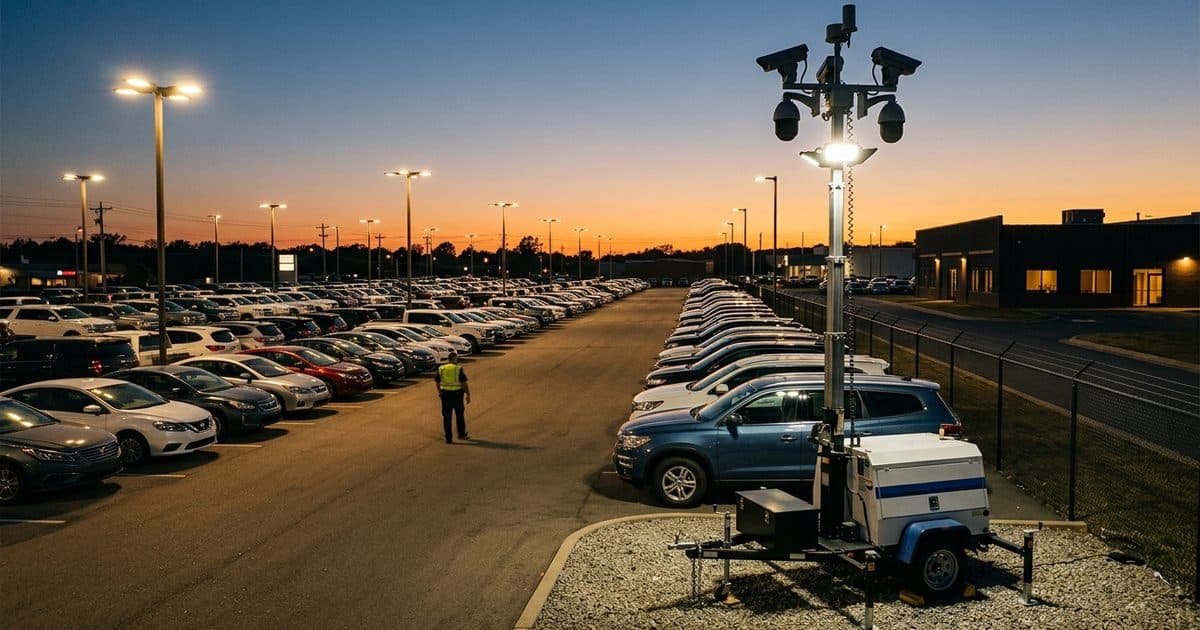
How these thefts happen
Wheel and tire theft is a speed game. A crew arrives with a vehicle and basic equipment, picks a target vehicle in a row they have already scouted, and removes the wheels or other parts. They are looking for rows that sit away from the showroom, away from streetlights, and away from neighbors who might notice noise.
New vehicles with factory wheels, trucks with large tires, and performance models are common targets because the parts are valuable and easy to resell. Catalytic converters are another part that follows the same pattern, covered in our guide to catalytic converter theft prevention. The same weak points that allow one kind of parts theft often allow the others.
Where the weak points are
Before buying equipment, walk the lot at night and look at it the way a thief would. The usual weak points are consistent from lot to lot.
| Weak point | Why it matters | Practical fix |
|---|---|---|
| Back rows and fence lines | Far from staff and traffic | Camera coverage aimed at the rear, added lighting |
| Dark gaps between light poles | Shadows hide activity | Even lighting, replace failed fixtures |
| Vehicles parked beside vacant lots | Easy approach and exit | Move high-value inventory inward when possible |
| Open or unmonitored exits | Quick getaway | Gates or barriers, cameras on every exit |
| Service and storage areas | Spare parts and tire stock | Locked storage, interior and exterior coverage |
Lot design that makes theft harder
Some changes cost little and still make a difference.
- Park high-value or at-risk inventory in rows closest to the showroom and best-lit areas
- Keep rows straight and aisles clear so a camera can see down each one
- Maintain fixtures so no light stays out for weeks
- Trim vegetation and remove stacked pallets or parked equipment that blocks sightlines
- Use wheel locks or other deterrents on vehicles that stay in vulnerable rows, where it makes sense for your inventory
- Secure tire stock and spare parts in locked storage with its own camera view
These measures do not end theft, but they raise the effort and the risk for anyone who tries. For more on layout and coverage on car lots generally, see our overview of car dealership security cameras.
Camera coverage that works for rows of vehicles
The right camera layout depends on how the rows run. Long straight rows are best watched from a position where the camera looks down the row rather than across it, since that keeps more vehicles in the frame. Wide-angle cameras keep continuous coverage, while a PTZ camera can zoom in on a suspicious vehicle or person and follow them.
Mounting height is a trade-off. Higher mounting widens the view and reduces blind spots between vehicles, but it reduces facial detail. A lot with a long back row often benefits from a tall mast that sees over the vehicles. Our security camera field of view guide explains how to plan coverage so rows are not left in the gaps.
Night performance matters as much as day performance. Infrared illumination lets cameras see in low light, but it works best with some ambient lighting and clean lenses.
Why live monitoring changes the outcome
Wheel theft often takes only a short time. If nobody sees the activity until morning, the crew is long gone. If a monitoring team sees it as it happens, they can intervene.
Research on CCTV across many studies found that actively monitored systems were associated with a larger reduction in crime than passive, recording-only systems. For dealerships, the practical meaning is simple. A camera that someone is watching can trigger a loudspeaker warning and a police call while the crew is still in the row. Read more about how that works in our piece on live talk-down audio deterrence.
Analytics help the monitoring team by flagging people and vehicles in the lot after hours, so they are not scanning blank video all night. The cameras and analytics do the watching so people, yours or your security partner's, handle verified incidents. Our page on remote monitoring describes the model in more detail.
What to do after a theft
Even with good controls, a loss can happen. A short response routine keeps the evidence usable.
- Call police and report the incident with a time window.
- Save the original video files and note which cameras covered the area.
- Photograph the vehicle and the surrounding row before anything is moved.
- Check nearby vehicles and rows for similar damage.
- Notify your insurer and follow its documentation requirements.
- Review whether lighting, camera positions or exits need adjustment.
Rules about retention and sharing footage vary by state, so confirm your approach with counsel.
Covering lots that have no infrastructure
Many dealership lots are hard to wire. A satellite lot, a leased overflow lot, or a new storage area may have no power run to the back rows and no network at all. A mobile surveillance trailer can be placed in the exact spot that needs coverage, which is often the far corner where the problem started. The same approach works for any dealership with inventory spread across several areas.
Working with insurers and police
Wheel and parts theft is often reported to both police and the dealership's insurer, so clear records save time. Keep a simple incident log with the date, the rows affected, the parts taken and the camera views that covered the area. Photographs of the vehicle before and after the theft help document the loss.
Police are more likely to act on a report that includes clear timing and a description of the vehicles involved. If your cameras capture a vehicle or plate near the scene, include that in the report. Patterns across several thefts, such as the same night of the week or the same row, can help investigators connect incidents. Keep original footage in a safe place, since it may be requested later. Requirements for retaining and sharing footage vary by state, so confirm them with counsel.
How VDS fits
VDS builds solar-powered mobile surveillance trailers. Each carries a 5MP PTZ camera with 25x optical zoom and three 8MP wide-angle cameras on a 22 ft telescopic mast, with 30 ft available. A 900W bifacial solar array charges an 11.8 kWh LiFePO4 battery bank with reserve for 3-5 consecutive cloudy days, and dual-SIM 4G/5G cellular means no site power, internet or trenching is needed.
AI detection covers people, vehicles, loitering, objects and license plates. A 24/7 US-based security operations center verifies events, responds with live talk-down through a loudspeaker, then dispatches police with video. The hardware is NDAA Section 889 compliant. Most deployments go from signed quote to live monitoring in about a week, and on-site setup takes one person under 20 minutes. Rental, month-to-month and term subscriptions are available. See the mobile surveillance unit or talk to our team.