
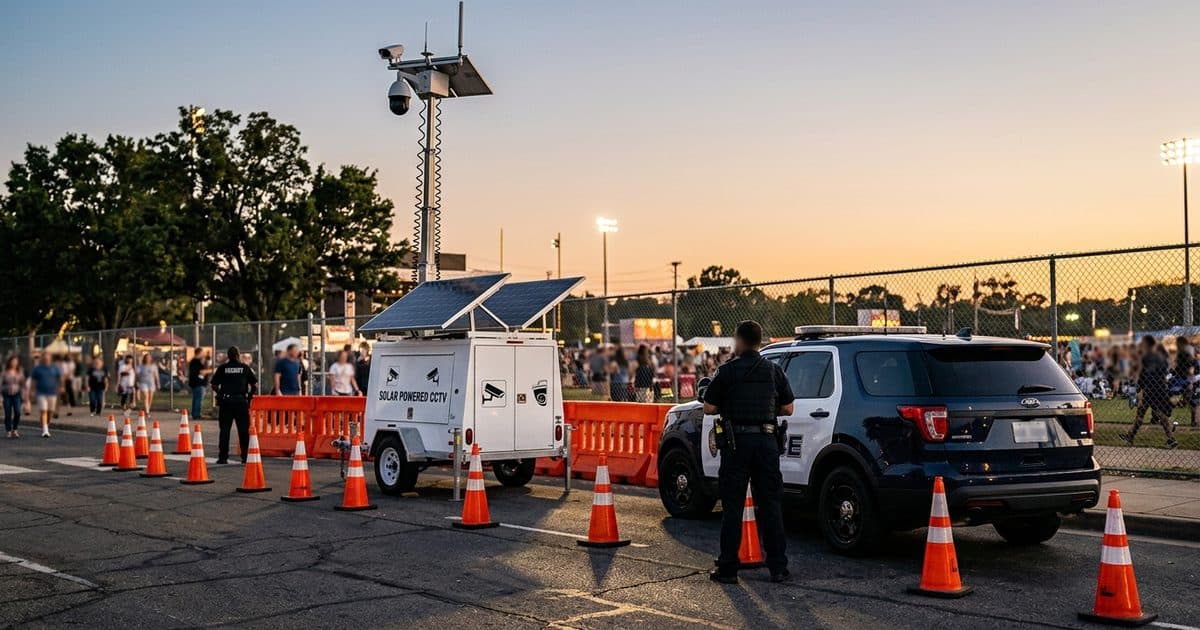
Why Law Enforcement Agencies Are Deploying Mobile Surveillance Trailers
The applications are broader than most agencies initially consider. The four most common use cases:
High-Crime-Zone Deterrence
Visible surveillance changes behavior. The research behind this is consistent enough that the International Association of Chiefs of Police has addressed surveillance technology as a documented deterrence tool in community policing frameworks. When a trailer with a raised tower and active lighting is positioned at a known problem location—a transit hub, a parking structure, a commercial strip—offenders notice it. Agencies that have deployed trailers in targeted zones have documented reductions in reported incidents during deployment periods. The deterrence effect is real, and it is one of the primary reasons mobile units outperform fixed cameras in hotspot programs: you can move them as the problem moves.
Event Coverage
Concerts, parades, protests, and sporting events all create the same operational challenge: concentrated crowds, limited sight lines, and a command team that needs real-time awareness across a large footprint. Mobile surveillance trailers can be pre-positioned at entry points, perimeter edges, or high-density areas before an event begins. With remote access through cellular connectivity, command staff can monitor feeds from a vehicle or operations center without requiring a dedicated officer at each unit.
Investigation Support
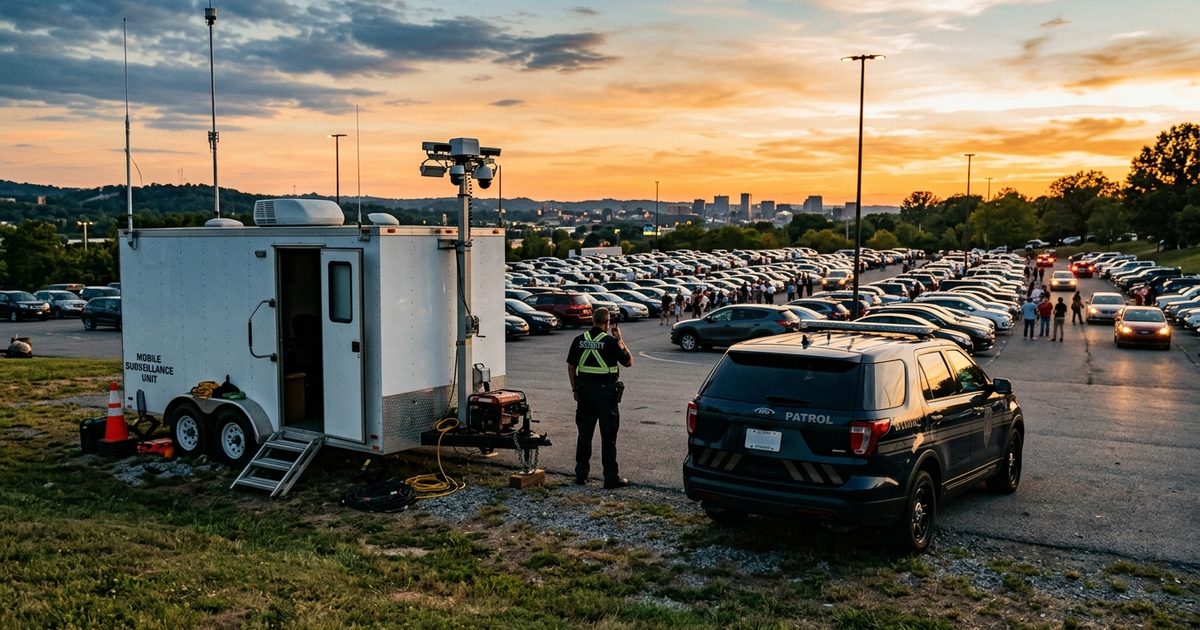
Parking lots connected to known drug corridors, transit hubs with recurring theft patterns, and commercial areas under active investigation all benefit from passive, continuous recording at high resolution. A trailer positioned correctly captures vehicle traffic, foot patterns, and individual-level footage without alerting subjects the way a marked unit would. Combined with license plate recognition, the evidentiary value compounds quickly.
Rapid Post-Incident Deployment
After a shooting, a carjacking pattern, or a major theft event, agencies need visible presence and intelligence capability quickly. A mobile trailer can be repositioned within hours, providing both deterrence signal and continuous recording at the affected location while investigations develop.
What a Law Enforcement Mobile Surveillance Trailer Includes
Not all trailers are configured the same way. Understanding the component set helps agencies evaluate what they are actually getting. A law enforcement mobile surveillance trailer built for operational deployment typically includes:
- PTZ cameras (pan-tilt-zoom): Operator-controlled cameras that can track movement, zoom to specific subjects, and cover wide areas from a single mount. Essential for active monitoring scenarios.
- Fixed wide-angle cameras: Passive, continuous recording across the full perimeter. These run 24/7 and are not operator-dependent—the foundation of evidence capture.
- License plate recognition (LPR): Vehicle identification at intersections, entry and exit points, or along monitored corridors. LPR data creates searchable vehicle records that support investigations far beyond what standard video review provides.
- High-mast telescoping tower: Typically 20 to 30 feet. Placing cameras above visual obstructions—parked vehicles, fencing, crowds—is what makes wide-area coverage practical in real environments.
- Solar power with battery backup: Self-sufficient power means no dependence on external hookups. Trailers can be deployed in locations where grid power is unavailable or impractical.
- 4G/LTE/FirstNet connectivity: Cellular connectivity enables remote access for dispatch and command center monitoring. FirstNet is the preferred standard for law enforcement—it provides priority bandwidth on a network built specifically for public safety communications.
- LED lighting: Active lighting extends usable camera coverage into low-light environments and adds deterrence value after dark. Most incidents happen at night.
- PA speaker: Some configurations include public address capability for verbal warnings or crowd direction. Useful for event deployments and deterrence applications.
For agencies running vehicle-centric investigations, the LPR capability integrated into mobile units is worth specific evaluation. Hotlist matching, time-stamped reads, and exportable vehicle records can feed directly into investigations in ways that standard video review cannot replicate efficiently.
NDAA Compliance: A Non-Negotiable for Federal Grant Recipients
If your agency is funding equipment through federal grants—JAG, COPS Office technology programs, DHS Homeland Security grants—the hardware must be compliant with the National Defense Authorization Act. NDAA compliance prohibits the use of camera equipment from specific foreign manufacturers flagged as national security risks. This is not a technicality. Non-compliant hardware purchased with federal funds can create grant clawback exposure and departmental liability.
Before any procurement, agencies should request NDAA compliance documentation from the provider in writing. For a detailed breakdown of what compliance means, what manufacturers are affected, and what documentation to request, the NDAA-compliant security cameras buyer's guide covers the requirements in full. Do not assume compliance—verify it with documentation before a purchase order is issued.
Deployment Considerations Agencies Need to Address
The equipment decision is only part of the evaluation. How a trailer is deployed determines whether it produces operational value or sits underperforming in a problem location.
Placement and Jurisdiction
Trailer placement involves more than choosing a good camera angle. ADA accessibility requirements, traffic sight-line regulations, lighting ordinances, and property easements all affect where a unit can legally be positioned. Agencies should confirm that their deployment partner understands municipal placement constraints and can advise on compliant positioning that still achieves coverage objectives.
Connectivity: FirstNet vs. Standard Cellular
Standard 4G/LTE works in most environments, but public safety deployments—particularly during major incidents or large events—can encounter network congestion at the worst possible moment. FirstNet, built on AT&T's network with dedicated public safety prioritization, provides a meaningful reliability advantage for law enforcement deployments. Confirm that any provider you evaluate has FirstNet capability and that the trailers are provisioned for it, not just standard cellular.
Evidence Standards and Chain of Custody
Footage captured for investigative or prosecutorial use needs to meet evidentiary standards. That means minimum 1080p resolution, defined retention periods that cover the relevant timeframe before the footage is overwritten, and a documented export process that preserves metadata and maintains chain of custody. Agencies should establish these requirements in writing with their provider before deployment, not after an incident when footage is needed for court.
Relocation Flexibility
One of the primary advantages of mobile units is that they follow the problem. A hotspot that drives deployment in March may not be the priority in May. Confirm with your provider how quickly a unit can be relocated, what the logistics process involves, and whether relocation is included in the service agreement or treated as a separate cost event.
Remote Monitoring and Dispatch Integration
Most agencies do not have the internal staffing to monitor live feeds around the clock. A managed remote video monitoring service with defined escalation protocols is the realistic operational model for most departments. The key questions: Can the monitoring center alert dispatch directly? What are the response thresholds? How are incidents documented? Agencies should review the escalation workflow in detail—a monitoring service without a defined dispatch protocol is recording equipment, not an operational tool.
The Field Deployment Process
Agencies that get consistent results from trailer deployments follow the same five-step process:
1. Define the mission and operational owner. Align on why the trailer is being deployed, what success looks like (reduced incidents, faster response, evidence capture), and who owns the operational workflow — watch commander, detail lead, or event ops.
2. Site walk and constraints check. Confirm safe placement with line-of-sight to priority zones, the power and connectivity approach for the environment, lighting conditions and headlight-glare risk, and any physical obstructions (trees, signage, parked trucks) that will block views.
3. Position for evidence-ready footage. Validate that footage is usable for identification — not just general awareness — that night performance is acceptable for the mission, and that key zones get the right balance of context and detail.
4. Configure monitoring, alerts, and escalation. Define what triggers an alert (time windows, motion zones, loitering patterns), who receives notifications (on-duty supervisor, event ops, dispatch), what the response action is, and what gets recorded and reported. Verified response and documented escalation turn a trailer from "footage later" into "action now."
5. Set up documentation, retrieval, and retention. Document the retention window and export procedure, access controls for viewing and exporting footage, how footage is labeled and stored for investigations, and how timestamps are verified.
Night performance testing
Night is where many deployments fail if testing is skipped: review short night clips from critical angles, check glare and washout from headlights and streetlights, confirm motion doesn't blur identification detail, and confirm priority zones stay visible with passing traffic.
Common mistakes agencies can avoid
- Placing trailers for convenience rather than at chokepoints and approach routes
- Relying on one wide shot that cannot identify people or vehicles
- Skipping night validation and glare testing
- No defined escalation workflow, so footage is only reviewed after the fact
- An unclear retrieval/export process that delays evidence when it's needed
- Leaving deployments static even after activity patterns shift
For the research behind hot-spot camera programs, the Fourth Amendment guardrails, and what separates monitored from record-only deployments, read how police security cameras enhance public safety.
Six Questions Agencies Should Ask Before Deployment
- What is the camera resolution and night-vision capability? Minimum 1080p for evidential-quality footage. Confirm how cameras perform in low-light without active illumination.
- What connectivity does the system use, and what is the failover plan? Cellular, FirstNet, or fixed? What happens during an outage—does the unit continue recording locally?
- What is the video retention period, and what are the export procedures? How long is footage retained before overwrite? What does the export and chain of custody documentation process look like?
- Is the hardware NDAA-compliant? Required for federal grant-funded deployments. Request written documentation.
- What monitoring options are available, and is there a 24/7 dispatch escalation workflow? Self-monitored or managed? What does escalation to dispatch look like in practice?
- What is the deployment and relocation process? How quickly can a unit be repositioned? What does that process cost and require logistically?
Vision Detection Systems supports law enforcement and public safety deployments nationally, with NDAA-compliant hardware, FirstNet-capable connectivity, remote video monitoring with defined escalation protocols, and video retrieval support for evidence export. If your agency is evaluating mobile surveillance technology for deterrence programs, event coverage, or investigation support, contact our team to discuss deployment options and coverage planning for your jurisdiction.