
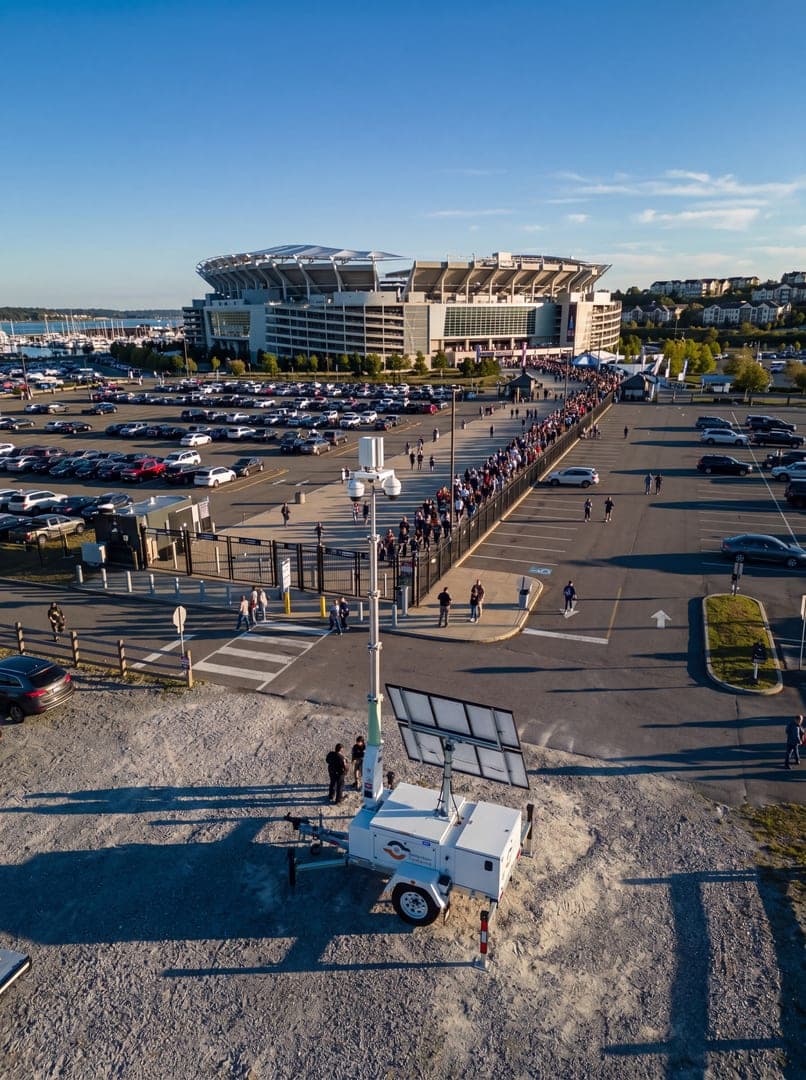
This guide covers the planning, positioning, and operational considerations for event surveillance deployments.
Why Events Need Different Security Thinking
Event security differs from construction site or facility security in important ways that affect how surveillance should be planned:
Crowd dynamics create new risk patterns. In construction security, you're looking for people who shouldn't be there. In event security, you're looking for specific behaviors and incidents among thousands of legitimate attendees. This changes detection priorities, alert thresholds, and what operators are looking for.
Multiple simultaneous high-risk zones. A typical outdoor event has many concurrent priority areas: entry and exit gates, cash handling locations, main stages, medical stations, VIP areas, and perimeter segments. Coverage needs to reach all of them simultaneously.
Setup and breakdown are high-risk periods. The hours before and after an event—when equipment is staged, cash is being counted, and fewer security personnel are present—often represent higher theft and security risk than the event itself.
Rapid deployment and repositioning requirements. Event venues often have limited advance access for setup. Surveillance systems need to be deployed quickly and be fully operational before crowds arrive.
Mobile surveillance trailers handle all of these requirements effectively because they combine rapid deployment, self-contained power, and professional remote monitoring into a single integrated system.
Planning Your Event Coverage: Key Zones
Effective event surveillance starts with mapping your priority zones before determining equipment placement. For most outdoor events, these zones fall into five categories:
Entry and exit control points are mandatory camera locations. Every ticket gate, access lane, and wristband check area requires camera coverage to document crowd flow, identify incidents, and maintain evidence for any entry-point disputes or incidents.
Cash and revenue handling areas have concentrated asset risk at specific, predictable moments (between acts, at intermissions, at breakdown). Camera coverage of box offices, merchandise booths, and bar service areas requires specific positioning for both deterrence and documentation.
Main performance areas and stages have the highest crowd density and the highest likelihood of crowd-related incidents, medical emergencies, and security interventions. Overview cameras with PTZ capability allow operators to monitor crowd density and identify developing situations.
Perimeter boundaries at event venues are often permeable—temporary fencing, parking area edges, and adjacent property lines. Perimeter coverage reduces both unauthorized entry and the post-event theft of equipment and materials.
Back-of-house and support areas including generator facilities, production vehicles, and artist/staff areas have significant asset concentration and limited crowd scrutiny, making them attractive targets during events.
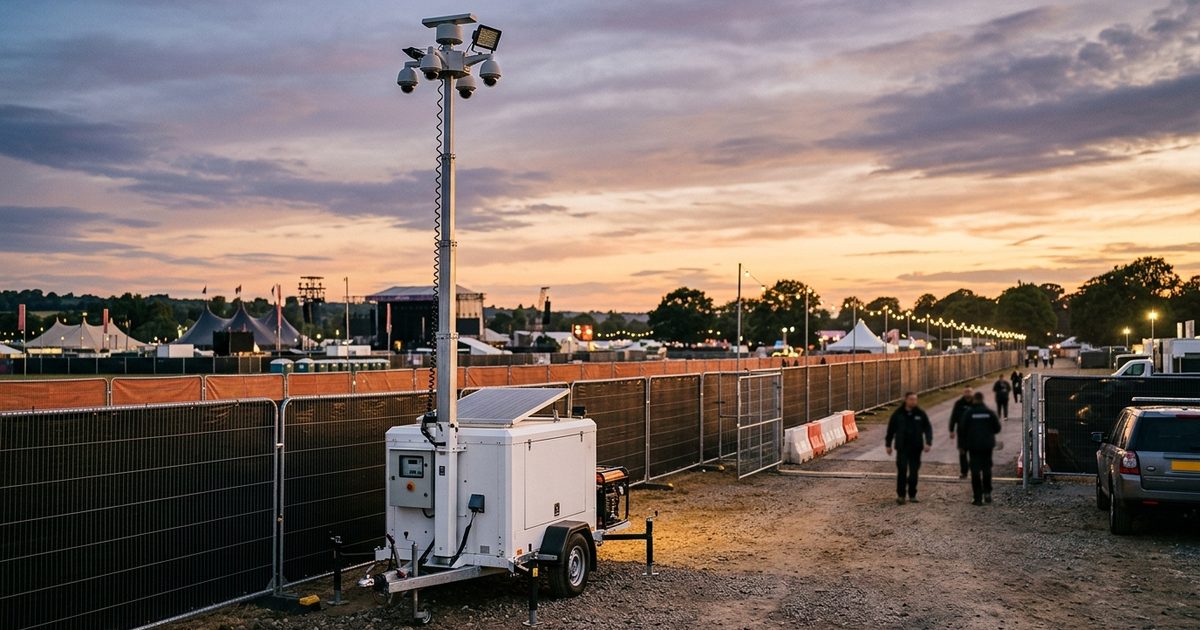
Positioning Mobile Surveillance Trailers for Events
Event venue geometry varies more than construction sites, but the core positioning principles are consistent:
Corner and elevation advantage: Position trailers at the highest available elevation points to maximize camera sightlines over crowd. Corner positioning, as with construction sites, provides coverage along two zones simultaneously.
Entry point saturation: Each primary access point benefits from its own dedicated surveillance trailer or dedicated camera. Attempting to cover multiple entry points from a single distant position compromises footage quality at each.
Separation from crowd traffic: Trailers positioned too close to crowd pathways are vulnerable to accidental damage from passing attendees and may be partially obscured by crowds. Position trailers behind barriers or in areas that provide natural separation from pedestrian flow.
Avoid solar panel obstruction: Event infrastructure—temporary structures, lighting rigs, large tents—can shade solar panels and reduce battery charging. Survey the site for shading risk and position trailers for maximum sky access.
| Event Size | Recommended Trailer Count | Key Positions |
|---|---|---|
| Small (under 2,000 attendees) | 1–2 trailers | Primary entry + main event area |
| Medium (2,000–10,000 attendees) | 3–5 trailers | All entries + main stage + revenue areas |
| Large (10,000–50,000 attendees) | 6–10+ trailers | Full perimeter + all risk zones |
| Major festival | Custom assessment | Multiple units per zone |
The Setup Process: From Delivery to Live
The typical deployment sequence for event surveillance:
Day -7 to -5: Site survey (physical or virtual). Coverage map development. Camera positions confirmed. Equipment reserved and staged.
Day -2 to -1: Trailer delivery and positioning. Camera aiming and field-of-view verification. Communication links established and tested. Monitoring center receives site map and event brief.
Day 0 (Event day): System fully live before any attendees or setup crew arrive. Monitoring center briefed on event-specific alert protocols, event schedule, and priority contacts for ground security team.
Post-event: Monitoring continues through breakdown. Final footage archived. Incident documentation packages prepared if any events occurred.
Tip: The monitoring center pre-brief is a step that many event organizers overlook. Operators who understand the event schedule, know what "normal" looks like at different times, and have direct contact with ground security supervisors respond faster and more accurately than operators working without that context.
Crowd Monitoring and Safety Applications
Beyond security, modern AI video analytics provide crowd management capabilities that have safety implications:
Crowd density heatmaps show real-time distribution of attendee density across the venue. Areas approaching dangerous density (typically above 4–5 people per square meter) are flagged for operator attention and ground team response.
Crowd flow analysis tracks directional movement through entry/exit points and venue pathways, helping event coordinators identify bottlenecks and redirect traffic before dangerous compression develops.
Perimeter breach detection alerts on individuals crossing event boundaries at non-designated points—both unauthorized entry and exit events that may indicate someone leaving without assistance following a medical or safety incident.
Incident detection uses behavior analytics to flag fighting, falls, and crowd surges that match specific movement signatures, helping operators identify medical and security incidents faster than relying on attendee reports alone.
Note: AI crowd monitoring tools are decision-support systems, not autonomous safety management. Human operators and on-site security personnel remain the decision-makers for all interventions. The technology's value is in surfacing potential incidents earlier so human response is faster.
Coordination with Ground Security Teams
Event surveillance delivers maximum value when it's integrated with ground security operations, not running in parallel with them.
Best practices for monitoring-ground coordination:
- Dedicated radio channel connecting monitoring center operators to ground security supervisors
- Pre-event walkthrough with monitoring center operators reviewing camera positions against site map
- Live escort capability where operators can direct ground staff to specific locations in real time via radio
- Incident response protocol defining who has authority to dispatch ground staff based on monitoring alerts
- Post-event review of footage with security leadership to inform planning for future events
The coordination model transforms monitoring from a passive evidence collection system into an active tactical asset for ground security operations.
After the Event: Documentation and Retention
Event footage serves several important functions after the event concludes:
Incident investigation: Any incidents that occurred during the event—theft, assault, medical emergencies, property damage—benefit from complete video documentation with operator logs.
Insurance and liability: Documentation of security measures in place, coupled with incident footage, is critical for liability defense if event-related injuries or incidents result in claims.
Planning improvement: After-action video review identifies coverage gaps, crowd flow problems, and operational patterns that inform better planning for future events.
Law enforcement cooperation: For incidents resulting in criminal investigation, chain-of-custody video documentation from a professional monitoring service carries significant evidential weight.
Talk to the VDS team for your upcoming event. Our team handles coverage planning, deployment logistics, and monitoring operations for events of all sizes.