
Start with why people are on the property
Trespassers are not one group. Some are cutting through, some are sleeping in a sheltered spot, some are teenagers looking for somewhere to gather, and some are scouting or stealing. Each calls for a slightly different mix of measures. Walk the site at the hours when problems occur and note where people enter, where they linger and what they touch. Past incident reports, complaints from neighbors and the pattern of damage tell you more than a general checklist will.
Also decide what you are protecting. A fenced yard with equipment, a retail lot with a closed building, a vacant building and a loading dock each have different entry points and different consequences if someone gets in.
Define the boundary
A boundary that is obvious is easier to enforce, because nobody can claim they did not know where the property began. Fencing, bollards, planters, gates and cable barriers all do this job at different strengths. Fencing slows a person down and signals that the area is private. It rarely stops a determined one, so treat it as a delay that buys time for the other layers.
Check the edges that get ignored. Gaps at the end of a fence run, drainage cuts, loose panels, overgrown sections and shared property lines are common points of entry. Remove climbing aids such as stacked pallets, dumpsters and parked vehicles near the fence line.
Post signs that are specific
Signs help in three ways. They tell honest visitors where not to go, they establish that entry was a choice, and they can support enforcement later. Place them at every entrance and at regular intervals along the boundary, at a height and size that can be read from where a person would stand. Say what is happening on site, for example that the area is under video surveillance, only if it is true. Requirements for wording and placement vary by state and by city, so confirm with counsel before you rely on a sign for enforcement. Our overview of business security camera laws is a useful starting point for the video side.
Fix lighting and sight lines
Darkness is the easiest condition to remove. Light the entrances, the building edges and the paths people would use to approach. Aim for even coverage without deep shadows, because bright spots next to dark ones make it harder to see. Make sure lights are protected from tampering and that someone is responsible for replacing failed fixtures.
Sight lines matter as much as light. Trim vegetation that hides the fence, move stacked material that creates hiding places, and avoid parking large vehicles where they block the view from the street. People are less likely to enter a place where they can be seen from outside.
Control who can come in
Access control is the layer that turns a boundary into a decision point. For vehicles, that usually means gates, with a clear procedure for who opens them and when. For buildings, it means locked doors, key control and a way to remove access when someone leaves. Keep a record of who has keys, codes and credentials.
For after-hours and low-traffic periods, decide in advance what normal looks like. A delivery at midnight, a contractor on a weekend and a cleaning crew should all be known to whoever is watching the site. Surprises are easier to spot when the exceptions are written down.
Use cameras that someone is watching
Cameras are most useful when they are positioned to see the approach and the entry points, and when they are connected to a person who can act. A 2019 systematic review of 76 studies found that actively monitored camera systems were associated with a reduction in crime of about 15%, while passive systems that only record showed no significant effect. Programs that combined cameras with several other interventions showed larger reductions, about 34%. The lesson for trespass is the same as the lesson of this whole article, which is to combine layers and make sure someone is watching. See our article on whether security cameras deter crime for more detail.
Detection can help the people doing the watching. Software that picks out people and vehicles in a defined zone, or flags loitering, reduces the amount of footage a person has to look at. For longer fence lines, it is worth reading about perimeter intrusion detection systems and what each type of sensor does well.
Challenge early, then escalate
The best moment to stop a trespasser is before they have done anything. A recorded or live voice message through a loudspeaker, telling a person that they are on camera and need to leave, often ends the encounter without anyone being confronted in person. If the person stays or the situation looks dangerous, the next step is a call to police with a clear description and live video.
Write down the escalation path. Who is called first, what the person watching the cameras can say, when police are called and what information they will want. Staff and security partners should not be improvising this at three in the morning.
Work with police and document everything
Introduce yourself to the local department before there is an emergency. Ask what authorization or paperwork it needs from property owners so officers can act on trespass at your site, and whether there is a process for enrolling the property. These procedures vary by jurisdiction.
Keep a running log with dates, times, locations, descriptions and the video clip for each incident. Footage that is labeled and easy to export is much more useful than hours of unsorted recording. Our guide to security camera footage as evidence covers how to preserve and hand over video.
Quick reference
| Layer | What it does | Common gap |
|---|---|---|
| Fencing and barriers | Defines the boundary and slows entry | Gaps, climbing aids, shared lines |
| Signage | Sets expectations and supports enforcement | Hard to see, missing at side entrances |
| Lighting | Removes cover and improves video | Failed fixtures, deep shadows |
| Access control | Controls vehicles and doors | Unrecorded keys and codes |
| Monitored cameras | Detect and interrupt in real time | Recording with nobody watching |
| Police coordination | Makes enforcement possible | No paperwork, no incident log |
Where VDS fits
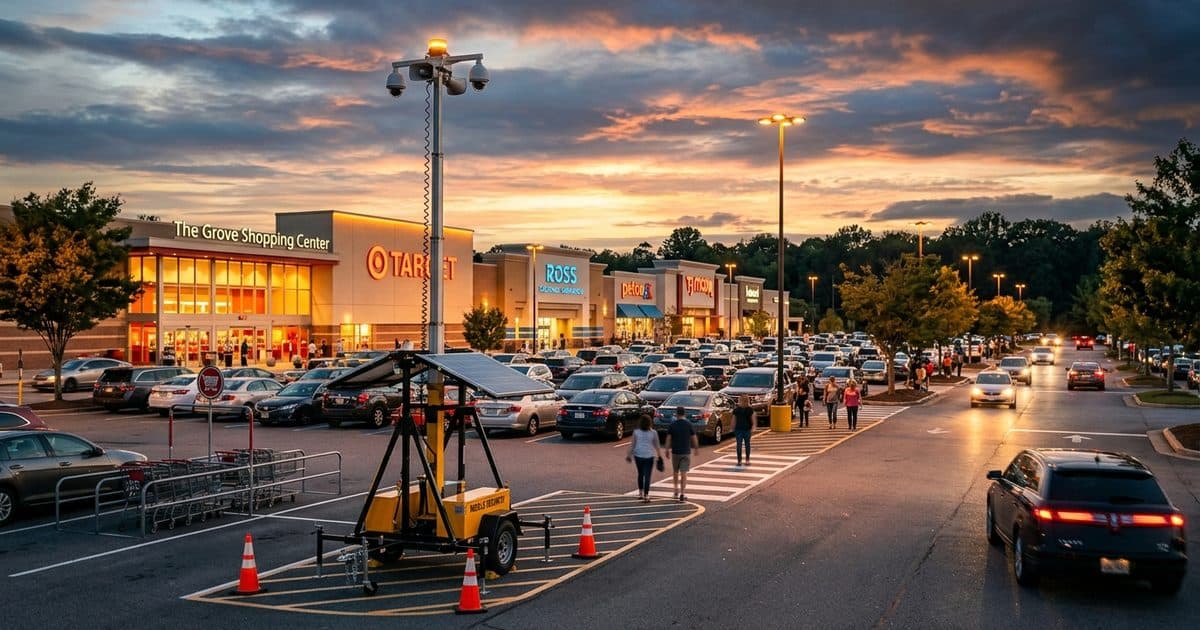
Many properties that suffer trespassing have no power or network at the fence line, or are only occupied part of the day. A VDS mobile surveillance unit is a solar-powered trailer with a 5MP PTZ camera with 25x optical zoom and three 8MP wide-angle cameras on a 22 ft telescopic mast. It needs no site power, internet or trenching, and uses dual-SIM 4G/5G cellular. AI detects people, vehicles and loitering, and a 24/7 US-based security operations center verifies events, speaks through a loudspeaker and sends police dispatch with video when needed. That is remote video monitoring so people, yours or your security partner's, handle verified incidents. Talk to our team about your site.
Sources
- Piza, E. L., Welsh, B. C., Farrington, D. P., & Thomas, A. L. (2019). CCTV surveillance for crime prevention: A 40-year systematic review with meta-analysis. Criminology & Public Policy, 18(1). onlinelibrary.wiley.com