
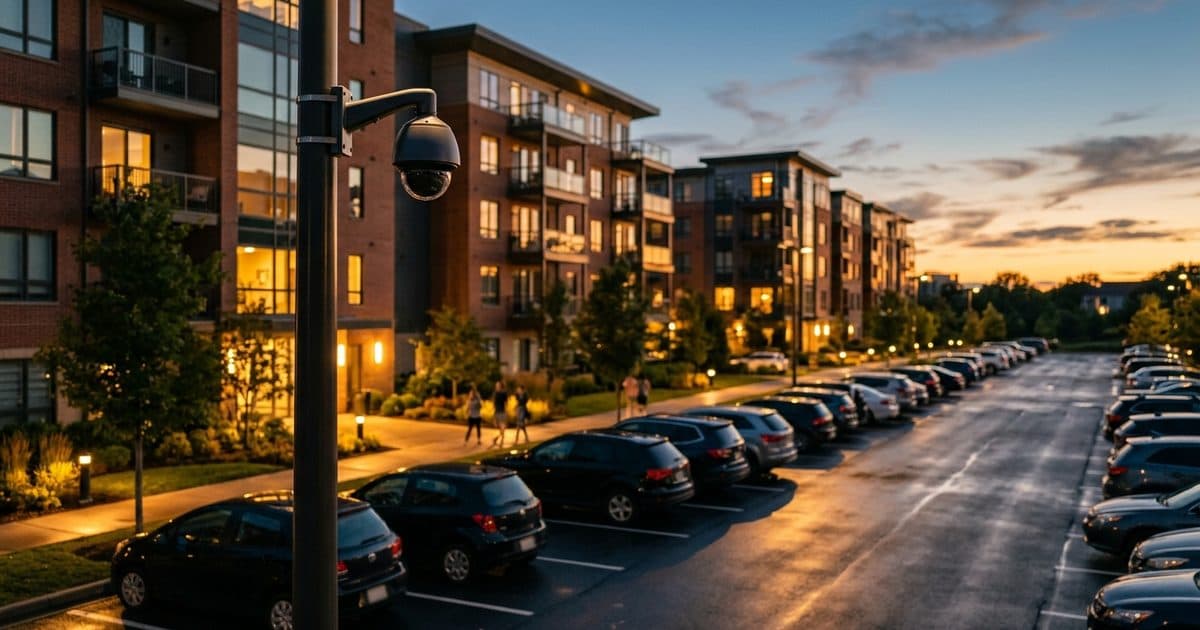
Where crime actually concentrates at apartment complexes
The national picture is improving. The US property crime rate fell to 1,835.1 incidents per 100,000 people in 2024, down about 9% from the prior year, according to the FBI. But national averages say little about where incidents happen on your property, and the geography is remarkably consistent: vehicles, perimeters, and shared spaces carry most of the risk.
Parking lots and garages are the standout. Federal victimization surveys have long indicated that roughly one in ten violent victimizations occurs in a parking lot or garage, and that is before counting the far more common property incidents: car break-ins, catalytic converter theft, stolen vehicles, and vandalism. Perimeter zones follow close behind: dumpster corrals, pool gates after hours, bike storage, and dimly lit walkways between buildings.
Deterrence research supports putting visible coverage exactly there. In a 2013 University of North Carolina at Charlotte study that interviewed 422 incarcerated burglars, about 60% said they would seek a different target if they discovered an alarm or camera on site (UNC Charlotte via ScienceDaily). The study is older and focused on burglary, but it remains one of the few data points drawn from offenders themselves, and its lesson holds: visible, working security changes target selection.
Parking lot coverage: the highest-leverage camera investment
Most apartment communities under-camera the areas where most incidents occur. A leasing office may have four cameras while 300 parking stalls have none. If budget forces a choice, cover the lot first: it is where residents' most valuable property sits overnight and where after-hours activity is hardest for staff to observe. Our guide to 24/7 parking lot surveillance covers monitoring workflows in depth; the placement priorities below apply to almost any multifamily property.
| Coverage zone | Typical incidents | What works |
|---|---|---|
| Entrances and exits | Stolen vehicles, unauthorized entry | Angles that capture plates and faces at choke points |
| Drive lanes and stall rows | Break-ins, catalytic converter theft | Elevated wide-area views with night-capable cameras |
| Far corners and carports | Loitering, dumping, vandalism | Mobile surveillance units where power and conduit do not reach |
| Perimeter and fence lines | Cut fences, cut-through traffic | Overlapping views plus motion analytics tuned to people and vehicles |
Garages versus open lots
Structured garages favor fixed cameras: entries and exits are natural choke points, power is available, and lighting is controlled. Open lots are harder. Fixed poles require trenching for power and data, sightlines shift as trees mature and vehicles park, and the far corners that attract trouble are usually the farthest from any conduit run.
That is where a solar-powered mobile surveillance unit earns its place: it covers wide areas from a mast-mounted vantage point without construction, and it can relocate as problem spots shift or as a repaving or renovation project changes the lot. Budget planning for both approaches, including what drives the totals, is covered in our parking lot security camera cost guide.
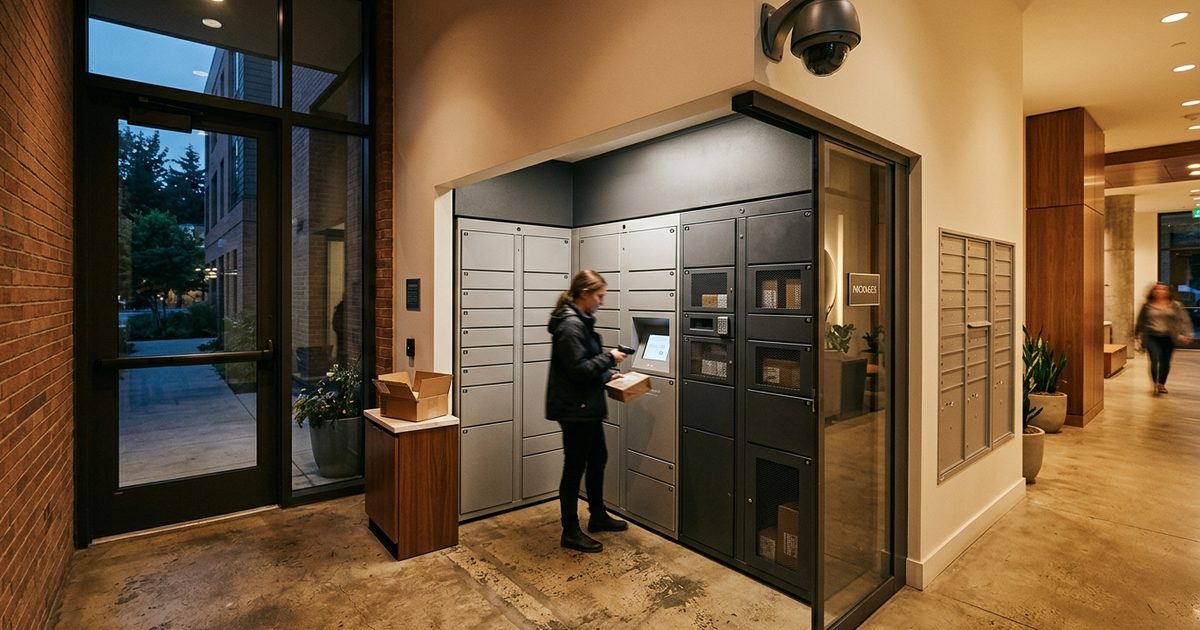
How to stop package theft: mailrooms, lobbies, and monitored lots
Package theft hits multifamily properties harder than almost any other housing type. In an annual consumer-research firm survey, Security.org found apartment residents are 34.1% more likely than the average American to have a package stolen, and more than 35% of Americans reported a package theft in the past year. For property managers, that translates into resident complaints, disputes with carriers, and a grievance that shows up in reviews and non-renewals.
Indoor cameras over mailrooms, parcel rooms, and lobby drop zones are the documentation layer. Position them to capture faces at entry points and hands at shelves, keep recordings long enough to cover delayed discovery, since residents often report thefts days later, and pair cameras with access control so parcel room entries are logged.
The lot is the prevention layer. Many package thieves follow delivery vehicles into a property, sweep breezeways and doorsteps, and leave within minutes. Monitored lot and entrance cameras catch that pattern at the gate rather than at the shelf: a live operator can issue an audio warning while the person is still in their vehicle, before packages disappear. Signage at entrances stating that the property is under live video monitoring reinforces the deterrent.
Layer in package lockers or a staffed pickup window where delivery volume justifies it. Cameras do not replace those systems; they make every layer auditable.
Premises liability: the exposure cameras help manage
Negligent security claims are among the costliest risks a multifamily operator faces. In most states, owners owe residents and guests reasonable care against foreseeable criminal acts, and foreseeability is often argued from prior incidents on or near the property. A history of car break-ins in your lot can become evidence that worse was foreseeable, and plaintiffs' counsel will ask what the property did about it.
Working cameras help on both sides of that equation. They deter some incidents outright, and they document that management took visible, reasonable steps. They also produce the evidence that resolves disputes: footage frequently clarifies what happened in slip-and-fall claims, vehicle damage disagreements, and alleged assaults.
Two cautions. First, broken or dummy cameras can be worse than none. Plaintiffs argue they created a false sense of security, and jurors respond badly to photos of cameras that turn out to be props. If you install cameras, maintain them and verify they record. Second, set a written retention policy and follow it consistently: footage deleted off-schedule after an incident invites spoliation claims. None of this is legal advice; review your camera plan with counsel and your insurer.
The 2026 insurance squeeze: security as a cost-control lever
Insurance is the pressure that has moved security from a nice-to-have to a line-item strategy. Multifamily insurance costs rose 10.8% year over year to $777 per unit, on top of a roughly 25% jump in 2023, and 67% of operators raised deductibles to cope, according to the National Apartment Association. Higher deductibles change the math: more vandalism, theft, and property damage now comes straight out of the operating budget before coverage ever applies.
That makes prevention a direct P&L play. Every deterred break-in or interrupted vandalism spree is a deductible not spent and a claim not filed, and claims history feeds future premiums. Documented security measures, incident logs, and verified-response records also give your broker something concrete to present at renewal. Carriers differ in how they credit surveillance programs, so ask your broker what documentation matters for your specific coverage rather than assuming a discount. Either way, a property that can show fewer incidents and a working response process negotiates from a stronger position than one that can only show a loss run.
Courtesy officers and patrol partners: cameras as a force multiplier
Cameras do not replace people; they direct them. A courtesy officer or contracted patrol cannot watch 400 stalls, six breezeways, and two gates at once, and overnight staffing at most communities is thin. Remote video monitoring closes that gap: trained operators watch camera feeds live during the hours you choose, verify what triggered an alert, and escalate real incidents so people, yours or your security partner's, respond to verified situations instead of chasing noise.
In practice, that means an operator sees someone testing car door handles at 2 a.m., issues an audio talk-down through the camera's speaker, and, if the person persists, dispatches your courtesy officer or patrol partner with a description, a location, and live context. Patrol teams consistently prefer verified dispatches: their officers arrive knowing what they are walking into, and their shift time goes to actual incidents rather than false alarms. The same verification supports police response, because a crime witnessed live and in progress is a different call than an anonymous alarm signal.
Resident privacy: where cameras belong, and where they never do
Apartment surveillance carries an obligation the average commercial lot does not: people live there. The workable rule is simple: cameras cover shared, common areas only. Parking lots, garages, entrances, mailrooms, lobbies, pool decks, and perimeters are appropriate. Cameras must never face into unit windows or doors in a way that captures interiors, and they have no place in restrooms, locker rooms, or any space with a reasonable expectation of privacy.
Put the policy in writing. Disclose camera locations and monitoring practices in the lease or community rules, post signage at entrances, restrict footage access to named roles, and set a standard retention window. Communities that get this right find residents overwhelmingly welcome coverage of lots and package areas; it is opacity, not the cameras, that generates complaints. Boards and associations face a similar governance challenge, which we cover in our guide to HOA and community security cameras.
A practical rollout plan for property managers
- Map your incidents. Pull 12 months of incident reports, work orders, and resident complaints, and plot where they happened. Lot, package, and perimeter clusters set your camera priorities.
- Cover the lot and entrances first, then package and mail areas, then secondary common areas and amenities.
- Decide who responds. Unmonitored recording documents crime; monitored cameras interrupt it. Define the escalation path from operator to courtesy officer, patrol partner, or police before the first alert.
- Write the privacy policy and disclose it to residents before any camera goes live.
- Document everything for your insurer: equipment, monitoring hours, incident logs, and outcomes, so renewal conversations start from evidence.
Vision Detection Systems builds this model for multifamily operators: solar-powered mobile surveillance units that deploy in parking lots and along perimeters without construction, monitored around the clock by our security operations center, with verified incidents escalated to your on-site team or your security partner. For properties where crime concentrates outdoors and overnight staffing is thin, it is a practical way to put trained eyes on the ground you cannot otherwise watch.