
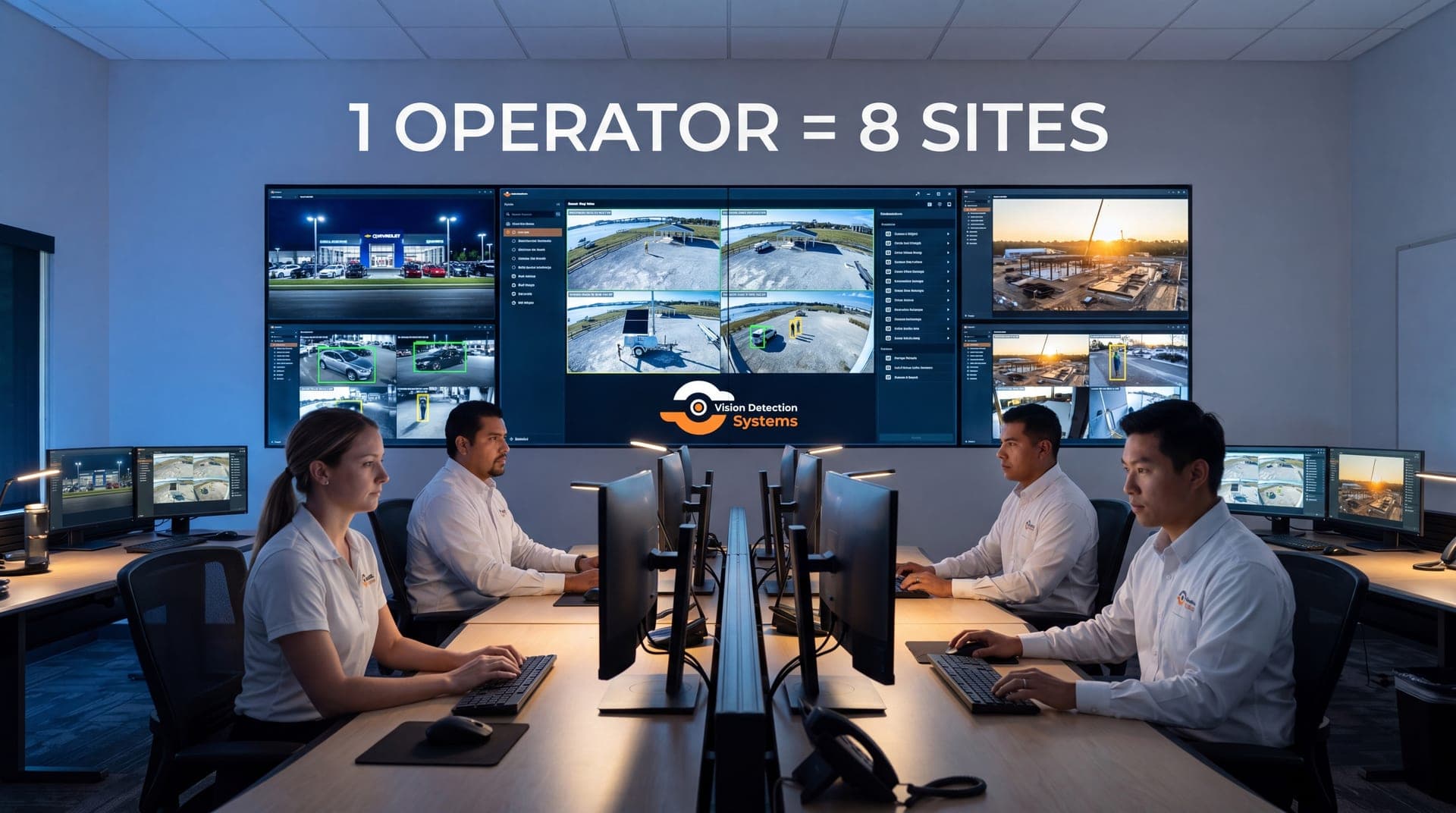
Here's a rigorous comparison of both approaches across the dimensions that matter most for protecting your assets.
The Real Cost of Security Guards
The $15–$25 per hour figure often quoted for security guards is only the starting point. Total employer cost—including payroll taxes, workers' compensation insurance, benefits, and agency margins—typically lands at $22–$38 per hour for each guard.
A single guard posted 40 hours per week costs $3,500–$6,000 per month before you account for overnight or weekend differential pay. Most sites require more than one shift. True 24/7 coverage at a single post, using three overlapping shifts plus relief coverage, runs $25,000–$35,000 per month at fully loaded rates — direct wages are only part of it once overtime, benefits, scheduling, and management overhead are counted.
| Coverage Model | Hours/Week | Estimated Monthly Cost |
|---|---|---|
| 1 guard, weekday business hours | 40 hrs | $3,500–$6,000 |
| 1 guard, after-hours + weekends | 60 hrs | $5,500–$9,000 |
| Full 24/7 single post (3+ guards) | 168 hrs | $25,000–$35,000 fully loaded |
| Remote video monitoring (full site) | 168 hrs | $1,500–$2,500 |
Add to this the management overhead: scheduling, turnover (an industry-wide challenge that guard companies themselves work hard against), retraining, and the liability that comes with putting a person alone on an exposed overnight post. None of these costs appear in the hourly rate.
What drives cost on each side
Guard costs are driven by the staffing model (one guard vs. multiple per shift), coverage hours (24/7 vs. nights only), post instructions (patrol-only vs. access control, reporting, and escort duties), site complexity (large footprints, multiple entrances, parking structures), and turnover and training quality — which directly impacts reliability.
Remote monitoring costs are driven by camera count and coverage complexity (entrances, perimeters, drive lanes), monitoring hours (after-hours only vs. 24/7), alerting rules (motion zones, loitering thresholds, schedules), escalation requirements (call lists, dispatch, law-enforcement protocols), and reporting needs (incident logs, clip exports, recurring summaries).
The practical takeaway: guards get expensive when you need continuous coverage across a large footprint, while remote monitoring becomes more efficient as you add coverage area and standardize workflows across sites.
Coverage Gaps One Person Can't Solve
A security guard covers one sightline at a time. When they're on patrol, the post is unattended. When they're responding to an incident on the north side of a site, the south side has no coverage. When they're on break, walking the far side of the site, or covering the gate, coverage gaps open somewhere else — that's geometry, not a performance problem.
Remote video monitoring eliminates these physics-based limitations. A well-positioned camera system covers multiple zones simultaneously, and monitoring center operators watch all feeds continuously. There's no patrol gap, no fatigue effect, no distraction window.
Note: Coverage doesn't mean cameras everywhere. Effective monitoring coverage means cameras positioned at entry points, high-value asset zones, and egress paths—with overlapping fields of view that leave no usable approach unmonitored.
For construction sites specifically, perimeter lengths and elevation changes make comprehensive guard patrols physically impractical without large teams. A single mobile surveillance unit with four to eight cameras covers the equivalent of what would require three to four guards to patrol.
Response Time: Who Gets There Faster?
Guards respond physically. If an incident occurs at the far end of a large site, a guard may take two to five minutes to arrive—if they detect the incident at all from their current position.
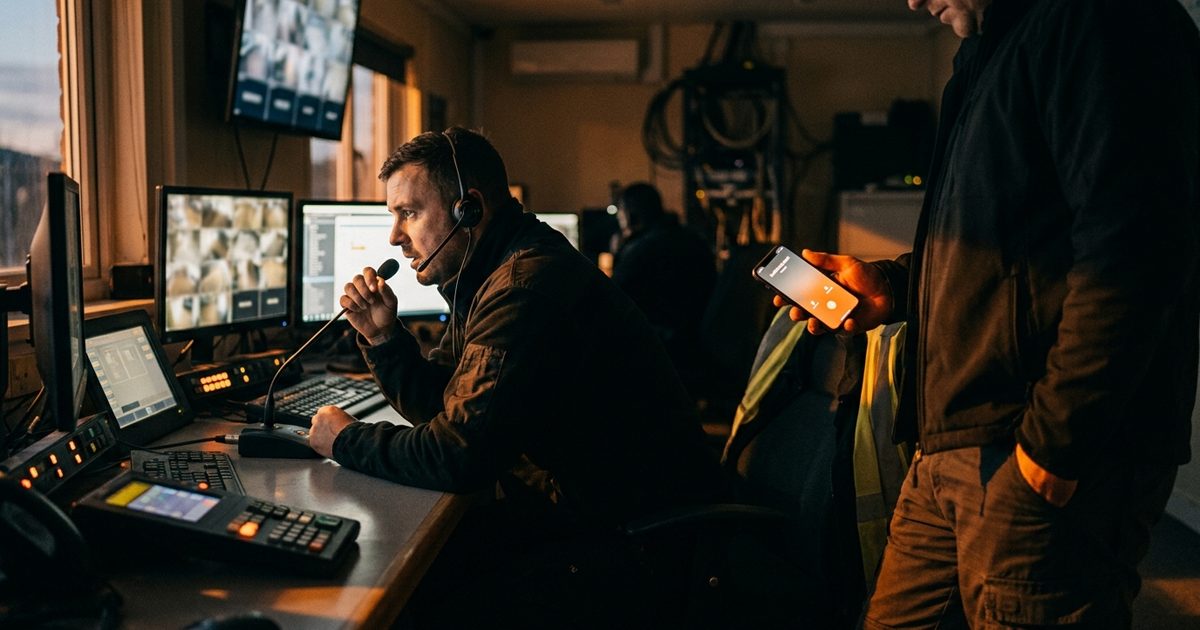
Remote monitoring operators respond in seconds. The workflow at a professional monitoring center like VDS looks like this:
- AI analytics detect motion or intrusion event and flag for human review
- Operator reviews live feed within 5–15 seconds of alert
- If confirmed, operator issues audio challenge via integrated speakers within 15–30 seconds total
- Most intruders leave on audio challenge—the site is documented, deterrence is successful
- If subject doesn't respond, law enforcement is contacted with real-time footage and description
This sequence happens faster than a guard can walk from one end of a construction site to the other. More importantly, the audio challenge and real-time law enforcement coordination happen regardless of what time it is or how long the shift has been running.
Evidence Quality and Incident Documentation
Written incident reports are produced after the fact, from memory, and rarely include the kind of precise timestamps, visual documentation, and behavioral detail that investigators need.
Remote video monitoring produces video evidence, verified in real time by a trained operator. When VDS operators contact law enforcement, they provide:
- Live camera feeds showing suspect location and movement
- Vehicle descriptions and license plate numbers if visible
- Precise timestamps of all activity
- Incident log with operator observations
This documentation matters enormously for insurance claims, prosecutions, and civil litigation. Video evidence with chain-of-custody documentation from a professional monitoring center carries significantly more weight than any after-the-fact written account.
Tip: Ask any monitoring provider how they handle incident documentation. Professional operations maintain timestamped operator logs alongside video, giving you a complete record that aligns with footage timestamps.
Where Security Guards Still Make Sense
Remote monitoring doesn't replace every function that guards perform. Guards remain the better choice—or a necessary complement—in these situations:
Controlled access with ID verification. If you need someone to check credentials, issue visitor badges, or verify vehicle manifests, a human at a gatehouse is still required.
Facilities with compliance-mandated on-site personnel. Some regulated environments (certain chemical storage, healthcare facilities, data centers) require documented human security presence.
Customer-facing environments. Retail loss prevention often requires someone who can approach customers, de-escalate shoplifting situations, and make judgment calls in complex social contexts.
High-contact deterrence environments. Some facilities benefit from the visible presence of a uniformed guard as a deterrent signal—particularly when the population of potential offenders knows that camera-based systems exist.
For all of these, the best approach is layered: remote monitoring as the primary coverage layer, with guards deployed where their unique capabilities are actually needed. This hybrid model typically costs less than full guard staffing while delivering meaningfully better coverage.
The Hybrid Model: What Most Commercial Properties End Up Using
If you're deciding "guards vs monitoring," the best answer is often both — in different roles. Common hybrid setups:
- Guards during business hours and remote monitoring after-hours
- A roving guard and remote monitoring across the whole property
- Guards at the main entrance and monitoring for perimeter and back-of-house zones
- Monitoring for verification and guard dispatch only when activity is confirmed
Why hybrid works: it reduces wasted guard hours watching empty space, improves time-to-awareness and reduces surprise incidents, creates consistent documentation for every event, and makes physical response more targeted and safer. Remote monitoring often improves time-to-awareness (knowing something is happening), while guards improve physical intervention (being able to act on site) — the strongest programs use monitoring to catch activity early and dispatch the right response before the incident escalates.
Decision Checklist: Choose What Fits Your Site
Choose security guards when:
- You need visible presence as the primary deterrent
- You require controlled access or human interaction
- Your risk requires physical intervention more than detection
- You can sustain staffing and training reliably
Choose remote monitoring when:
- Incidents occur after-hours or in low-visibility zones
- You need broader coverage than a patrol can provide
- You want standardized escalation and reporting
- You manage multiple sites and need consistent operations
Choose a hybrid approach when:
- You need presence sometimes, but not 24/7
- Your property has large blind-spot risk (perimeter, lots, yards)
- You want verified response and fewer false alarms
- You need both fast awareness and on-site intervention
AI-Assisted Monitoring vs. Passive Recording
Not all remote monitoring is equal. Many low-cost providers offer "monitoring" that is actually passive recording with motion-triggered alerts that are reviewed only after an incident. This is fundamentally different from true remote video monitoring with live human operators.
VDS operates a staffed Security Operations Center (SOC) with trained operators who watch live feeds, respond to AI-flagged events, and interact directly with sites via integrated two-way audio. This is the model that produces 15–30 second response times and the kind of intervention capability that actually deters crime.
Passive recording services might cost $200–$500 per month and provide footage retrieval. True monitored protection is a different category of service.
Making the Right Choice for Your Operation
For most commercial and construction sites, the decision framework is straightforward:
- Temporary site or defined project timeline: Remote monitoring via mobile surveillance trailer, no guards required
- Permanent facility without access control needs: Remote monitoring, potentially with periodic security patrols for physical presence
- Facility with access control or compliance requirements: Guards at access points, remote monitoring for perimeter and interior coverage
- High-value asset environment with theft history: Remote monitoring as primary, guards during peak risk periods
The evidence consistently shows that professional remote video monitoring delivers better deterrence, faster response, higher-quality documentation, and lower cost than equivalent guard staffing for the vast majority of sites. The question isn't really monitoring versus guards—it's understanding which human functions can't be replaced and deploying people only where they're genuinely needed.
Contact the VDS team to get a site-specific assessment and a monitoring quote that shows exactly what coverage would cost for your location.