
Why linear projects are hard to protect
A building site has a fence and a gate. A transmission line has neither. The route may cross farmland, forest, wetlands and public roads, and the work area is a corridor that moves week by week. Crews set foundations, erect structures, pull conductor and restore the ground, often with different contractors for each task.
That structure creates three problems. There is no perimeter to defend. Crews are dispersed, so nobody is near most of the material most of the time. And access is easy, since the whole corridor is reached by a network of temporary roads and gates that few people monitor.
The practical answer is to find the points where value gathers, which is usually at the places where trucks load and unload. These resemble other utility staging areas, which we cover in utility laydown yard security.
Where the risk sits along the route
Not every mile is equal. The exposure sits in a few types of location:
- Main laydown yard. Conductor reels, hardware, structure components, tools and often fuel.
- Satellite staging areas. Temporary storage close to the work, often with minimal fencing.
- Structure pads and foundations. Anchor bolts, rebar, forms and cable left between phases.
- Equipment parking. Cranes, excavators, pole trailers and trucks left overnight.
- Fuel storage and mobile tanks. Easy to drain and valuable. See diesel fuel theft prevention.
- Access gates and temporary roads. The entry points that let a truck reach the corridor at night.
Laydown yards come first
The laydown yard is the most valuable and the most defensible part of the project, so it is where to start. Material arrives in volume, sits for weeks, and leaves in pieces. A yard that has a single gate, decent lighting and a log of what enters and leaves is much harder to steal from than one that does not.
Treat inventory as a security control. Count reels and bundles on receipt, count them again at the end of each week, and reconcile with the field. A difference between the two is an early warning, and video from the yard can help explain it. Cameras at the gate capture vehicles and drivers, and a camera on the reel storage covers the highest-value stacks.
Access roads and gates
On a linear project, access roads are the real perimeter. Temporary roads often cross private land and join public roads at several points. Each junction is a place where an unfamiliar vehicle can enter, and few have gates or any means of recording who comes and goes.
Reduce the number of entry points. Gate and lock the ones you keep, record the vehicles that use them, and mark them clearly so crews know which ones are authorized. Cameras at the primary access points capture a good record of vehicles, and detection can flag entries after working hours. Where a gate cannot be locked because crews need continuous access, add a camera and a sign.
For similar problems on other linear projects, see our article on pipeline right-of-way security.
Phase-by-phase coverage
The risk profile changes as the work moves along the route. Update the plan at each phase.
| Phase | What is on site | Where cameras go |
|---|---|---|
| Clearing and access | Heavy equipment, fuel, new roads | Equipment parking, main gate |
| Foundations | Rebar, anchor bolts, concrete equipment | Active foundation sites, fuel storage |
| Structure erection | Steel or pole sections, cranes, hardware | Laydown yard, structure staging |
| Conductor stringing | Conductor reels, pulling equipment, tools | Reel storage, stringing setup areas |
| Restoration | Equipment demobilizing, scrap and surplus | Yard, surplus material storage |
The most valuable material is often the conductor itself during the stringing phase, which makes that the time to add coverage if the budget requires choosing.
Working without site power or internet
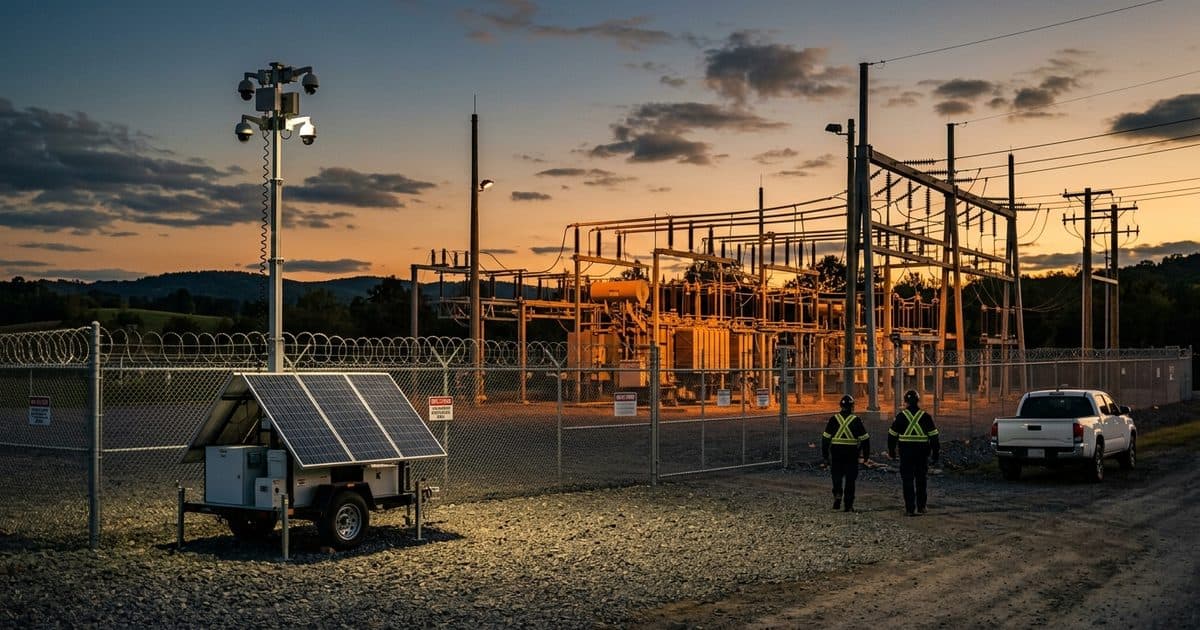
Right-of-way land rarely has power or wired internet. Cameras that need either one are limited to the project office, which is not where the loss occurs. Solar-powered, cellular-connected trailers can be placed where the material is stored. Check cellular coverage along the route before choosing locations. Our guide to surveillance trailer site selection covers sun exposure, signal and ground conditions, and why a spot that looks fine on a map may not work in practice.
Because crews move down the line, plan for units that can be relocated. A trailer that stays with the highest-risk stage of the work gives more coverage than several cameras fixed at the start of the route.
Fuel, tools and the small stuff
Large material draws attention, but the steady losses on linear work are often small. Fuel from mobile tanks, hand tools, chainsaws, generators and small trailers leave in ones and twos, and each loss looks minor. Over a long project they add up, and they are the first sign that someone has learned the site is unwatched. Lock tools in secured containers at the end of each shift, park fuel trailers inside the camera view of the main yard, and keep a simple tool log by crew. A pattern of small losses is a useful reason to move a camera, and it is better to act on that signal than to wait for a large loss.
Communication with landowners and crews
Cameras on a utility corridor interact with people who are not part of the project, such as landowners, neighbors and recreational users. Agree on signage and notification in advance, and place cameras so they point at project assets, not nearby homes. Rules on recording vary by state, so confirm requirements with counsel and the project owner.
Inside the project, tell every contractor about the camera coverage and the after-hours access rules. Clear rules keep alert volume down because known crews are not flagged.
How VDS fits
VDS builds solar-powered mobile surveillance units that suit this kind of work. Each carries a 5MP PTZ camera with 25x optical zoom plus three 8MP wide-angle cameras on a 22 ft telescopic mast, with a 30 ft mast available. A 900W bifacial solar array charges an 11.8 kWh LiFePO4 battery bank with reserve for 3-5 consecutive cloudy days, and dual-SIM 4G/5G cellular carries the video, so no site power, internet or trenching is required.
AI detection covers people, vehicles and loitering. A 24/7 US-based security operations center verifies events, speaks to intruders through a loudspeaker, and dispatches police with video if needed, so your team or your security partner handles verified incidents. Most deployments go live about a week after a signed quote. See our utility industry page or talk to our team.