
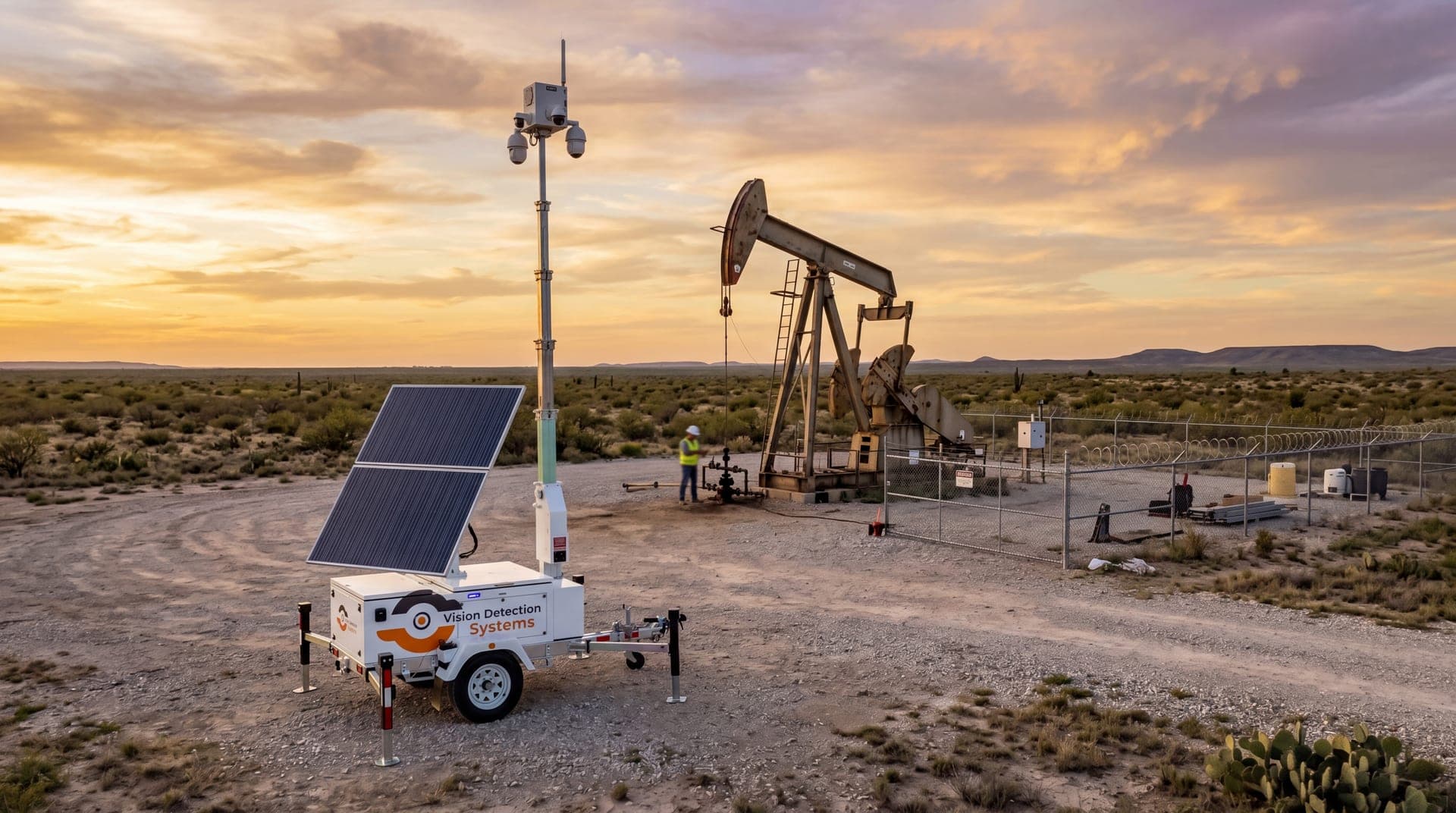
The problem with long linear assets
A building has a fence and a front door. A pipeline has neither. It crosses farmland, forest, creeks, highways and private property, usually in a strip that is visible to anyone who knows where to look. Access points are everywhere, power is rare, and a patrol vehicle can only be in one place at a time.
This is why linear assets are managed differently from fixed sites. You cannot guard the line itself. You guard the places along it where something can go wrong, and you accept that the rest is covered by inspection, aerial survey and field staff.
That approach only works if the high-value points are actually watched. Many of them are small, unmanned and far from any building.
Where the exposure sits
The points that tend to matter most are not spread evenly. They cluster around infrastructure that is above ground and easy to reach by vehicle:
- Valve sites and block valves, often fenced but unlit and unpowered.
- Meter stations, regulator sites and pig launcher and receiver areas.
- Pump and compressor stations, which hold more equipment and more value.
- Road, rail and water crossings, where outsiders pass close to the line.
- Staging areas and laydown yards during construction, repair or expansion.
Each of these has a different threat profile. Some face theft of metal, tools or fuel. Others face trespass, curiosity, vandalism or people working near the line without permission. The mix varies by region and by operator, so a site assessment is a better starting point than a rule of thumb.
For a wider view of the sector, see our overview of oil and gas security cameras and the guide to critical infrastructure physical security.
Why mobile units fit remote gaps
Permanent camera systems assume power and a data connection. At a remote valve site, neither exists. Running electrical service or fiber for a single small site is slow and expensive, and it becomes a fixed investment in a place whose risk may change next year.
A solar-powered mobile unit avoids that. It generates its own power, sends video over cellular and can be deployed in days. When a trespass problem moves, or a project finishes, the unit moves too. Our comparison of a mobile security tower and a trailer covers the tradeoffs in height, footprint and ease of placement.
Cellular coverage is the main variable. Rural right of way can have patchy signal, so confirm coverage at each candidate location before committing, and ask how the unit behaves when the signal drops. The basics of 4G and 5G camera connectivity are worth reading before you plan a route.
Detection that works over distance
Remote sites need detection that is useful at long range and quiet in bad weather. A few principles apply:
- Define zones. Alert on people and vehicles inside the fence or near the equipment, not on the whole field of view.
- Use AI detection that classifies what it sees, so animals, vegetation and weather do not generate constant alerts.
- Add night imaging suited to the site. Infrared and thermal behave differently, so see our guide to infrared versus thermal night vision when choosing.
- Consider whether a perimeter layer such as radar suits large open areas. Our piece on perimeter intrusion detection explains how the options differ.
None of this helps if alerts go nowhere. The value comes from having someone verify the event on video and act on it, whether that is a warning over a loudspeaker or a call to your security partner or police.
Handling trespass along the line
Most trespass along a right of way is not malicious, but it is still a safety and liability issue. Off-road vehicles, hunters, hikers and contractors can all end up near equipment. Deterrence works best when it is visible and immediate.
A live voice warning from a monitoring center tells the person they are being watched and asked to leave, which is often enough. Signage, lighting and a visible camera support that. For general approaches, see our guide to stopping trespassing on commercial property.
Rules on recording, signage and audio vary by state and by landowner agreements along the route, so confirm requirements with counsel before deployment.
Working with landowners and field crews
A right of way crosses land that other people own and use. Before placing a unit, agree on location, access and expectations with the landowner or the relevant easement holder, and tell field crews what the equipment is so that maintenance visits do not trigger alerts. Keep a short contact list for who is called when an event is verified, including after-hours numbers. Clear roles matter as much as the hardware, because a verified alert is only useful if the right person picks up.
Planning coverage
A simple way to plan is to rank sites by consequence and by ease of access, then cover the top of the list first.
| Site type | Typical exposure | Coverage approach |
|---|---|---|
| Remote block valve | Trespass, tampering, theft | One unit with zone detection and talk-down |
| Meter or regulator station | Equipment theft, vandalism | Unit covering fence and approach road |
| Pump or compressor station | Theft, unauthorized access | Perimeter coverage plus gate monitoring |
| Road or water crossing | Unplanned access, vehicles | Temporary unit during problem periods |
| Construction laydown yard | Material and equipment theft | Relocatable unit through the project |
Review the list after incidents. If a site keeps producing alerts, move coverage there. If a site has been quiet, move the unit on.
How VDS fits
VDS builds solar-powered mobile surveillance trailers that need no site power, internet or trenching. Each unit has a 5MP PTZ camera with 25x optical zoom and three 8MP wide-angle cameras on a 22 ft telescopic mast (30 ft available). A 900W bifacial solar array charges an 11.8 kWh LiFePO4 battery bank with reserve for 3 to 5 consecutive cloudy days, and dual-SIM 4G/5G cellular carries the video.
AI detects people, vehicles, loitering, objects and license plates. A 24/7 US-based security operations center verifies events, responds with live talk-down, then dispatches police with video. The hardware is NDAA Section 889 compliant. Most deployments go from signed quote to live monitoring in about a week. See the mobile surveillance unit or talk to our team about your route.