
Where the chain is weakest
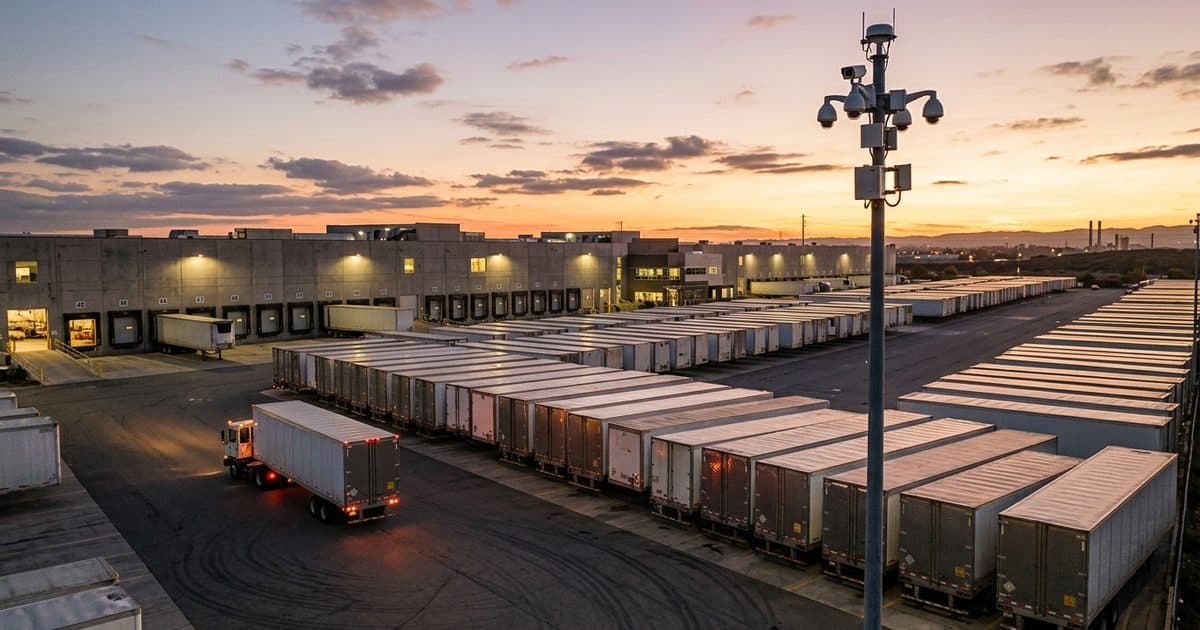
Freight is safest when it is moving under a driver's eye. It is most exposed when it stops. That includes the dwell time in a yard waiting for a pickup, the hours in a trailer lot over a weekend, the staging area outside a dock door, and any lot a driver uses overnight. Thieves look for loads that sit in predictable places with little observation.
For current numbers on how often this happens, see our roundup of cargo theft statistics. The practical takeaway is that coverage should follow the cargo, not just the building.
Mapping the handling points
Start by drawing the path a load takes through your site, from gate-in to gate-out, and mark every place it stops. Then ask what you would need to see at each stop to settle a dispute.
| Handling point | What video should show | Common blind spot |
|---|---|---|
| Gate-in and gate-out | Plate, truck, trailer number, time | Glare, bad angle, no coverage on exit |
| Check-in and guard shack | Driver approach, paperwork exchange | Cameras aimed at the booth, not the lane |
| Dock doors | Door open and close, loading activity, seal | Wide shots that are too far to read details |
| Staging lanes | Pallets and trailers waiting | Dark corners between rows |
| Yard parking | Trailer positions, landing gear, fifth wheel area | Far rows that no camera reaches |
| Fence line and perimeter | Cuts, climbs, vehicle access | Long stretches behind buildings |
Gate cameras and plate capture
The gate is the single best place to start, because every vehicle passes through it. A good gate setup records the plate, the truck, the trailer and the time on entry and exit. Plate readability depends on camera angle, shutter speed, lighting and the speed of the vehicle. As a rule of thumb from our setup guides, plate characters need roughly 20 to 30 pixels of height, a shutter of 1/1000s or faster for moving vehicles, and an angle within about 15 to 30 degrees of the plate. Our license plate recognition camera guide walks through the details.
Do not forget the exit lane. Many sites cover entry carefully and leave exit as an afterthought, which is exactly the direction a stolen load takes.
Docks and chain of custody video
Chain of custody simply means being able to show continuous control of a load. Video supports it in three ways:
- It time-stamps each handoff, so a driver arrival, a loading start and a departure each have a record.
- It shows the condition of the trailer and seal at key moments.
- It lets you check a claim against what actually happened instead of memory.
For video to carry weight, keep the clock accurate, keep exports organized and keep a written record of who accessed footage. Our article on security camera footage as evidence explains how to preserve video so it holds up. Rules on admissibility and handling vary, so confirm specifics with counsel.
Yards and trailer parking
Yards are large, open and often dark. Wide-angle cameras cover broad areas, and a PTZ camera can zoom in on a specific trailer or person when an alert fires. Placement matters more than camera count. Cover the ends of rows, the gaps between buildings and the fence segments that face roads. For a deeper look, see the truck yard cargo theft guide and the logistics yard checklist.
Consider the hours too. A yard that is lively at noon may be empty from midnight to dawn. That empty window is when a monitored camera earns its keep, because an alert on a person walking between trailers at 3 a.m. is meaningful in a way it is not at noon.
Seals, trailers and exceptions
Many cargo disputes come down to a single question, was the trailer in the condition the paperwork says it was at a given time? Video helps when a camera sees the trailer door and seal at gate-in, at the dock and at gate-out. Even a short clip of the door being closed and sealed can settle an argument later.
Exceptions deserve extra attention. A trailer that sits unusually long, a vehicle that enters without a scheduled pickup, or a driver who arrives well outside a window are all patterns that video and logs can surface. Decide in advance which exceptions trigger a call, and who makes it.
Recording versus monitoring
Cameras that only record tell you what happened after the load is gone. Monitored cameras let someone act while it is still on site. The 2019 systematic review of CCTV research found that actively monitored systems were associated with about a 15% reduction in crime, while passive recording-only systems showed no significant effect. That finding applies to public-area systems rather than to freight yards specifically, but it supports the same principle. See what remote video monitoring does for how live review fits into a security plan.
Where VDS fits
Many yards and staging areas have no easy power or network at the far edges. A VDS mobile surveillance unit is a solar-powered trailer with a 5MP PTZ camera with 25x optical zoom and three 8MP wide-angle cameras on a 22 ft telescopic mast, with dual-SIM 4G/5G cellular and no need for site power, internet or trenching. AI detects people, vehicles, loitering and license plates. Our 24/7 US-based security operations center verifies events, speaks through a loudspeaker and dispatches police with video when needed, so people, yours or your security partner's, handle verified incidents. Visit our logistics solutions page or talk to our team.
Sources
- Piza, E. L., Welsh, B. C., Farrington, D. P., & Thomas, A. L. (2019). CCTV surveillance for crime prevention: A 40-year systematic review with meta-analysis. Criminology & Public Policy, 18(1). onlinelibrary.wiley.com