
Why event parking is hard to secure
A stadium or arena lot spends most of the week quiet. On event day it becomes a small city. Tens of thousands of people may arrive within a few hours, many of them on foot between cars and gates, many tailgating, and many unfamiliar with the layout.
Several conditions create exposure:
- A short, intense window of arrivals and a long, slow departure.
- Overflow lots on grass, gravel or leased land with no lighting.
- Attendees who leave bags, electronics and valuables in cars for hours.
- Alcohol, crowds and darkness after evening events.
- Thin staffing, since event personnel are often assigned to gates and seating rather than distant lots.
Vehicle break-ins and theft are the most common property concerns. Personal safety, fights and medical emergencies are the main human concerns. Both benefit from the ability to see what is happening and send help to the right place.
The three phases of an event
Security needs differ across the day. Thinking in phases helps with staffing and camera placement.
| Phase | What is happening | Security focus |
|---|---|---|
| Before the event | Lots open, early arrivals, tailgating | Gate and entrance coverage, traffic flow, setup of temporary coverage |
| During the event | Lots mostly parked, attendees inside | Parked vehicles, perimeter, unattended cars |
| After the event | Mass departure, congestion, darkness | Exit routes, pedestrian paths, fights, medical calls |
The during-event phase is the one many venues overlook. Thousands of unattended vehicles sit in lots with few people nearby, which is the situation thieves look for. Coverage during this window deserves as much attention as the arrival and departure rushes.
Temporary coverage for lots that have no cameras
Few venues have permanent cameras across every lot. Overflow areas and leased fields usually have none, and installing cable to them is not practical for a few events a year.
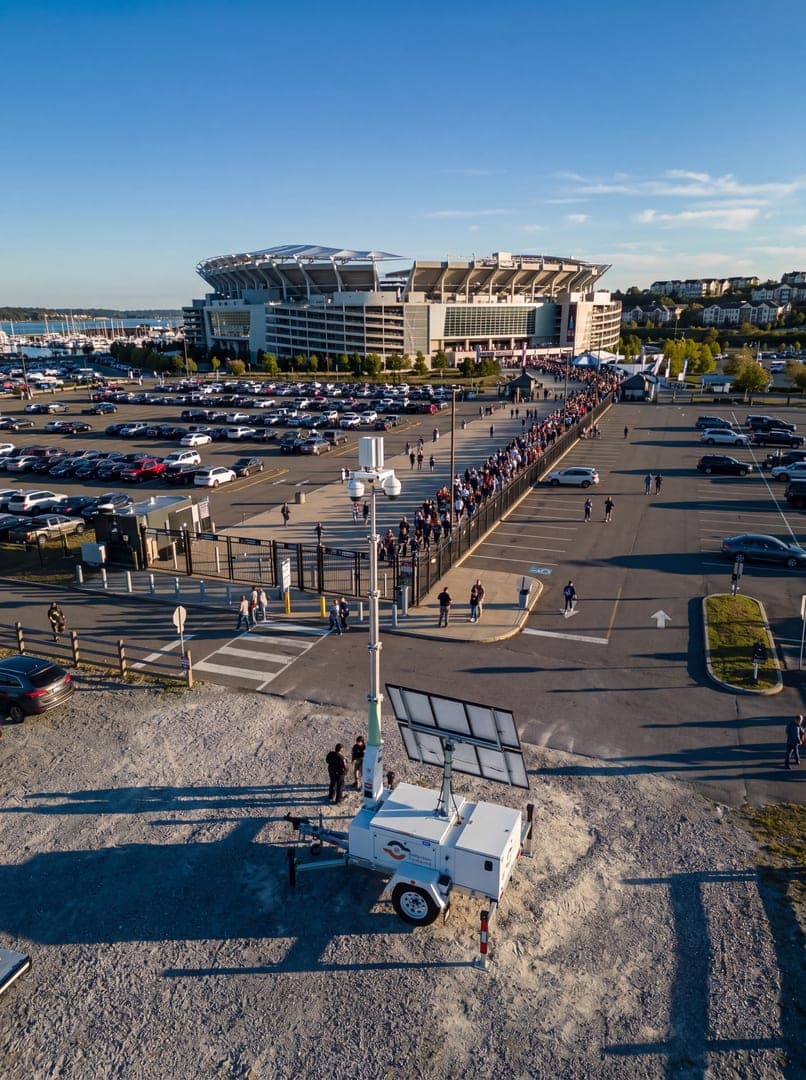
Self-powered mobile surveillance units fill that gap. They can be placed at the edge of an overflow lot, along a pedestrian route or at an exit, and they connect over cellular rather than a venue network. When the event ends, they can stay for overnight coverage or move to another lot. Our guide to temporary security cameras explains the options, and the article on the mobile surveillance trailer for events covers event use in more detail.
Planning points for placement:
- Choose positions with a clear view down the main aisles, not behind obstacles.
- Place units where they will not be blocked by parked vehicles, buses or temporary structures.
- Keep units out of the way of traffic and emergency access routes.
- Get approval from the lot owner, the city or the event organizer as needed.
- Check ground conditions, since soft or sloped ground affects setup.
Watching crowd flow
Cameras serve a second purpose at events. They show how people and vehicles move. A backed-up exit, a crowd forming at a gate or a gap in traffic control is visible on video before it becomes a problem on the ground.
Operators and event staff can use that view to redirect traffic, open an additional lane or send a staff member to a congested point. Analytics that count people can add detail on how busy a pathway is. See our overview of people counting cameras for how that technology works and what to ask a provider.
Crowd flow also affects safety. Congestion near exits slows emergency vehicles. Keeping routes clear is a core planning goal, and cameras help confirm that it is happening.
Coverage after the crowd leaves
When the last cars pull out, the risk does not end. Vehicles left behind, tailgate debris, people sleeping in cars and equipment left in lots all remain. Some venues host multi-day events, with cars parked overnight in camp areas.
A lot that is empty after an event is also an easy place to trespass or dump. Monitoring through the night helps catch anything unusual and gives the venue a record in case of a claim. The after-event hours are where a self-powered unit adds value, since it keeps watching without needing anyone on site.
Response, not just recording
A recording of a break-in helps after the fact. An event lot needs a way to act during the event. With remote video monitoring, an operator verifies what the cameras flag and can speak to people through a loudspeaker. If someone is in the wrong place or approaching vehicles, a spoken warning often ends the situation. If it does not, the operator can send video to police dispatch.
A 2019 systematic review of 76 studies found CCTV associated with roughly a 13% reduction in crime in target areas and about 37% in parking lots. Actively monitored systems showed about a 15% reduction, while passive recording-only systems showed no significant effect. For a busy event, that distinction supports pairing cameras with someone who is watching.
This works best when cameras do the watching so people, yours or your security partner's, handle verified incidents. Our guide to live talk-down audio deterrence explains the approach, and our parking lot security article covers lot basics.
Building a plan with the people involved
Event security involves several groups: the venue, the city, police, traffic control, vendors and often a private security partner. Agree on a short plan before the season starts.
- Name one coordinator for parking security.
- Decide who can view video and who can request footage.
- Set contact numbers and escalation steps for medical, fire and police calls.
- Rehearse the plan before the biggest event of the year.
Rules on recording, notice and public records vary by state and by venue ownership, so confirm the details with counsel.
How VDS fits event parking
The VDS mobile surveillance unit is a solar-powered trailer with a 5MP PTZ camera with 25x optical zoom and three 8MP wide-angle cameras on a 22 ft telescopic mast. A 900W bifacial solar array charges an 11.8 kWh LiFePO4 battery bank, and dual-SIM 4G/5G cellular carries video, so it needs no site power, internet or trenching.
AI detection looks for people, vehicles, loitering, objects and license plates. Our 24/7 US-based security operations center verifies events, uses live talk-down through a loudspeaker, then dispatches police with video. Rental, month-to-month and term subscriptions are available, which suits seasonal needs. See our event and temporary site page or talk to our team.
Sources
- Piza, E. L., Welsh, B. C., Farrington, D. P., & Thomas, A. L. (2019). CCTV surveillance for crime prevention: A 40-year systematic review with meta-analysis. Criminology & Public Policy, 18(1). onlinelibrary.wiley.com