
What this guide covers, and what belongs with safety professionals
School security spans two very different domains, and it helps to be honest about the line between them. The first is life safety: emergency planning, threat assessment, building access control, and coordination with police. That work is led by school resource officers (SROs), district safety directors, state school safety centers, and specialized consultants, and nothing in this article substitutes for it. If your district is reviewing its emergency operations plan or indoor security posture, start with those professionals and your local law enforcement partners.
The second domain is property protection: keeping vehicles, buildings, grounds, equipment, and construction materials safe from theft, vandalism, trespass, and fire, mostly outdoors and mostly after hours. That is where this guide lives, and where outdoor camera systems, including mobile surveillance units, do their best work.
Coverage in this second domain is far less consistent than the headline adoption numbers suggest. Pew Research finds that US school security procedures have become more widespread in recent years but are still unevenly adopted, and outdoor, after-hours property coverage is one of the most common gaps: a district may have hundreds of interior cameras and almost nothing watching the back parking lot at 2 a.m. on a Saturday.
Why do perimeters and parking lots need dedicated coverage?
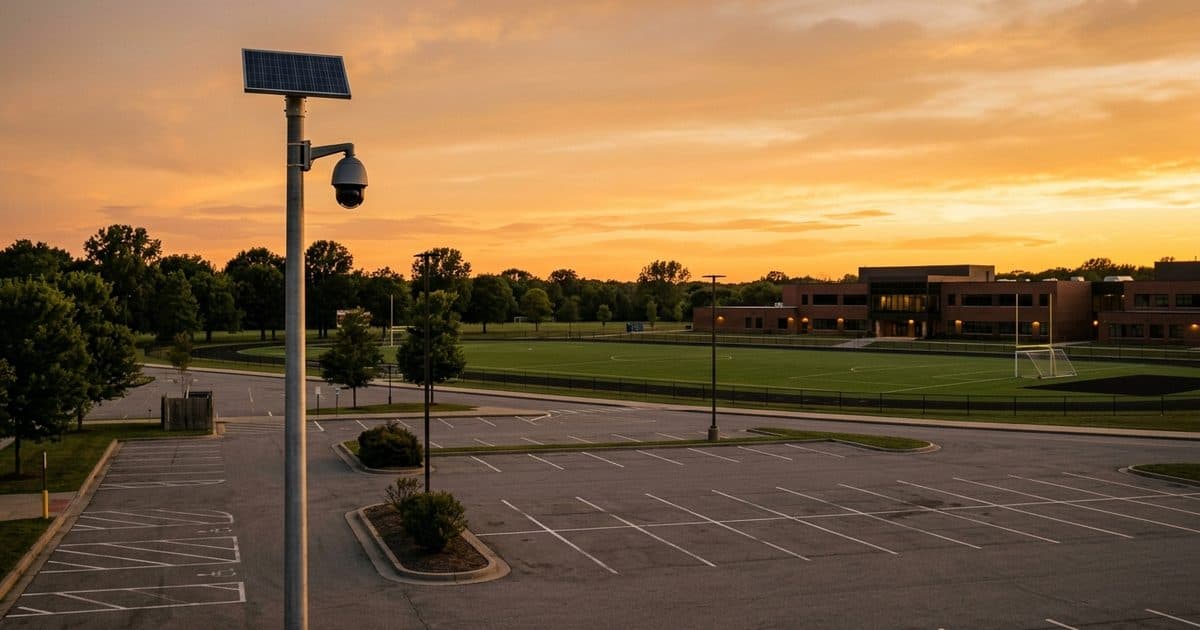
Fixed school camera systems were usually designed around the building envelope: entrances, hallways, and cafeterias. Parking lots and perimeters are a different problem. They are large, often poorly lit, active in the early morning and late evening, and empty for long stretches in between. That combination invites vehicle break-ins, dumped debris, graffiti, and damage to windows, portables, playgrounds, and athletic facilities.
The costs add up quietly. By commonly-cited estimates, vandalism costs US schools hundreds of millions of dollars annually (see this EBSCO research overview), though rigorous national tallies are scarce, and most individual incidents are too small to make the news. A broken window here and a tagged wall there come out of the same facilities budget that pays for classroom repairs, which is why prevention matters more than after-the-fact documentation. The dynamics closely mirror what parks departments see with after-hours damage, covered in our guide to park security cameras and vandalism.
Parking lots also carry a duty-of-care dimension: staff arriving before dawn, students leaving late after practice, and community members attending evening events all deserve well-lit, visibly watched lots. The layout challenges, wide open areas, multiple entrances, and no place to mount fixed cameras, are the same ones property managers face in apartment complex parking security, and the solutions transfer directly: elevated camera positions with wide fields of view, clear signage, and monitoring that can respond while something is happening rather than reviewing footage afterward.
How do you secure an empty campus over summer and holiday breaks?
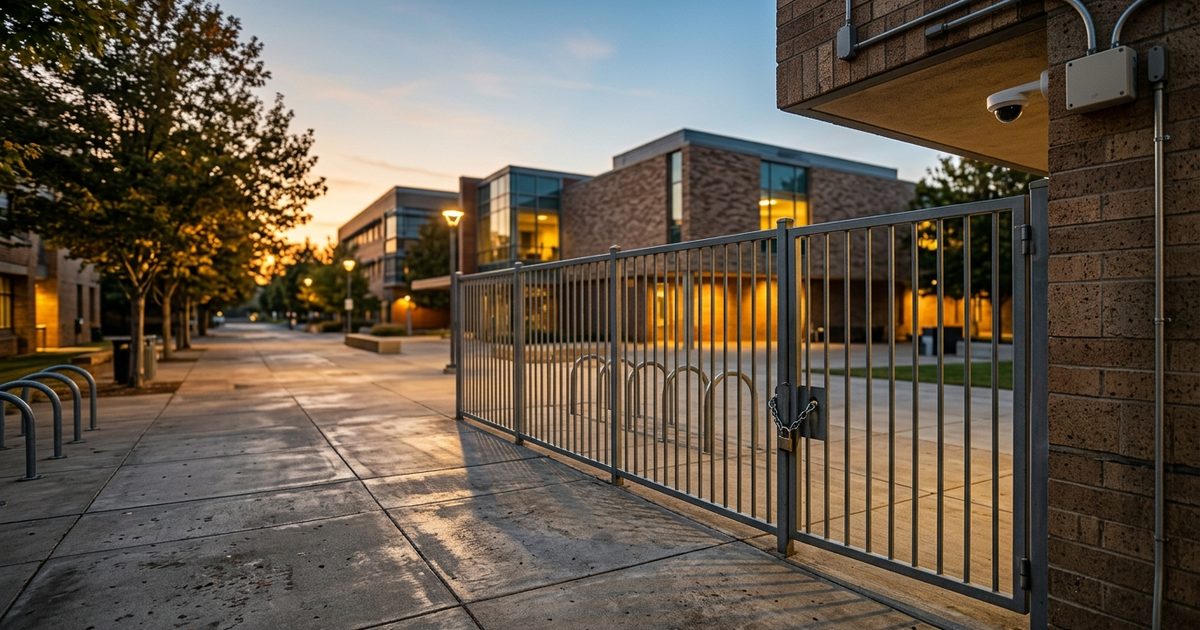
Between summer break, winter break, spring break, and holidays, a typical school calendar leaves campuses largely empty for roughly a quarter of the year. During those windows a school behaves less like a school and more like a vacant commercial property: predictable emptiness, valuable contents (HVAC equipment, copper, computers, kitchen equipment), and long delays before anyone notices damage. A window broken in mid-June may not be discovered until an August walkthrough, after weeks of water intrusion. The playbook in our vacant property security guide applies almost point for point.
Break-period trespass on campuses deserves a measured framing. Much of it is not professional theft; it is neighborhood kids skateboarding loading docks, climbing roofs, or gathering after dark, activity that is dangerous for them and expensive for the district. The goal of coverage here is early, safe deterrence, not confrontation. A monitored camera with an audio warning that announces the property is being watched usually ends a trespass incident in seconds, before anyone is hurt, before damage is done, and before a police response is needed.
Because break coverage is seasonal, temporary equipment fits it better than permanent construction. Solar-powered mobile units can be placed in late May, watch the campus all summer, and be removed or moved to another school in the district when classes resume, with no trenching, conduit, or electrical work on district property.
Protecting school construction and renovation projects
School districts run a constant stream of bond-funded construction: new wings, roofing projects, HVAC replacements, stadium upgrades, and full campus builds, often compressed into summer to avoid disrupting classes. These projects concentrate exactly what thieves look for: copper, tools, appliances, and heavy equipment on an open, unfenced-or-lightly-fenced site with no occupants at night.
Fire risk is the other reason school jobsites deserve their own coverage. NFPA analysis of 2013-2017 data found that fires in structures under construction caused an average of $304 million in direct property damage per year nationally. On a campus project, a fire does not just delay a schedule; it can push a school's reopening past the first day of classes and force a district into temporary facilities. Overnight camera monitoring can flag smoke, glow, and unauthorized hot work when jobsites are unstaffed, a role we cover in depth in our construction site fire watch guide.
There is also a child-safety angle unique to school projects: an open jobsite sits yards from where curious students walk every day. Visible monitoring, recorded perimeter coverage, and rapid escalation when someone enters the site after hours protect the district's students and its liability position at the same time. Because the need ends at project completion, rental or temporary deployment is almost always the right structure.
Stadium events, overflow parking, and district maintenance yards
Two more campus scenarios reward temporary, relocatable coverage. Game nights and graduations push hundreds of vehicles into overflow lots and grass fields that have no fixed infrastructure at all, exactly when vehicle break-in opportunity peaks. A mobile unit can be staged at the overflow lot on Friday afternoon and back at its usual post by Monday.
District maintenance and transportation yards are the sleeper risk. Bus fleets, fuel tanks, mowers, and shop tools sit behind a chain-link fence on the edge of town, unoccupied every night of the year. Fuel theft, catalytic converter theft from parked buses, and tool theft from maintenance shops hit budgets that were never padded for losses, and a single disabled bus complicates the next morning's routes.
| Campus scenario | Typical risk window | Practical coverage approach |
|---|---|---|
| Parking lots and perimeters | Nights, weekends | Elevated mobile unit with wide-area view, signage, monitoring |
| Summer and holiday breaks | Weeks of predictable vacancy | Seasonal mobile unit placement with audio deterrence |
| Construction and renovation | Project duration, especially overnight | Temporary jobsite unit with intrusion and fire detection |
| Stadium and event overflow parking | Event evenings | Short-term unit staging, relocated per event calendar |
| Maintenance, bus, and fuel yards | Every night, year-round | Fixed or mobile coverage on gates, fuel points, and fleet rows |
How do you protect student privacy with campus cameras?
Property-protection cameras on a campus must be designed around student privacy from the start, not retrofitted after a complaint. The workable norms are well established. Cover common and exterior areas only: parking lots, perimeters, entrances, loading docks, and jobsites. Never place cameras where privacy is expected, and keep fields of view aimed at property, not at gathering students. Avoid facial recognition entirely; the job here is detecting after-hours activity on district property, and it does not require identifying individual students, a line many states are drawing in statute as well.
Governance matters as much as placement. Districts should adopt a board-approved policy that spells out camera locations and purposes, posts clear signage, sets a defined retention period, and restricts who can view footage and under what process. When footage captures identifiable students in a disciplinary context, it may implicate education-records obligations under federal and state law, so involve district counsel in the policy. Transparency with families, explaining that cameras watch parking lots and empty buildings rather than students, is what keeps a property-protection program from becoming a community controversy.
A force multiplier for district staff and SROs
The people responsible for district property, facilities teams, a small security staff, and often a single SRO per campus or per district, cannot physically watch a dozen sites at night, and no district's budget expects them to. Monitored cameras change the math. With 24/7 remote video monitoring, trained operators review alerts as they happen, dismiss the raccoons and windblown debris, and escalate confirmed activity with live detail, so people, yours or your security partner's, handle verified incidents instead of chasing every motion alert. Overnight, a verified escalation to local police carries far more weight than an unverified alarm.
For districts, Vision Detection Systems deploys this model as solar-powered mobile surveillance units: self-contained towers that need no power, trenching, or network connection, deploy in hours, and move between schools as the calendar shifts from summer vacancy to a fall construction project to event-season parking. It is a practical way to extend real coverage across an entire district's outdoor property without permanent infrastructure at every site, while the specialized work of indoor and life-safety security stays where it belongs, with your safety professionals and law enforcement partners.