
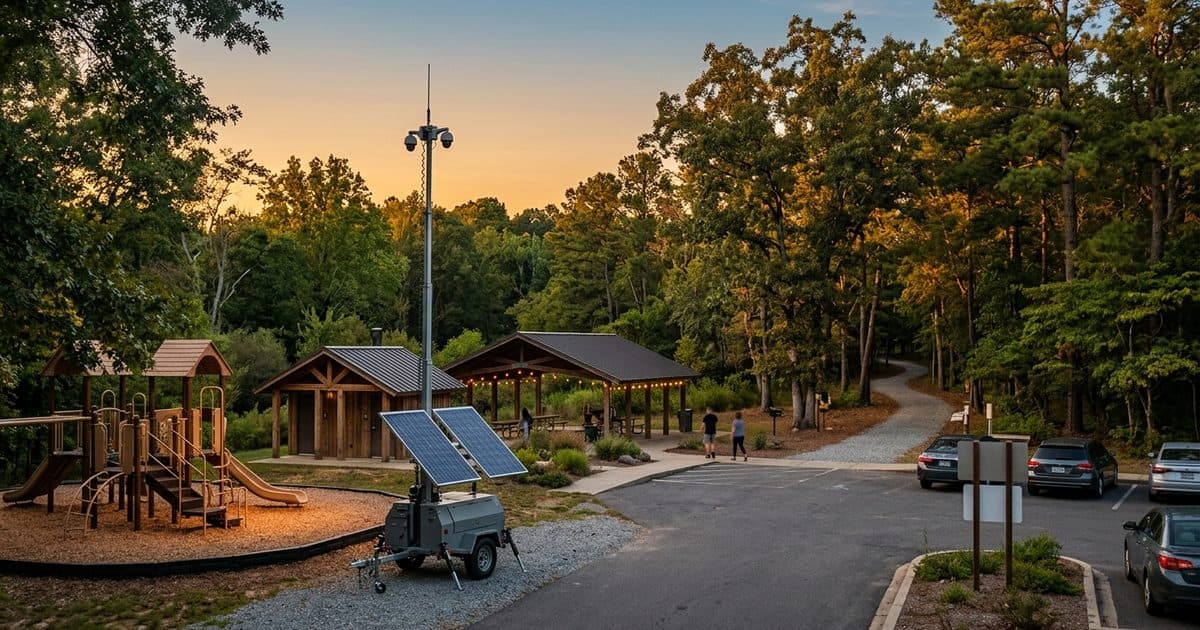
Municipal parks and public lands are built to be open, which is exactly what makes them hard to secure. There's no gate that locks the whole property, no staff on site once the sun goes down, and often no power run anywhere but the restroom building and the visitor center. Acres of turf, fence line, and gravel access road sit past the reach of the two fixed cameras someone bolted to the pavilion five years ago. Vandalism, graffiti, illegal dumping, after-hours parties, vehicle break-ins at the trailhead lot, and vehicles tearing up a ballfield all happen in that same unstaffed window — and a maintenance crew usually finds out about it the next morning, not while it's happening. This post covers the threats specific to parks and public recreation land, why fixed CCTV never reaches the parts of the property that actually get hit, what a coverage plan for a public parks system looks like, and how solar-autonomous surveillance with live monitoring changes the outcome.
The Threat Landscape at Parks & Recreation Sites
Vandalism is the most visible problem and the most expensive to keep repairing. Restroom buildings, pavilions, playground equipment, and dugouts take repeated hits — graffiti, broken fixtures, forced doors — and a department ends up repainting or replacing the same structure on a loop, with the repair bill compounding faster than the maintenance budget accounts for.
Illegal dumping is the quieter cousin of vandalism and just as costly. Gravel access roads, remote parking areas, and the back corners of public land become dumping grounds overnight — construction debris, yard waste, appliances, tires — because there's no one around to see the truck back in and no camera anywhere near it. The department absorbs the hauling cost with no one identified to bill, and the same unsupervised spot gets used again the next month.
After-hours trespass adds a different kind of risk. Groups climb a fence or simply ignore a closed gate for a late-night gathering, and what starts as a party ends as a trashed pavilion, broken lighting, and a string of noise complaints from the neighborhood bordering the park. Add vehicle break-ins at trailhead and boat-ramp lots — where gear left in plain sight in an unattended car is an easy target on a lot with no camera and no traffic — and vehicles driven straight onto turf that tears up a ballfield or green space overnight, and a parks department is exposed across every corner of the property at once, concentrated in exactly the hours nobody is watching.
The common thread is that public land is, functionally, unsupervised even when it's minutes from a police station or a residential street. The trailhead lot, the back fence line, and the pavilion at the far end of the park are unwatched sites — and that's precisely where the incidents cluster.
Why Fixed CCTV Fails Across Open Park Land
Departments that already have some cameras are often the most frustrated, because the losses keep happening anyway. Fixed CCTV goes where power and conduit already exist — usually the visitor center, the main restroom, maybe the front gate — and stops there. Everything past that radius, which for most parks is most of the property, is unmonitored.
| Capability | Fixed CCTV | Solar Mobile Surveillance |
|---|---|---|
| Coverage | Clustered near visitor center/restrooms; nothing at trailheads, fields, or access roads | Elevated wide-area coverage across the property from a single relocatable unit |
| Power & trenching | Requires grid power and conduit — rarely feasible mid-park or at a remote lot | Solar and cellular — deploys anywhere, no trenching turf or fields |
| Response | Passive recording reviewed after maintenance finds the damage | Live SOC verification and audio warning in real time |
| Seasonal shift | Fixed; can't follow the problem to a different field or lot | Relocatable to whichever site is being hit this month or this season |
| Deterrence | A camera bolted to a building nobody's watching live | Visible presence, lighting, and a live voice-down that clears a group out |
The gap that matters most is response, not just coverage. Footage that shows a pavilion getting tagged at 1am is useful for a police report, but it does nothing to stop the damage from happening. What changes the outcome is a system that detects the movement as it's happening, verifies it's a real problem, and puts a human voice into the park before the spray can comes out or the tailgate drops. Fixed cameras were installed to record an event after the fact; they were never built to interrupt one.
Tip: Site coverage to look across a park's open ground and along access roads, not just at a single building entrance. A unit positioned to see the length of a gravel road or the width of a parking lot catches a dumping run or a break-in as a vehicle arrives — which is the only point at which a live warning can actually prevent the loss instead of just recording it.
What a Coverage Plan Looks Like for a Parks System
An effective plan doesn't try to blanket the entire park boundary — it weights coverage toward the assets and the after-hours risk that's actually driving losses. For most municipal parks and public recreation sites, that means:
- Trailhead, boat-ramp, and entrance lots, with LPR: The chokepoint every vehicle passes through. License plate recognition at the lot ties every entry and exit to a plate and a timestamp, exposes repeat visitors tied to prior incidents, and flags hotlisted vehicles.
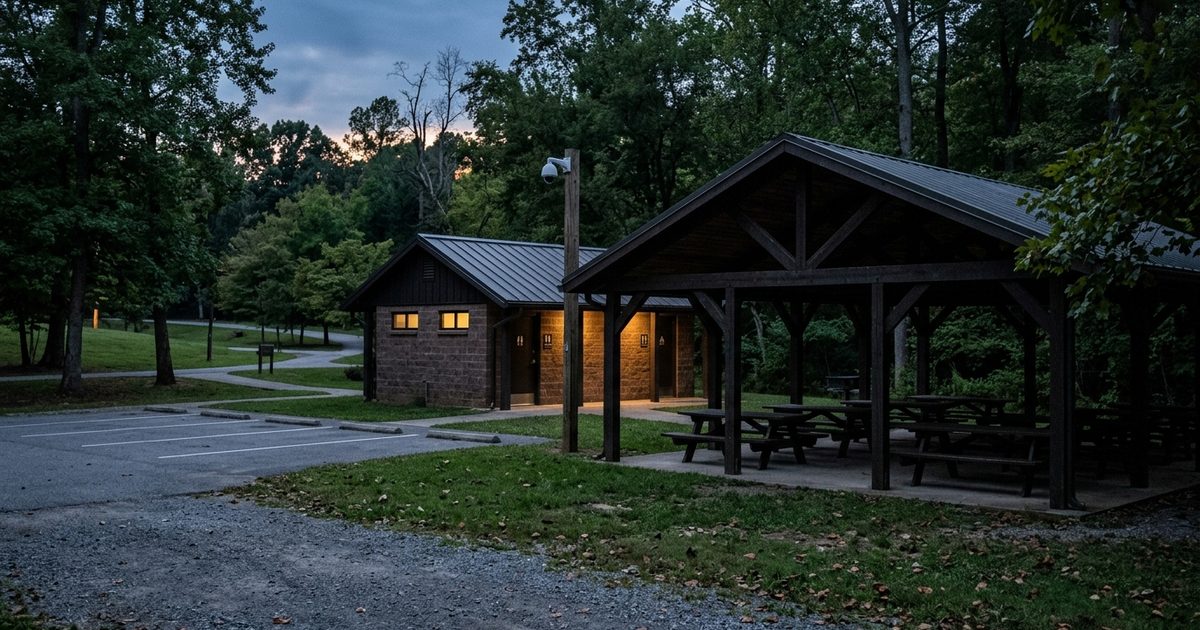
- Pavilions, restrooms, and sports facilities: The structures that take the most repeat vandalism. Elevated coverage with object detection to classify people versus vehicles and flag activity in closed sections after the park's posted hours.
- Access roads and remote lots: The gravel roads and back corners where illegal dumping happens because no one's ever there to see it. Coverage here with loitering detection catches a vehicle stopped and idling somewhere it shouldn't be.
- Playgrounds and plazas: High-visibility community spaces where a visible unit — camera, lighting, and speaker together — changes how the space reads to anyone considering after-hours misuse.
The piece that turns this from a recording system into actual protection is on-site presence that can be seen and heard: a Mobile Surveillance Unit with a mast-mounted light or a standalone solar light at a trailhead makes the difference between a dark, inviting lot and one that visibly isn't worth the risk — and because the whole system runs on solar and cellular, it goes wherever the problem actually is, not wherever a utility line happens to run.
Live Monitoring: The Ranger Patrol, Replaced
Stationing a ranger or security guard at every park after hours isn't realistic for most municipal budgets, and a camera with no one watching it live doesn't stop anything either. Live remote monitoring is the model that delivers real deterrence without either cost.
Remote video monitoring routes every alert to a SOC operator who verifies it against live video in real time. When a camera flags a group climbing the fence at midnight or a vehicle idling on the access road with the tailgate down, the operator confirms what's actually happening, then acts — a live audio warning through the unit's speaker, which alone disperses most groups and stops most dumping runs before they finish, followed by escalation to law enforcement with time-stamped footage and, if a vehicle was involved, the plate on record. Someone who counted on an empty, unlit park instead gets an immediate response from a real person.
That model gives a parks department two things a patrol schedule can't. It covers every monitored site continuously instead of wherever a single truck happens to be driving that hour, and it produces a documented incident record — the alert, the verification, the audio warning, the escalation, the plate — every time. That record is exactly what a department needs for a council budget conversation, an insurance claim after major vandalism, or a case handed to public safety partners. For a publicly funded system, NDAA-compliant hardware also keeps the procurement clean from the start, which matters for municipal buyers working through a formal bid process.
Seasonal Risk and Deployment That Follows It
Parks don't carry the same risk profile all year, and a fixed camera system can't follow the risk even if the department wanted it to. Summer brings longer hours, packed sports complexes, and tournament weekends that turn a normally quiet lot into a magnet for break-ins. A single park that starts taking repeated vandalism hits needs coverage now, not after next year's capital budget clears. An acquired or newly opened site needs a security plan on day one, not once conduit gets run.
A relocatable, solar-autonomous unit matches that reality instead of fighting it. It moves to the sports complex for tournament weekend, shifts to the trailhead lot after a string of vehicle break-ins, and covers a new park the same week it opens — deployed in under 20 minutes, with no trenching, no conduit, and no waiting on a utility crew. Coverage becomes something a department positions where the problem actually is this month, not a fixed asset frozen wherever it was first installed a decade ago.
Common Mistakes in Parks & Recreation Security
- Clustering cameras at the visitor center. The vandalism, dumping, and break-ins happen at the trailhead lot, the back access road, and the far pavilion — exactly where fixed coverage stops. Weight coverage toward the sites actually taking losses, not the building with the easiest power run.
- Recording without responding. Footage that only gets reviewed after maintenance finds the damage the next morning prevents nothing. Detection has to be tied to live verification and a real-time audio warning to actually change what happens overnight.
- Skipping LPR at lots and trailheads. The entrance lot is the one chokepoint every vehicle has to use. Without a plate-and-time record, dumping and break-in investigations start from nothing.
- Treating every park the same, all year. Risk shifts by season and by site — tournament weekends, summer parks, a location getting repeatedly hit. A one-size, fixed deployment doesn't track that; relocatable coverage does.
- Assuming a permanent install is the only option. Waiting on a capital project to trench power and conduit to a remote lot means a park stays exposed for months or years. Solar-autonomous units are deployable now, at the site where the losses are actually happening.
Public parks are one of several open, low-staffed, high-visibility environments where the same solar-autonomous, live-monitored model closes the after-hours gap — from border and perimeter land to beach and coastal access points. If vandalism, dumping, or after-hours trespass has become a recurring line item in your maintenance budget, talk to our team about a coverage plan for the sites actually driving the losses, or see how other public-sector deployments held up in our case studies.