
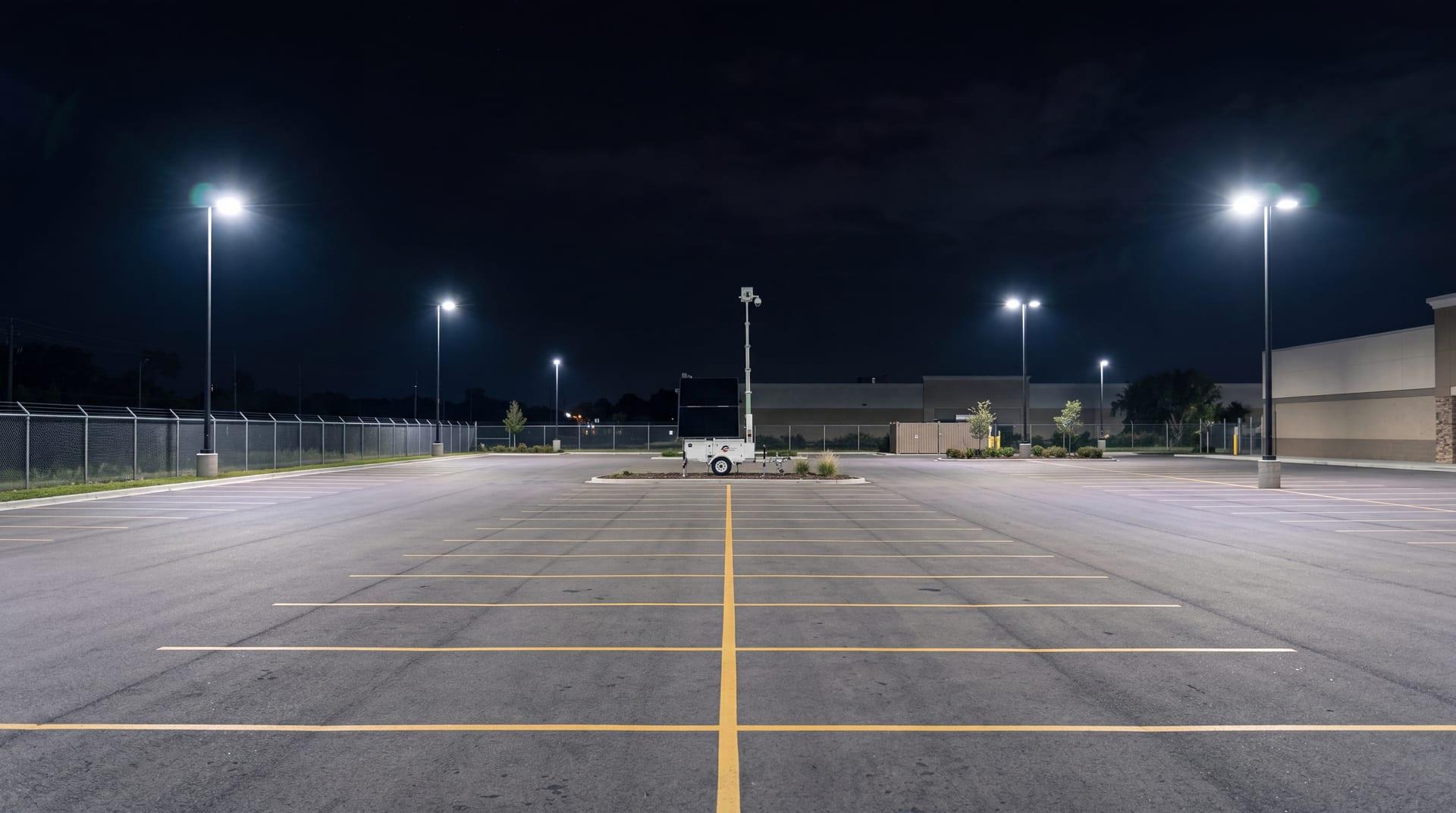
Why restaurant lots are a particular challenge
Most businesses close and empty their lots. Restaurants do not. Guests arrive and leave at all hours, delivery drivers idle in the lot, and staff leave after the last table is cleaned, often in the dark and often carrying cash or trash. Quick-service restaurants with drive-throughs add a long line of idling vehicles, and late-night locations keep the lot occupied well after neighboring businesses have gone dark.
That mix creates predictable exposure. Parked vehicles with visible items attract break-ins. Staff walking out alone are easy targets for robbery or harassment. Groups that gather in the lot after closing can intimidate customers and deter them from coming back. And many restaurants sit on pads at the edge of larger shopping centers where lighting and security are not entirely under the operator's control.
The common problems, in plain terms
| Problem | When it tends to happen | What helps |
|---|---|---|
| Vehicle break-ins | Evenings, busy periods, dark corners | Lighting, visible cameras, signage, monitored detection |
| Vehicle and parts theft | Overnight, rear rows | Cameras on the rows, catalytic converter theft prevention measures |
| Loitering and gatherings | After close, late evening | Lighting, loitering detection, live talk-down |
| Staff confrontations | Closing, cash drops, trash runs | Closing in pairs, escorts, monitored cameras |
| Vandalism and graffiti | Overnight | Cameras on walls and dumpster areas |
| Dumpster and rear-door issues | Closing and early morning | Lighting, camera at the rear entrance |
| Drive-through disputes | Peak and late hours | Camera at the window and lane |
Use this as a prompt for your own walk of the lot, not as a statement of what you will face. Local patterns differ widely.
Start with lighting and layout
Cameras and monitoring only work as well as the environment lets them. Lighting is the cheapest improvement and often the most overlooked.
Walk the lot at night, not in daylight. Look for dark pockets behind dumpsters, at the edges of the lot and along the path from the back door to employee parking. Check whether trees or signs block light. Even lighting works better than a single bright fixture, since harsh glare and deep shadow both make it harder for cameras and for people to see. The security camera lighting guide explains how light and camera settings interact.
Layout counts too. Keep employee parking close to the entrance, in view of the windows where possible. Trim vegetation that hides vehicles or doors. Place dumpsters away from the back door and out of cover. Keep lines of sight clear from inside the dining room to the front of the lot.
Protect the staff who close
Staff safety deserves attention in its own right, separate from asset protection. The riskiest moments are predictable: leaving after close, carrying the cash drop and taking out trash.
- Close in pairs, and have the last two people leave together.
- Walk staff to their cars, or have a manager watch from the door until they drive off.
- Schedule cash drops and trash runs at set times, with a second person.
- Keep the back door locked and lit, and never prop it open.
- Give staff a way to report problems and tell them they should not confront anyone.
Training matters more than equipment here. A short briefing on what to do when someone is in the lot, to call the manager or police and avoid engagement, protects people better than any camera.
What cameras should cover
A restaurant lot has more areas to cover than it appears. At a minimum, consider the main entrance and exit, the front row of parking, the employee parking area, the rear door and dumpster enclosure, the drive-through lane and window, and any outdoor seating.
Camera type matters. A fixed camera covers a defined area continuously, while a PTZ camera can scan and zoom, though it looks at only one place at a time unless set to tour. Our guide to parking lot security covers coverage planning in more depth.
Remember that recording is not the same as protecting. A large systematic review of CCTV studies found that parking lots showed one of the biggest crime reductions among the settings studied, and that systems that were actively monitored did better than systems that only recorded. A camera nobody watches may help an investigation afterward, but it will not interrupt a break-in.
Add monitoring and a voice
Live monitoring is the difference between knowing about an incident and stopping one. When AI detects a person loitering in the lot after close, an operator can verify the event on video, speak through a loudspeaker and tell the person they are being watched. If they do not leave, the operator can send video to police dispatch. For a restaurant, that response comes without a manager having to step outside.
The effect is stronger when the message is specific. A voice that says what the person is wearing and where they are standing is hard to ignore. See live talk-down audio deterrence for how this works, and loitering detection cameras for how the detection side is set up.
Loudspeaker use near homes and in mixed-use areas raises noise questions. Rules vary by locality, so confirm with counsel or your landlord before turning it on.
Plan for the lease and the neighbors
Many restaurants lease space in a larger property. Your lease may give the landlord control of lighting, common-area cameras and lot security, or it may put those on you. Before spending money, ask what the landlord already provides, what you may add and who pays for it.
If neighbors in the center share a problem, consider a shared solution. A single monitored unit placed to cover a common lot can serve several businesses, and a joint request often gets more attention from a property manager than a single tenant's complaint.
How VDS fits
VDS builds solar-powered mobile surveillance trailers for outdoor lots, which means there is nothing to wire, trench or connect to the restaurant's network. Each unit has a 5MP PTZ camera with 25x optical zoom and three 8MP wide-angle cameras on a 22 ft telescopic mast, a 900W bifacial solar array, an 11.8 kWh LiFePO4 battery bank and dual-SIM 4G/5G cellular.
AI detects people, vehicles, loitering, objects and license plates. A 24/7 US-based security operations center verifies events, uses live talk-down through the loudspeaker and sends video to police dispatch when needed, so people, yours or your security partner's, handle verified incidents. Rental, month-to-month and term subscriptions are available, and most deployments go from signed quote to live monitoring in about a week. Review the mobile surveillance unit or talk to our team at (410) 401-1986.
Sources
- Piza, E. L., Welsh, B. C., Farrington, D. P., & Thomas, A. L. (2019). CCTV surveillance for crime prevention: A 40-year systematic review with meta-analysis. Criminology & Public Policy, 18(1). onlinelibrary.wiley.com