
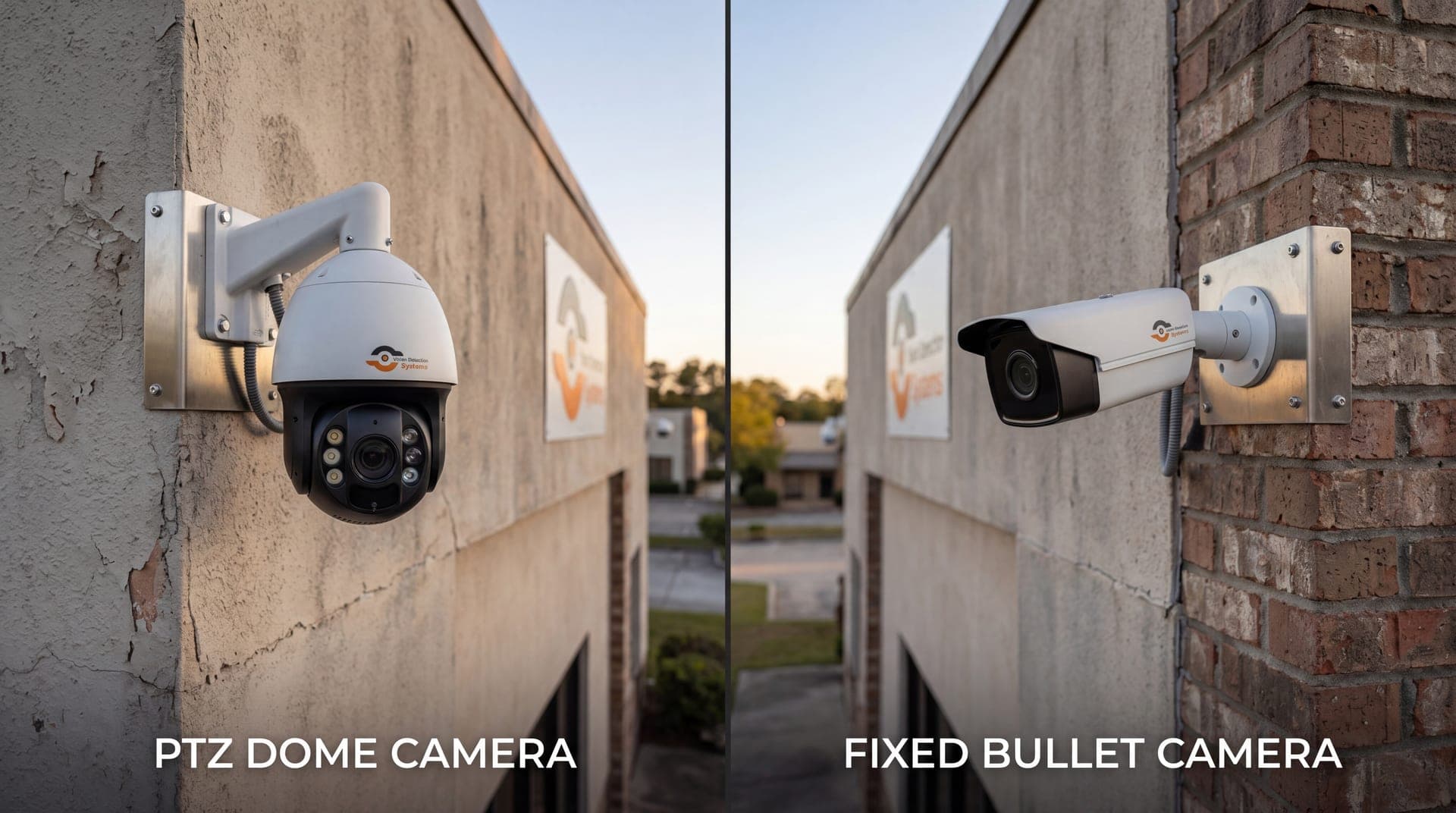
What a PTZ camera is
PTZ stands for pan, tilt and zoom. A motor turns the camera horizontally (pan) and vertically (tilt), and an optical zoom lens narrows or widens the view. One PTZ can cover a large area by moving, and it can zoom in for detail on a distant subject. Our guide to what a PTZ camera is covers the basics.
The tradeoff is that a PTZ can only look at one place at a time. While it is zoomed on one corner of a yard, it is blind to the rest. That is why a PTZ is often compared with fixed cameras, which see one fixed view all the time. See PTZ versus fixed cameras for that comparison.
How auto-tracking works
Auto-tracking connects detection to camera movement. The sequence is generally:
- Analytics detect an object that meets a rule, such as a person entering a defined zone.
- The system locks onto that object and estimates its position and direction.
- The camera pans and tilts to center the subject.
- Zoom adjusts so the subject fills a useful part of the frame.
- The camera keeps following until the subject leaves the scene, stops, or an operator takes over.
The detection can run inside the camera or come from another device, such as a wide-angle camera that spots activity and hands off to the PTZ. The second approach is common because a wide view finds the subject while the PTZ provides the close-up.
Good systems also return the camera to a home position after a set time, so it does not stay fixed on an empty area.
When auto-tracking helps
Auto-tracking earns its keep in specific situations.
- Large, open sites. Yards, lots, lay-down areas and long fence lines where one fixed camera would show only small figures.
- Unattended periods. After hours, when no one is available to steer the camera manually.
- Getting detail on a distant subject. Zooming in can show clothing, tools, vehicle type or what someone is carrying.
- Following an intruder through a site. A tracked subject is less likely to be lost between camera views.
It is less valuable in tight spaces where fixed cameras already see everything, or where a single doorway is the only point of interest.
Where it falls short
Understanding failure modes keeps expectations realistic.
Multiple subjects. A PTZ usually follows one subject at a time. If several people split up, it may follow the wrong one or bounce between them.
Occlusion. Vehicles, equipment, stacked material and buildings can hide the subject. When it reappears, the camera may not re-acquire it.
Poor visibility. Darkness, glare, fog, rain and heavy glare reduce detection accuracy. For more on these conditions, see our explainer on infrared versus thermal night vision.
Speed and distance. A fast vehicle can outpace the motor, and a very distant subject may be too small to detect reliably.
Lens limitations. Zooming in narrows the field of view, so the camera can lose the subject if it changes direction suddenly.
Missed context. The camera follows what the rules say to follow, not what matters most. It may track a harmless worker while someone else enters elsewhere.
Setting expectations on speed and range
A PTZ is a mechanical device, and mechanical devices take time. Between detection and a useful close-up there is a short delay while the motor turns and the lens zooms and focuses. A subject who runs may be gone before the camera settles. For this reason, auto-tracking is better at following steady movement, such as someone walking along a fence, than at catching a sprint.
Range also needs honest treatment. Detection range, the distance at which the system notices a person, is not the same as identification range, the distance at which you can see what they are doing. Optical zoom helps with the second, while digital zoom only enlarges pixels and adds no detail.
A quick reference
| Task | Fixed wide-angle | PTZ with auto-tracking |
|---|---|---|
| Watch a whole area continuously | Strong | Weak, sees one place at a time |
| Show detail at distance | Limited | Strong with optical zoom |
| Follow a subject across the site | Weak | Strong when it keeps lock |
| Cover blind spots | Needs more cameras | Can sweep, but not constantly |
| Work without operator input | Strong | Moderate, with failure modes |
This is why many designs use both. Fixed cameras watch everything, and the PTZ goes where the action is. The field of view guide explains how coverage and detail trade against each other.
Why operators matter
Auto-tracking answers "where is the activity." It does not answer "is this a threat." That requires judgment. A trained operator watching live video can confirm whether a tracked person is an intruder, an employee, a delivery driver or a stray animal. The operator can also take manual control, zoom to read a plate or check what someone is carrying, and decide whether to respond.
This is the logic behind video-verified alarm response. Automation finds and follows, a person confirms, and only then does anything escalate. The response can start with live talk-down over a loudspeaker, which is often enough to end an incident, as described in our piece on live talk-down audio deterrence.
Without that human step, auto-tracking risks becoming an expensive way to record a crime in better detail.
What to ask a provider
- Does tracking run on the camera or on a separate system?
- What happens when two subjects appear at once?
- How quickly does the camera return to a default view?
- Can an operator override tracking immediately?
- Who watches the live video, and what do they do when they confirm a problem?
- How is tracking performance at night and in bad weather?
Request sample footage of tracking at a site like yours, not a staged demo.
How VDS fits
Each VDS mobile surveillance unit pairs a 5MP PTZ camera with 25x optical zoom with three 8MP wide-angle cameras on a 22 ft telescopic mast (30 ft available), so the wide cameras cover the area while the PTZ provides close detail. AI detection flags people, vehicles and loitering, and a 24/7 US-based security operations center verifies events and responds with live talk-down, then police dispatch with video. The cameras do the watching so people, yours or your security partner's, handle verified incidents.
To discuss coverage for a specific site, talk to our team.