
Why night work changes the picture
A closed site is simple. Nobody should be there, so any person is an alert. An active night site is different. Workers, haulers and inspectors move around in reflective gear, equipment runs, and lights cast hard shadows. A trespasser can look like part of the crew, and a crew member can look like an intruder to someone watching a screen.
At the same time, the stakes rise. Unauthorized people near moving equipment are a safety problem, not only a theft problem. Night work also tends to attract copper, fuel and equipment thieves who know that supervision thins out on the edges of a busy site. A plan has to handle both the active zone and the quiet perimeter.
Lighting for safety first, cameras second
Lighting on a night site is mainly there so workers can do the job and see hazards. Plan it for that, then check what it does for your cameras. Our security camera lighting guide explains how placement, glare and color affect video.
A few practical points follow.
- Avoid pointing lights directly into camera lenses, which washes out the picture.
- Light the gate and any vehicle entry point so faces and vehicles can be identified.
- Keep portable light towers from creating deep shadows behind stored materials.
- Light storage and staging areas even when no one is working there.
Cameras differ in low-light performance. Some use infrared illumination, others rely on sensitive sensors, and thermal is a separate technology. See the comparison of infrared and thermal night vision before you assume a camera will see what you need.
Define zones and hours
The most useful step is to divide the site into zones and attach expected activity to each.
| Zone | Night activity expected | Security approach |
|---|---|---|
| Active work area | Crews and equipment during shift | Safety focus, spotters, controlled access |
| Gate and entrance | Shift changes, deliveries, inspectors | Sign-in, identification, clear sight lines |
| Material staging | Occasional pickups | Alert on unplanned presence |
| Equipment parking | None during shift unless moved | Alert on movement outside plan |
| Perimeter and fence line | None | Alert on any person or vehicle |
With zones defined, monitoring can ignore normal crew movement where it is expected and focus on the places where nobody should be. Without them, every alert looks the same and operators spend time sorting normal from abnormal.
Tell the monitors who is on site
A common source of confusion is a monitoring team that does not know a crew is working. Send the shift schedule, the expected headcount, the vehicles and a site contact before each shift, and send a note when the crew leaves. If someone has to work an unplanned hour, call it in.
This is a simple discipline that prevents two failures. One is a worker getting a talk-down meant for an intruder. The other is a real intruder being dismissed as crew. A written call-in routine solves both.
Keeping trespassers out of an active site
Trespass at night often comes from curiosity, shortcuts or people looking for scrap and fuel. A visible boundary, signage and lighting reduce casual entry. Our guide on stopping trespassing on commercial property covers deterrence and response in more detail.
For linear work zones, such as roadwork, perimeter control is harder because the site is long and open to traffic. Whatever the layout, keep unauthorized people away from moving equipment, since that is where a trespasser is most likely to be hurt.
Using talk-down and escalation well
A spoken warning delivered through a loudspeaker is often enough to turn away a trespasser, and it works best when the operator can see exactly what the person is doing. At night, the operator also needs to avoid addressing a worker by mistake, which is why the call-in routine matters. Read more about live talk-down audio deterrence.
Set an escalation path in advance. If a person ignores the warning or approaches equipment, who calls police and who calls the site supervisor? Write the steps down and test them at least once before the project reaches full night operations.
Worker safety is not only about intruders
Night work carries risks that security cannot fix. Fatigue, low visibility and traffic near work zones call for safety procedures, trained spotters and supervision. Monitoring is a supplement. It can spot an unauthorized person in a restricted area or a vehicle where it should not be, but it does not replace safety planning. Keep security and safety plans separate, and make sure they do not contradict each other. For example, a rule that gates stay locked must not trap a crew that needs an emergency exit, and a talk-down script should never tell a worker to stop moving near live equipment. Review both plans together with the site safety lead before night work begins, and again when the shift pattern changes.
A simple night-shift checklist
Before each shift, confirm the following.
- Monitors have the schedule, headcount, vehicles and a site contact.
- Gate, staging and storage lighting works and is not glaring into camera lenses.
- The active work zone is marked, and everything outside it is treated as restricted.
- Equipment is parked in the planned spot with keys removed.
- Everyone knows the escalation path and who makes the call to police.
After the shift, confirm that the crew has left, the gate is secured and the monitors have been told. A site that cycles between active and empty every day needs this handoff each time.
Where VDS fits
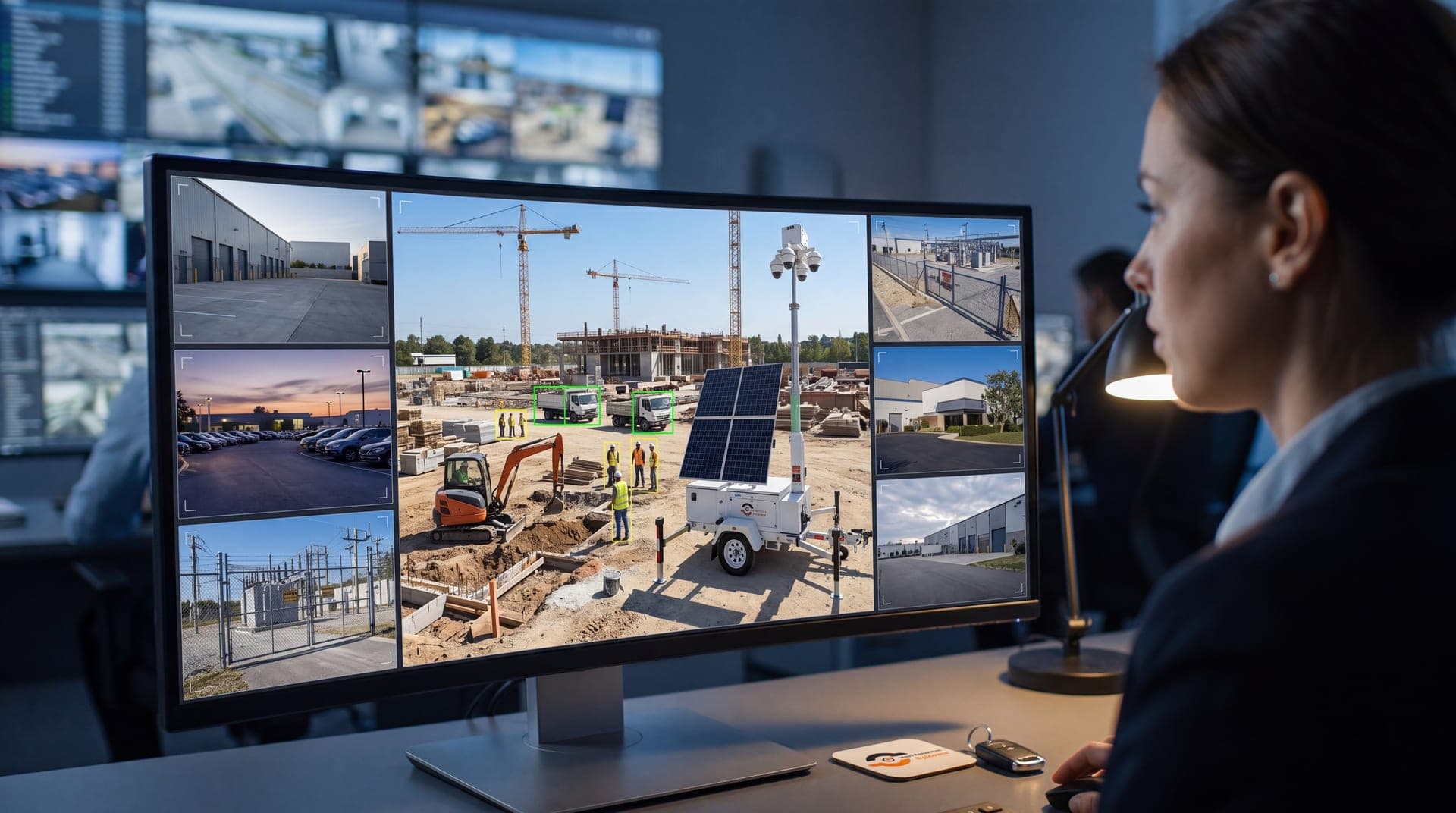
VDS builds solar-powered mobile surveillance units that need no site power, internet or trenching, so coverage can follow a night site as it moves. Each unit has a 5MP PTZ camera with 25x optical zoom and three 8MP wide-angle cameras on a 22 ft telescopic mast. AI detects people, vehicles and loitering, and a US-based 24/7 security operations center verifies events, uses live talk-down through a loudspeaker and escalates to police dispatch with video, so people, yours or your security partner's, handle verified incidents. Learn about remote monitoring or talk to our team about your shift schedule.