
Why tow yards carry unusual exposure
Most businesses protect their own assets. An impound lot or tow yard protects other people's vehicles and everything inside them, and the owners tend to arrive already frustrated. That combination creates three recurring problems.
Damage disputes. An owner sees a scratch, a cracked bumper or a missing wheel and says it happened in your yard. Without good records, you cannot show otherwise.
Theft and stripping. Parts, wheels, batteries and contents are attractive, and vehicles that sit for days or weeks, often unlocked or with keys unavailable, are easy to work on at night.
Release errors. A vehicle handed to the wrong person, or released without the right paperwork, is an expensive mistake.
Rules governing towing, storage, liens, release and liability vary by state and often by municipality. Confirm requirements and your exposure with counsel, and check the terms of any contracts with police agencies or property owners that send you vehicles.
Build the intake record first
The strongest defense against a damage claim is a clean record made at the moment of arrival. Do this the same way for every vehicle:
- Photograph all four sides, the roof if accessible, the wheels and any existing damage.
- Record the plate, vehicle description, location of the tow and the driver.
- Note visible contents and whether the vehicle is locked.
- Capture the vehicle on camera as it enters the lot and as it is placed in a row.
- Assign a stall or row location and write it down.
Photographs should carry a date and time stamp. A video of the intake area gives a second source, and the two together are hard to dispute. Our guide on security camera footage as evidence explains how to preserve and present video so it holds up.
Cover the gate with cameras and a log
The gate is where you control who and what enters and leaves, so it deserves the most attention.
Keep a gate log that records date, time, vehicle description, plate, the person driving or collecting and the paperwork checked. A written log is useful, but a log can be wrong or altered, which is why video of the gate matters. A camera aimed at the entrance and exit, set up to capture plates, lets you check the log against what actually happened.
Plate capture depends on setup. As a rule of thumb, plate characters need roughly 20 to 30 pixels of height, moving vehicles call for a shutter of 1/1000s or faster, and the camera should sit within about 15 to 30 degrees of the lane. The license plate recognition camera guide covers this in detail, and automated gate access with LPR explains how plate reads can support access decisions.
Watch the rows and the perimeter
Once vehicles are in the lot, the risks shift to stripping and vandalism. Coverage should be planned around the places people actually approach: the fence line, the corners, any gap where a gate meets a fence and the back rows farthest from the office.
Think about what a camera can see. Rows of tall vehicles block lines of sight, and a single camera at ground level will see little past the first row. Mounting higher widens the view across the lot, at some cost to facial detail at distance. A PTZ camera can cover a large area, though it only looks at one place at a time unless it is set up for patrols or auto-tracking.
Lighting matters as much as cameras. Poorly lit rows are ideal for stripping parts, and cameras perform badly in the dark without adequate light or infrared. See the security camera lighting guide for how light and camera settings work together.
Quick reference for intake, gate and rows
| Area | Main risk | Control | Record to keep |
|---|---|---|---|
| Intake | Disputed damage | Photos and video at arrival | Time-stamped photo set and intake form |
| Gate | Wrong release, unauthorized entry | Gate log, plate capture, ID check | Log entry plus gate video |
| Back rows | Stripping, vandalism | Monitored cameras, lighting | Video of rows and perimeter |
| Office | Key and paperwork handling | Controlled access, logged keys | Key log, release paperwork |
| Perimeter | After-hours entry | Fence, lighting, monitored detection | Alert log, video clips |
| Storage period | Long-stay vehicles forgotten | Periodic walk and camera check | Dated condition notes |
After-hours is when the losses happen
Most stripping occurs when nobody is on site. A yard that is staffed during the day and empty from evening until morning has a long window with no one watching. Recording alone helps afterward but does not stop the loss. Research on closed-circuit cameras has found that actively monitored systems are associated with a larger crime reduction than passive recording-only systems, and parking lots showed some of the largest effects among the settings studied.
Monitoring means a person verifies an event, speaks to the intruder and, if needed, calls police with video. That changes the outcome from finding a missing wheel in the morning to interrupting the person who was about to take it. Our overview of remote monitoring explains how this works.
Handling a claim when it comes
Even a well-run lot gets claims. A good process keeps them manageable.
- Pull the intake photos and video first, and compare condition at arrival with the complaint.
- Check the gate log and gate video for the release.
- Review row video for the date range if theft is alleged.
- Keep the evidence in a protected folder and avoid altering originals.
- Share video with police or insurers using a clear procedure.
- Refer legal questions to counsel before making statements about liability.
Consistent records also help you sort real incidents from false claims. Not every complaint will be valid, and being able to show a clear record is often the most efficient way to resolve one.
How VDS fits
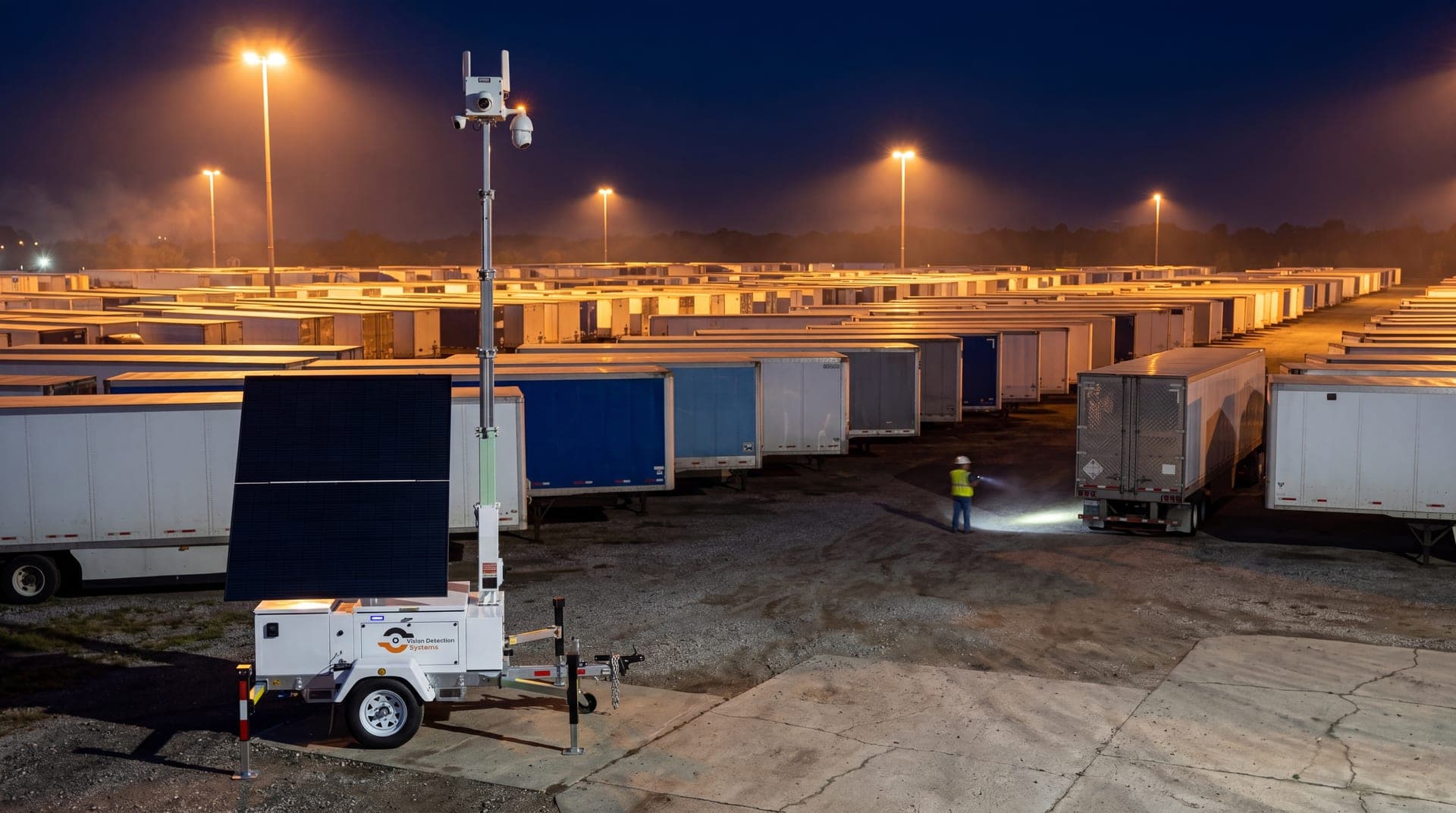
VDS builds solar-powered mobile surveillance trailers that can be placed on a lot with no site power, internet or trenching. Each unit has a 5MP PTZ camera with 25x optical zoom and three 8MP wide-angle cameras on a 22 ft telescopic mast (30 ft available), a 900W bifacial solar array charging an 11.8 kWh LiFePO4 battery bank, and dual-SIM 4G/5G cellular.
AI detects people, vehicles, loitering, objects and license plates. A 24/7 US-based security operations center verifies events, speaks through the loudspeaker for live talk-down and sends video to police dispatch when needed, so people, yours or your security partner's, handle verified incidents. Most deployments go from signed quote to live monitoring in about a week. Review the mobile surveillance unit or talk to our team at (410) 401-1986.
Sources
- Piza, E. L., Welsh, B. C., Farrington, D. P., & Thomas, A. L. (2019). CCTV surveillance for crime prevention: A 40-year systematic review with meta-analysis. Criminology & Public Policy, 18(1). onlinelibrary.wiley.com