
Why a hospital garage is a different environment
A hospital garage is not a typical office lot. It serves a building that is open every hour of every day, so there is no quiet period when the structure can be locked down. Shifts change at night. A nurse finishing at 3 a.m. walks to a car through a space that may be nearly empty. A family member arriving after a late emergency may be upset and not paying attention to surroundings.
Several conditions raise the importance of security:
- Constant foot traffic at all hours, with changing patterns across shifts.
- Visitors who are stressed, tired or unfamiliar with the layout.
- Staff who leave alone at night, sometimes after long shifts.
- Multi-level structures with stairwells, corners and low ceilings that limit sightlines.
- Vehicles left for long periods, which can attract theft and break-ins.
None of this means a hospital garage is unusually dangerous. It means the design should assume that people are there at the hours when visibility is lowest, and that security staff cannot be everywhere at once. Hospital security teams are usually busy with the emergency department, patient areas and access control, so the garage competes with many other demands for attention.
Start with lighting
Lighting is the foundation of garage safety, and it is also what makes cameras useful. A dim corner is uncomfortable to walk through and produces a poor image. Check that lights are working, evenly spaced and positioned to reduce deep shadows near pillars, ramps and stairwells.
Color and brightness matter for video. Warm, uneven light may leave faces dark, and glare from a bare bulb can wash out a view. Our parking lot security article covers surface lots in more detail. Our security camera lighting guide explains how lighting affects image quality, and it is worth reviewing before choosing camera positions.
Where cameras do the most good
In a multi-level structure, camera placement should follow how people actually move.
| Location | Why it matters |
|---|---|
| Vehicle entrances and exits | Records every vehicle in and out, supports plate capture |
| Pedestrian entrances and exits | Captures people arriving and leaving on foot |
| Stairwell doors and landings | Common point of concern for personal safety |
| Elevator lobbies | Natural gathering point where people wait |
| Each level, down the main aisle | Gives a view along the drive lane and parked vehicles |
| Pay stations and call points | Where people stop and may be distracted |
| Surface lots and walkways to the building | The last stretch before staff reach a door |
Keep cameras focused on parking areas and approaches, and review the field of view after installation to make sure it shows only what it should. Hospitals have additional privacy obligations, and rules vary by state, so confirm what is allowed with your counsel before placing any camera near patient areas or building interiors.
Emergency response and getting help quickly
Camera coverage supports security staff, but people also need a way to ask for help. Many hospitals add emergency call points, clearly marked and well lit, along the paths to the car. Escort programs for staff leaving at night are also common.
What matters is the time between something happening and someone reacting. A call point with no one watching the video leaves security guessing. A call point near a camera that is monitored lets the operator see the situation, speak through a loudspeaker and send help to the right level.
Our article on live talk-down audio deterrence explains how a spoken message can stop a problem early. A voice saying that the person has been seen and help is on the way often changes behavior before anyone gets hurt.
Cameras with monitoring, not cameras alone
A recording-only system helps investigate after something has occurred. A hospital that never closes needs more than that. Monitoring turns cameras into a live safeguard, since someone is watching when no staff member is looking at a screen.
Research supports the difference. A 2019 systematic review of 76 studies found CCTV associated with roughly a 13% reduction in crime in target areas and about 37% in parking lots. Actively monitored systems showed about a 15% reduction, while passive recording-only systems showed no significant effect. Programs that combined cameras with multiple other interventions, such as lighting and access changes, showed about a 34% reduction.
That last finding fits a hospital well. Lighting, cameras, call points and monitoring work better as a package. Our overview of parking lot surveillance with 24/7 monitoring describes how that package comes together.
Connectivity inside a concrete structure
Parking structures can be hard on wireless signals. Concrete and steel block cellular and Wi-Fi, so cameras inside often rely on wired connections to the hospital network. Plan cable routes early and coordinate with the facilities and IT teams. Camera security matters here as well, since devices on a hospital network should be kept up to date and isolated from systems that handle patient data.
Surface lots and the approaches to a garage are different. They often have open sky and no convenient power or network, which makes them a good fit for a self-powered unit.
Temporary coverage during construction or events
Hospitals are often under construction. A garage closed for repair, a surface lot used for overflow parking or a new building under development can all create gaps in coverage. A mobile unit can cover those areas without waiting for new wiring, then be moved when the project ends. Our healthcare industry page describes more about how monitoring fits healthcare sites.
How VDS fits hospital parking
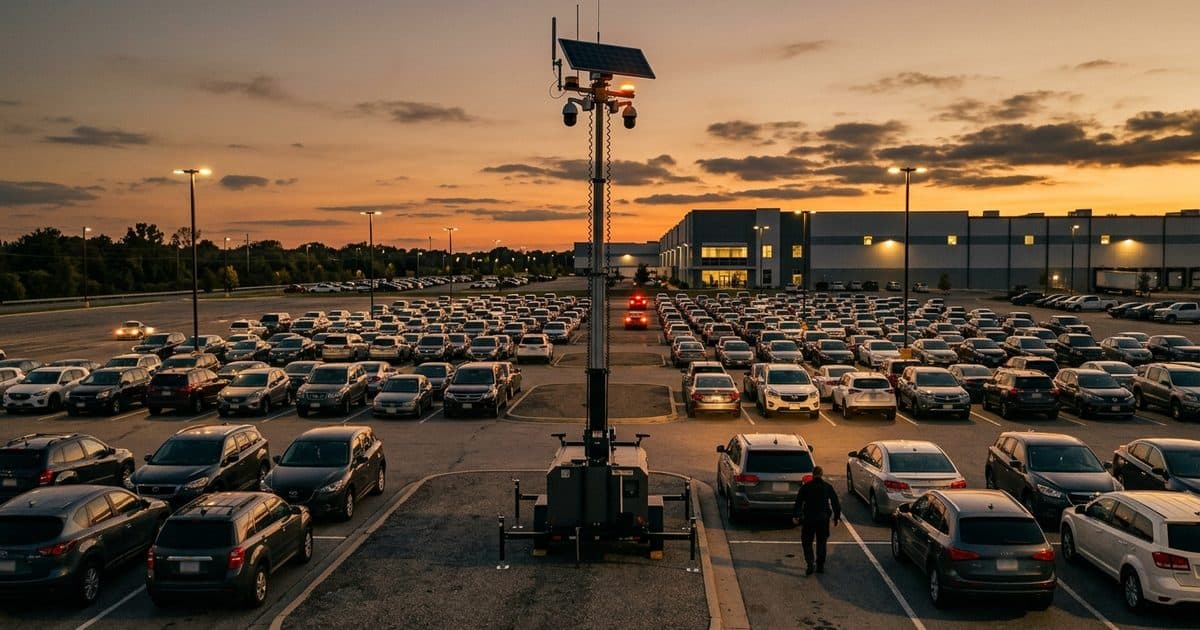
The VDS mobile surveillance unit is a solar-powered trailer with a 5MP PTZ camera with 25x optical zoom and three 8MP wide-angle cameras on a 22 ft telescopic mast. It runs from a 900W bifacial solar array and an 11.8 kWh LiFePO4 battery bank, and connects over dual-SIM 4G/5G cellular, so it needs no site power, internet or trenching. That suits surface lots, overflow areas and construction zones around a hospital campus.
AI detection looks for people, vehicles, loitering, objects and license plates. Our 24/7 US-based security operations center verifies events, speaks through the loudspeaker, then contacts police with video when needed, so people, yours or your security partner's, handle verified incidents. Learn more about remote monitoring or talk to our team.
Sources
- Piza, E. L., Welsh, B. C., Farrington, D. P., & Thomas, A. L. (2019). CCTV surveillance for crime prevention: A 40-year systematic review with meta-analysis. Criminology & Public Policy, 18(1). onlinelibrary.wiley.com