
Two kinds of risk at one site
Fuel facilities have an ordinary property-crime problem and a safety problem, and they interact.
- Theft. Product, equipment, tools, catalytic or copper components, and fuel taken from trucks or equipment on site.
- Tampering. Opening or damaging valves, fittings, gauges or controls.
- Trespass. People climbing tanks, entering dikes or wandering through the yard.
- Fire and spill. Whether accidental or deliberate, the consequence can be severe.
Insiders deserve a mention. Security at fuel sites is often designed against outsiders, but employees, drivers and contractors have the most access. Controls that log who did what, backed by video, protect honest staff as well as the product.
The second group raises the stakes of the first. A small act at the wrong place can cause a large loss, so response speed and certainty matter. Our article on diesel fuel theft prevention covers the theft side in more depth.
Start with a site walk by zone
Terminals differ, but most contain similar zones. Walk each with operations and safety staff.
- Outer fence and gates. The boundary, vehicle gate, pedestrian gate and any emergency access.
- Tank farm and dike areas. Tanks, ladders, stairways, dike walls and drainage.
- Pump, manifold and valve areas. Where product is moved and directed.
- Loading racks. Truck bays, meters, controls and connections.
- Control and office buildings. Records, control systems and staff.
- Parking and staging areas. Where tank trucks wait and where visitors park.
Gates and vehicle control
Every tank truck is a potential theft vector or accident, so entry control is central. Capture the vehicle, plate and driver at the gate, check them against expected loads, and keep time-stamped records. See our license plate recognition camera guide for setup considerations.
Unscheduled arrivals, vehicles that linger outside the fence and trucks parked in unusual spots are all patterns worth flagging. Make sure the person who sees the alert knows what to do about it.
Loading racks
The loading rack is where product leaves, so accuracy and accountability matter.
- Video of each bay, tied to the loading record, helps reconcile disputes and catch fraud.
- Cameras should show the driver, the vehicle and the connection area.
- After-hours loading should be known in advance, so unexpected activity stands out.
- Review exceptions such as loads without matching records.
Drivers and loaders are part of the picture as well. Know who is allowed to load, whether credentials are shared, and whether the same person appears on video at the rack as on the paperwork. Many theft schemes depend on shared credentials or on an insider, so records and video reinforce each other.
Rules for equipment near the rack differ by site classification, which brings us to hazardous areas.
Hazardous areas and equipment
Parts of a fuel facility are classified as hazardous because of flammable vapors. Electrical and electronic equipment used in those areas must be rated for them, and requirements vary by site and jurisdiction. Do not assume a standard camera can be mounted anywhere. Confirm placement and equipment ratings with your safety and engineering teams and the authority having jurisdiction.
A common approach is to monitor from outside classified zones, using cameras on masts or fence lines with a view into the area, and to use rated equipment only where it is required.
Fire and spill considerations, in general terms
Video analytics can flag smoke or flame as an early warning. Our article on fire and smoke detection cameras explains how that works and its limits. At a fuel facility it supplements, and never replaces, dedicated fire detection, spill controls and the site emergency plan.
For a spill, the useful camera question is usually not detection but verification: when another system raises an alarm, can someone see the area quickly and decide what to tell responders?
Quick-reference table
| Zone | Main concern | Useful coverage | Safety note |
|---|---|---|---|
| Fence and gates | Trespass, unauthorized vehicles | Perimeter analytics, plate capture | Keep clear of emergency access |
| Tank and dike areas | Climbing, tamper | Views of ladders and valves | Confirm equipment ratings |
| Valves and manifolds | Tamper, theft | Close views, alarms | Check classification |
| Loading racks | Product theft, fraud | Bay video tied to records | Follow site rules |
| Staging and parking | Fuel theft from vehicles | Lighting, video | Control unknown vehicles |
Verification and escalation
Speed and certainty both matter. A slow response lets damage grow, while a false dispatch pulls responders away and can erode trust in the system. Verified video is the usual way to get both. Treat alerts seriously and define escalation in advance. Who is called for a person inside the dike, a vehicle at the fence at night, or smoke at a rack? The plan should name the people, the order and the information passed on. Related reading includes our guide to oil and gas security cameras.
Where a mobile unit fits
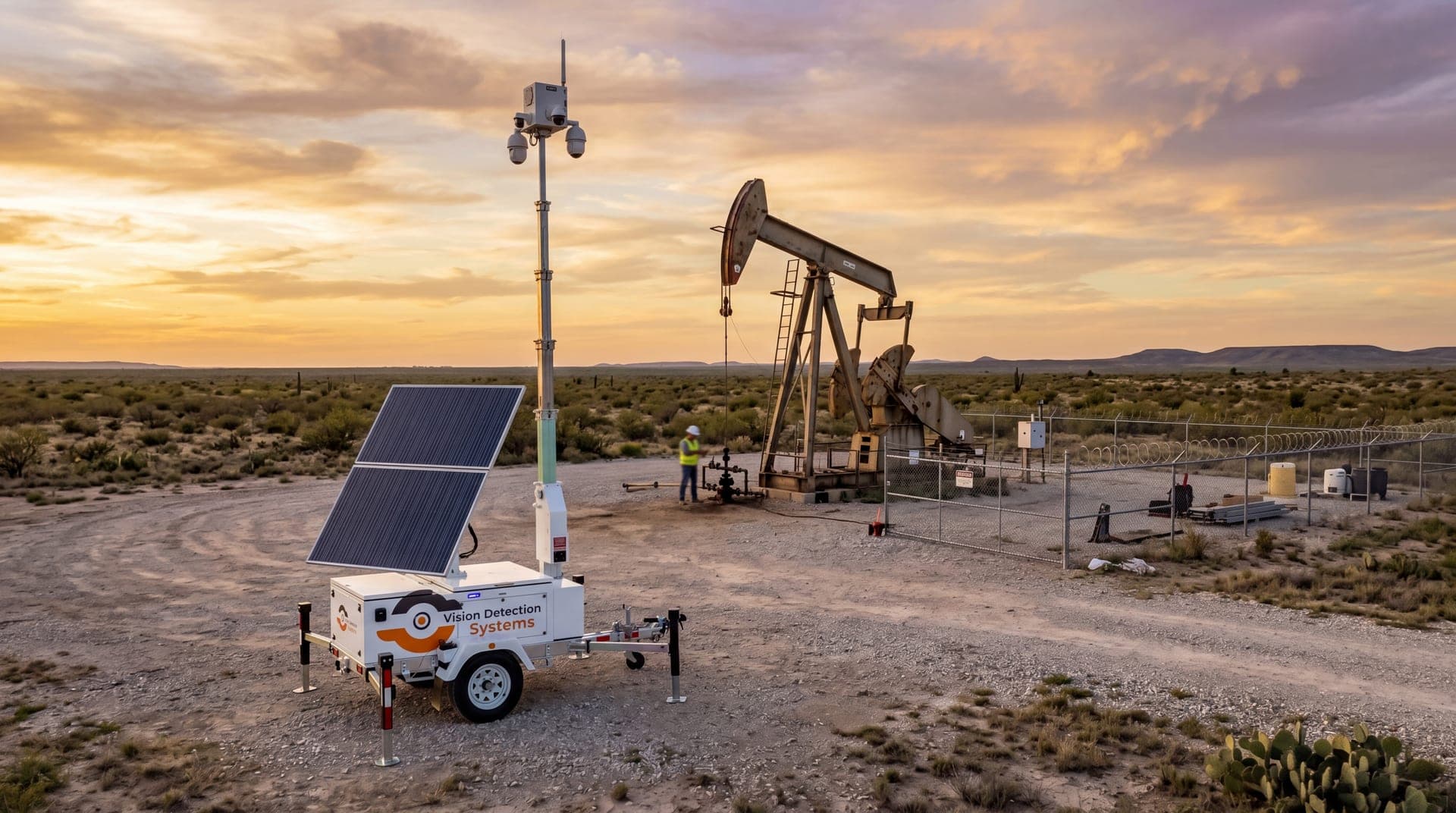
A VDS mobile unit works well for fence lines, yards, staging areas and temporary work zones outside hazardous classified areas. It is a solar-powered trailer with a 5MP PTZ camera with 25x optical zoom and three 8MP wide-angle cameras on a 22 ft telescopic mast (30 ft available), and needs no site power, internet or trenching. AI detection flags people, vehicles, loitering and license plates, and platform analytics pages also exist for fire and smoke.
A 24/7 US-based security operations center verifies events, responds with live talk-down through a loudspeaker, then dispatches police with video. That lets cameras do the watching so people, yours or your security partner's, handle verified incidents. The hardware is NDAA Section 889 compliant. See the oil and gas industry page and the mobile surveillance unit, and confirm placement with your safety team. To discuss a site, talk to our team.
Security decisions at fuel facilities are never made alone. Bring operations, safety and engineering into every step, from camera placement to alert response. Document the decisions too, including why a camera sits where it does and which areas are intentionally not covered, so that the next person who reviews the system understands the reasoning and does not undo it by accident.