
What makes these sites hard
The usual advice for industrial sites assumes a boundary, a gate and an owner who controls who comes and goes. Dams and levees often have none of these in the ordinary sense.
Dams and levees combine several difficult conditions at once. They are public works that people use, they are long and irregular, and they are often far from staff and utility power.
- Mixed use. Anglers, hikers, cyclists, boaters and neighbors may have lawful access to parts of the site, while other parts are restricted.
- Length. A boundary measured in miles cannot be fenced and watched evenly.
- Remoteness. Response time to a rural access road can be long, and cell coverage may be uneven.
- Weather and terrain. Floods, ice, vegetation and soft ground affect equipment and access.
- Consequence. The structure matters to public safety, so tampering is taken seriously even when the actual damage is small.
The security question is therefore selective. Which locations matter most, and what should happen when someone is there who should not be.
Map the real access points
Talk to the people who work the site every week, including operators, mowing crews and local law enforcement. They know which gates are routinely left open, where people park and which trails are used.
Start with a drive-through and a map, not a camera list. Note every way a person or vehicle can reach the site.
- Access roads and gates. Primary and secondary roads, maintenance tracks and gates that are often left open.
- Crest and walkways. Places where the public can reach the top of a structure.
- Control structures and equipment houses. Gate controls, pumps, panels and electrical gear.
- Water-side access. Boat ramps, shorelines and wading areas near restricted structures.
- Neighbors and trails. Informal paths from adjacent property or parks.
Our surveillance trailer site selection article discusses how to pick vantage points that cover several of these at once.
Separate public from restricted
Where the public is allowed, say so, and where it is not, mark it. Good signs, simple barriers and lighting at transitions reduce confusion and make later enforcement easier. Our guide to stopping trespassing on commercial property covers signage and posting principles, though rules differ by state and owner type, so confirm requirements with counsel.
Monitoring should reflect the same split. A person on a public trail is normal. A person at the door of a control house at night is not. Alert logic and reviewer instructions should know the difference.
Access roads are the cheapest layer
Most incidents involving a vehicle begin on the road. A monitored gate and a view down the road can reveal who arrives, when, and in what vehicle. Roads also tell you something about intent. Someone who drives a long dirt track at night and turns off the headlights is not a lost tourist, and an early view of that behavior gives a reviewer time to act before the vehicle reaches the structure.
- Keep gates in working order and record when they are left open.
- Light the gate area, and aim cameras so that headlights do not blind them.
- Capture vehicle details that support a report, such as the make, color and plate when visible, which takes deliberate camera placement and angle.
- Note who has keys and how often locks are changed.
Power, connectivity and weather
Remote dams may have power at the control house but not at the places where cameras would be most useful, and a levee may have none at all. Solar-powered systems avoid trenching and long cable runs, but should be sized for local conditions, including cloudy periods. See solar security camera battery life. Where cellular coverage is weak, ask a provider what alternative communication paths they support, and test signal at the exact spot before committing.
Floods and high water also matter. Equipment near a waterway should sit above expected water levels and be easy to remove ahead of a known event.
Quick-reference table
| Location | Main concern | Useful control | Who reviews |
|---|---|---|---|
| Access road and gate | Unauthorized vehicles | Lighting, gate monitoring, plate capture | Monitoring center or operator |
| Crest or walkway | Public in restricted areas | Signs, barriers, detection at transitions | Reviewer who knows normal use |
| Control house | Tamper, theft | Door alarms, video, talk-down | Verified before dispatch |
| Water-side access | Boaters near structures | Posting, lighting, video | Seasonal attention |
| Informal trails | Unnoticed entry | Detection on known paths | Pattern review over time |
Plan for the unusual days
Security needs change during inspections, repairs and emergencies. Equipment staged for a repair attracts attention, and flood fighting or post-storm work brings new people and vehicles to the site. Temporary coverage is useful on those days. Our notes on disaster recovery site security covers the pattern, and the same logic applies to dams and levees during flood response.
Where a mobile unit fits
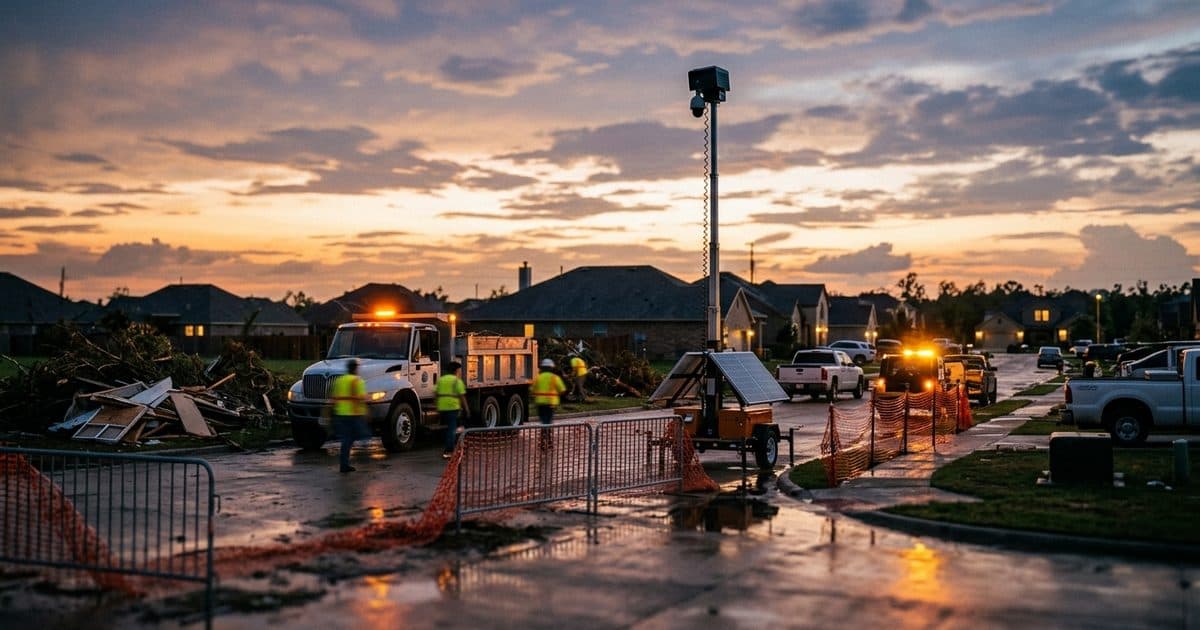
A VDS mobile unit is built for places without power or internet. It is a solar-powered trailer with a 5MP PTZ camera with 25x optical zoom and three 8MP wide-angle cameras on a 22 ft telescopic mast (30 ft available), charging an 11.8 kWh LiFePO4 battery bank with reserve for 3-5 consecutive cloudy days, with dual-SIM 4G/5G cellular. AI detection flags people, vehicles and loitering, and a 24/7 US-based security operations center verifies events, speaks to intruders through a loudspeaker, then dispatches police with video if needed.
That lets cameras do the watching so people, yours or your security partner's, handle verified incidents. Setup takes one person under 20 minutes, and the hardware is NDAA Section 889 compliant. See the disaster recovery industry page, the mobile surveillance unit, or talk to our team about a specific site.
Start with the road and the control house
If you can only cover two things, cover the access road and the equipment that operates or monitors the structure. Add coverage from there as the site's real traffic patterns become clear.
Keep a log of what the cameras see over the first few weeks. Fishing seasons, hunting seasons, holidays and school breaks change who visits, and early records help reviewers separate seasonal patterns from real problems. Share that log with the owner and operator so decisions about gates, signs and hours rest on observed use.