
What does remote guarding mean?
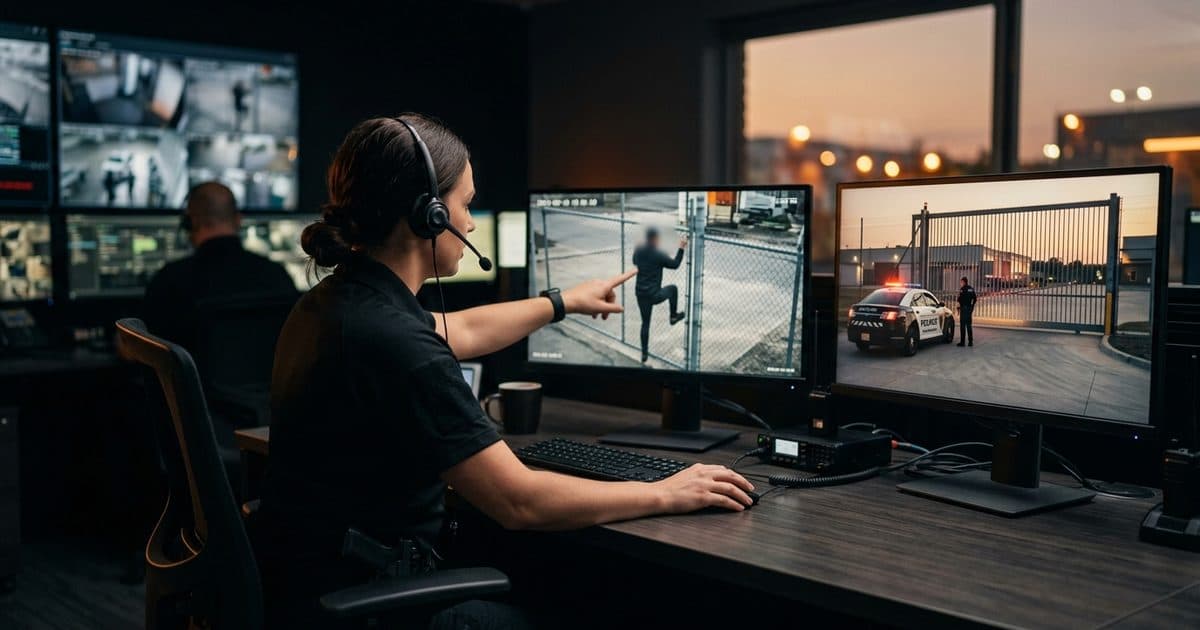
Remote guarding means live people are actively watching and acting on your cameras, not just recording footage for later. When motion analytics or AI detection flags activity on a protected site, an operator sees the triggering clip within seconds, judges whether it is a threat, and takes action: issuing a live audio warning, notifying the site contact, or escalating to a patrol response or police with verified evidence in hand.
You will see the same service sold under several names: virtual guarding, virtual guard services, remote video surveillance, and remote video monitoring. The terms overlap heavily. In practice, "remote guarding" tends to emphasize the active-intervention side of the service, especially live voice-downs and coordinated escalation, while "remote video monitoring" is the broader umbrella for any operator-watched camera service. If a provider uses one term or the other, what matters is the workflow underneath, which is why the evaluation questions later in this post focus on process rather than labels.
One point worth stating plainly, because the category is often framed badly: remote guarding is not a rival to the security officer profession. Guard and patrol companies are among the heaviest users and operators of this technology. Many run their own SOCs or white-label a remote monitoring service so their officers spend shifts responding to confirmed events rather than driving loops past quiet gates. The technology extends what a security team can cover; it does not change who does the guarding.
How does remote guarding work?
Most remote guarding programs follow the same four-stage loop: detect, verify, intervene, escalate. The stages matter because each one filters out noise before a human being is asked to respond in person.
Detection: analytics flag activity worth a look
Cameras equipped with video analytics watch for defined triggers: a person or vehicle entering a zone after hours, loitering near a laydown area, movement along a fence line. Modern AI detection on a monitoring platform can distinguish people and vehicles from swaying branches, headlights, and animals, which dramatically cuts the raw alert volume operators have to review. Detection tuning is not a one-time setup task; sites change, and the alert rules should change with them. Poorly tuned analytics bury operators in clutter, which is why reducing false alarms in video analytics is a discipline of its own.
Verification: a human confirms what the camera saw
This is the stage that separates remote guarding from a bare alarm system. An operator reviews the live feed and the triggering clip and answers one question: is this a real event? A delivery driver at the wrong gate, a tarp flapping in the wind, and an intruder cutting a lock all generate similar motion alerts. Only a person, aided by context like site schedules and authorized-visitor lists, can reliably tell them apart. Verified events move forward; everything else is logged and dismissed without anyone being dispatched.
Intervention: live audio changes behavior in the moment
When the event is real, the operator's first tool is usually a live or recorded voice warning over on-site speakers: naming what the person is wearing, stating that police are being contacted, and instructing them to leave. Hearing a specific, real-time description is a very different experience for a trespasser than noticing a passive camera. Many verified events end at this stage, before any response is needed on the ground.
Escalation: verified incidents reach the right responder
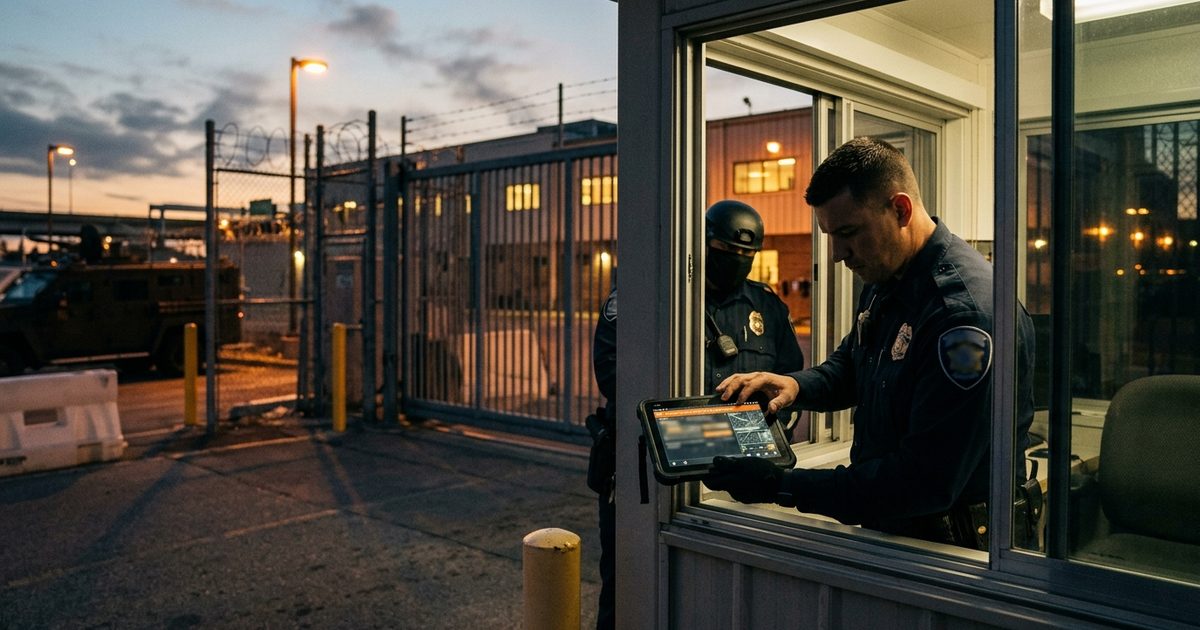
If the subject does not leave, or the event is serious from the start, the operator escalates according to a pre-agreed protocol: the site owner, the client's security partner's patrol team, or police, with live video context and a description to relay. Verified escalation matters twice over. It means responders arrive knowing what they are walking into, and it means police treat the call as a crime in progress rather than one more unverified alarm. The whole loop, from trigger to escalation, is measured in minutes; the 60-second SOC breakdown walks through what happens inside that window.
Does remote guarding actually deter crime?
The evidence on actively monitored cameras is encouraging, with honest caveats. An Urban Institute evaluation of public surveillance camera programs found that actively monitored cameras reduced crime by up to roughly 20% in the areas studied. Two caveats belong next to that number: the evaluation dates to 2011 and covered public-space camera programs, and results varied by city and by how actively the feeds were watched. The consistent thread in the research is the word "actively." Cameras that no one watches document crime; cameras with live operators behind them interrupt it.
Deterrence also compounds over time on private sites. Word travels when a property answers after-hours intrusions with an immediate, specific voice warning and a fast, verified escalation. Sites that respond in real time stop being easy targets, and repeat probing tends to fall off.
Where does remote guarding fit alongside on-site officers?
The most accurate frame for remote guarding is a force multiplier for security teams, not a substitute for them. On-site officers do things no camera can: control access in person, de-escalate face to face, escort people and assets, respond physically. Remote guarding takes over the part of the job that spreads a team thin, which is continuously watching every corner of every site at once, and hands officers something better than a patrol loop: a queue of verified incidents.
Staffing reality makes this pairing more valuable, not less. The Bureau of Labor Statistics projects about 162,300 openings for security guards each year on average over the decade, most of them from replacement churn as workers change occupations or leave the labor force. Guard companies fight that churn constantly, and every hour of coverage is hard-won. Remote guarding lets a security team, in-house or contracted, put its people where verified incidents are happening instead of stretching them across quiet hours and empty lots. That is exactly why so many guard companies operate remote guarding programs themselves: it makes each officer they field count for more.
For a deeper look at how the two models divide the work in practice, see remote video monitoring vs. security guards, which walks through pairing scenarios site by site.
How is remote guarding different from traditional alarm monitoring?
Traditional alarm monitoring reacts to sensor signals; remote guarding sees, verifies, and intervenes. The table below compares the three most common configurations on the capabilities that decide outcomes.
| Capability | Unmonitored cameras | Traditional alarm monitoring | Remote guarding |
|---|---|---|---|
| Detects activity in real time | Analytics only, no one watching | Sensor trip only | Analytics plus live operator |
| Verifies before escalating | No | Rarely (call-list checks) | Yes, human reviews live video |
| Intervenes during the event | No | No | Live audio warning |
| Escalates with evidence | Footage found after the fact | Signal only | Live video and description to responders |
| Typical false-dispatch risk | N/A | High | Low, unverified alerts are filtered out |
The verification row is the one that changes economics and outcomes. With 94-98% of alarm calls false per the DOJ COPS Office estimate cited above, unverified signals train everyone, including police in jurisdictions with verified-response policies, to deprioritize them. A verified call with live video attached gets a different response.
What can remote guarding not do?
Being honest about limits is part of buying this service well. Remote guarding cannot:
- Physically intervene. Operators can warn, notify, and escalate, but a person on the ground still handles anything requiring hands-on response. A response plan naming who that person is, your staff, your security partner's officers, or police, is not optional.
- See beyond camera coverage. Blind spots, obstructed views, and unlit areas are invisible to the SOC. Coverage design and lighting are as important as the monitoring itself.
- Run without connectivity and power. Cellular dead zones and power gaps interrupt live monitoring, which is why well-designed deployments include failover connectivity and on-board recording that keeps capturing during outages.
- Replace judgment on complex sites. Access-controlled interiors, workplaces with sensitive labor situations, and locations with heavy legitimate after-hours traffic need carefully built protocols, or operators drown in ambiguous events.
None of these limits argue against remote guarding. They argue for treating it as one layer in a security program that still includes people, procedures, and physical design.
What should you ask when evaluating a remote guarding provider?
The category is growing fast, which means more providers and wider quality variance. Third-party market research from Mordor Intelligence projects the physical security services market growing from an estimated $119.24 billion in 2025 to $149.19 billion by 2030, and video-centric services are a visible part of that growth. Use these questions to separate real operations from resold software:
- Who actually watches the cameras, and where? In-house SOC or subcontracted seats, staffing levels overnight, and operator training all shape response quality.
- What is your verification workflow? Ask them to walk through a real alert from trigger to disposition, including how they filter false alarms.
- Can you show verification-time data from live sites? Real dashboards beat quoted averages.
- How do you handle voice-downs and escalation protocols? You want site-specific scripts and a documented escalation tree, not a generic call list.
- How do you work with our existing security team or guard company? The right answer treats your officers or security partner as the response arm the service feeds, with shared protocols and shared reporting.
- What happens when connectivity or power fails? Look for failover paths and continuous on-board recording.
- How is footage retained and retrieved for police or insurance? Retention windows and evidence turnaround should be in the contract.
This is the model VDS runs: solar-powered mobile surveillance units feeding a 24/7 SOC where operators verify every alert, issue live audio warnings, and escalate confirmed incidents to the client's designated responders, whether that is an internal team, a contracted guard force, or police. The goal is the same force-multiplier outcome described throughout this post: fewer false dispatches, faster verified response, and security people spending their time on events that are real.
The bottom line on remote guarding
Remote guarding puts trained human judgment behind your cameras so that detection becomes verification, verification becomes intervention, and only confirmed incidents reach the people who respond. It will not replace physical response, and it should not try to; its value is making every responder hour count by filtering out the 94-98% of alarms that a long-cited DOJ estimate says are false. Whether the people acting on those verified events wear your badge or your security partner's, remote guarding is how a finite team covers more ground without burning out doing it.