
What a drop box camera actually needs to show
A drop box is a fixed, usually metal container in a public or semi-public place. The camera has one job, which is to produce a clear, time-stamped record of the box and its immediate surroundings. That means the box, the slot or deposit opening, the collection door, the lock, and the walkway or driveway used to reach it.
It does not need to read what anyone is carrying, and it should not be aimed at anything beyond the site. A narrow, deliberate field of view is easier to defend, easier to review and less likely to raise privacy concerns than a wide view that picks up neighboring property.
The risks that cameras help address
Most physical risks to a drop box are ordinary property problems. They are the same ones that affect any unattended equipment outdoors.
- Vandalism, graffiti or damage to the box, slot or lock.
- Attempts to pry, drill or force the door.
- Vehicles striking the box in a parking lot.
- Loitering near the box at hours when the site is otherwise empty.
- Arson or other deliberate damage.
- Interference with the camera itself, such as covering, spraying or moving it.
Cameras do not stop all of these. What they do is create a record, discourage casual mischief and, when someone is watching, allow a response while it is happening. A 2019 systematic review found that actively monitored camera systems were associated with a larger crime reduction than passive recording-only systems, which showed no significant effect.
Placement and field of view
Mount the camera high enough that it is hard to reach or cover, but low enough to keep useful detail. Higher mounting widens the view and reduces facial detail, so the right height is a trade-off. Pick the height by testing, not by habit.
Aim for an angle that sees both the person at the box and the approach path. A camera placed directly in front of the box tends to capture the back of a person's head. A camera placed at a diagonal sees more of the interaction. Avoid positions where the sun sits directly in the lens at the busiest times of day.
Before you commit to a position, check the view at three times: midday, dusk and the middle of the night. Many placements that look fine in daylight fail after dark.
Lighting and night video
Most drop boxes are used outside business hours, which makes night video the main test of any system. Infrared illumination built into a camera helps, but it produces black-and-white video and can wash out close subjects. Good white light on the box itself improves detail and also acts as a deterrent. Our security camera lighting guide covers how to combine the two.
Weather matters as well. Rain on a dome, glare off wet pavement and snow in front of the lens all degrade video. Choose a housing that sheds water, and plan for a periodic lens cleaning.
Power and connectivity where there is neither
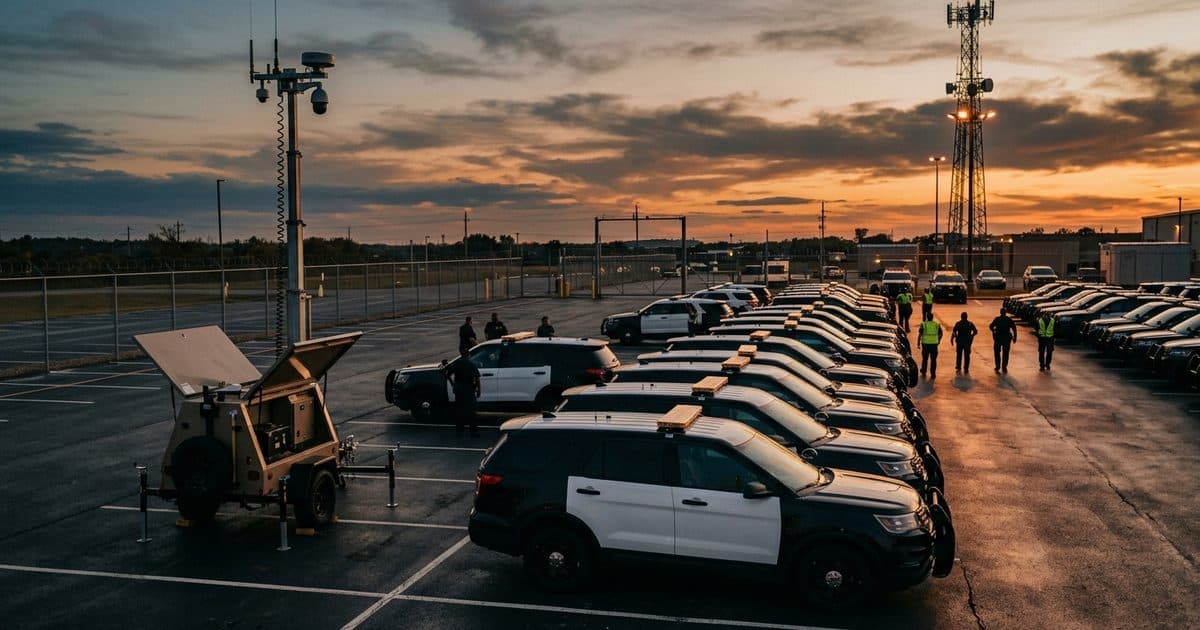
Some drop box sites have no convenient power or network, such as a corner of a parking lot or a rural pull-off. Running a trench or negotiating a connection to a nearby building can take longer than the project allows. A solar-powered camera trailer with cellular connectivity avoids both. Our guide to security cameras without Wi-Fi or power explains how these systems work and what to ask about battery reserve and signal.
Whatever you choose, confirm placement and any distance requirements with the election office before anything is installed.
Monitoring, alerts and tamper detection
A camera that records without anyone watching gives you evidence. A monitored camera gives you evidence and a chance to act. Useful alerts for a drop box site include a person near the box outside normal hours, a vehicle stopping and idling, loitering, and any sign that the camera has been blocked or moved. Camera tamper detection describes how that last alert works.
Decide in advance who receives alerts, what they are expected to do, and how quickly. A written escalation path, with a contact for the election office and for local law enforcement, prevents confusion at the moment it matters.
Quick reference
| Question | What to settle |
|---|---|
| What must the view show? | Box, slot, door, lock and the approach path |
| What height and angle? | Above reach, at a diagonal, tested at night |
| How is the site lit? | White light on the box plus camera infrared as backup |
| Is anyone watching? | Define who sees alerts and what they do |
| Is there power and network? | Use a self-contained unit if not |
| Who owns the footage? | A named custodian under written procedures |
| What do local rules say? | Confirm with the election office and counsel |
Records, retention and chain of custody
Video from a drop box site may be needed later, so treat it as a record. Set a retention period that matches your office's procedures, restrict who can view or export it, and keep a log of every export. Make sure clock settings are accurate, since a time stamp that is off by hours weakens the record. For general guidance, see how long security cameras should keep footage and security camera footage as evidence.
Retention periods, access rules and public records obligations for election materials vary by jurisdiction. Confirm them with counsel instead of relying on general guidance.
How VDS fits
VDS builds solar-powered mobile surveillance units that need no site power, internet or trenching. A unit carries a 5MP PTZ camera with 25x optical zoom and three 8MP wide-angle cameras on a 22 ft telescopic mast, with dual-SIM 4G/5G cellular. AI detection flags people, vehicles and loitering, and our 24/7 US-based security operations center verifies events, uses a loudspeaker for live talk-down, and can dispatch police with video. Hardware is NDAA Section 889 compliant. Most deployments go live about a week after a signed quote, and one person can set up a unit on site in under 20 minutes.
Whether a trailer is appropriate at a given drop box location is a decision for the election office. You can talk to our team about the site.
Sources
- Piza, E. L., Welsh, B. C., Farrington, D. P., & Thomas, A. L. (2019). CCTV surveillance for crime prevention: A 40-year systematic review with meta-analysis. Criminology & Public Policy, 18(1). onlinelibrary.wiley.com