
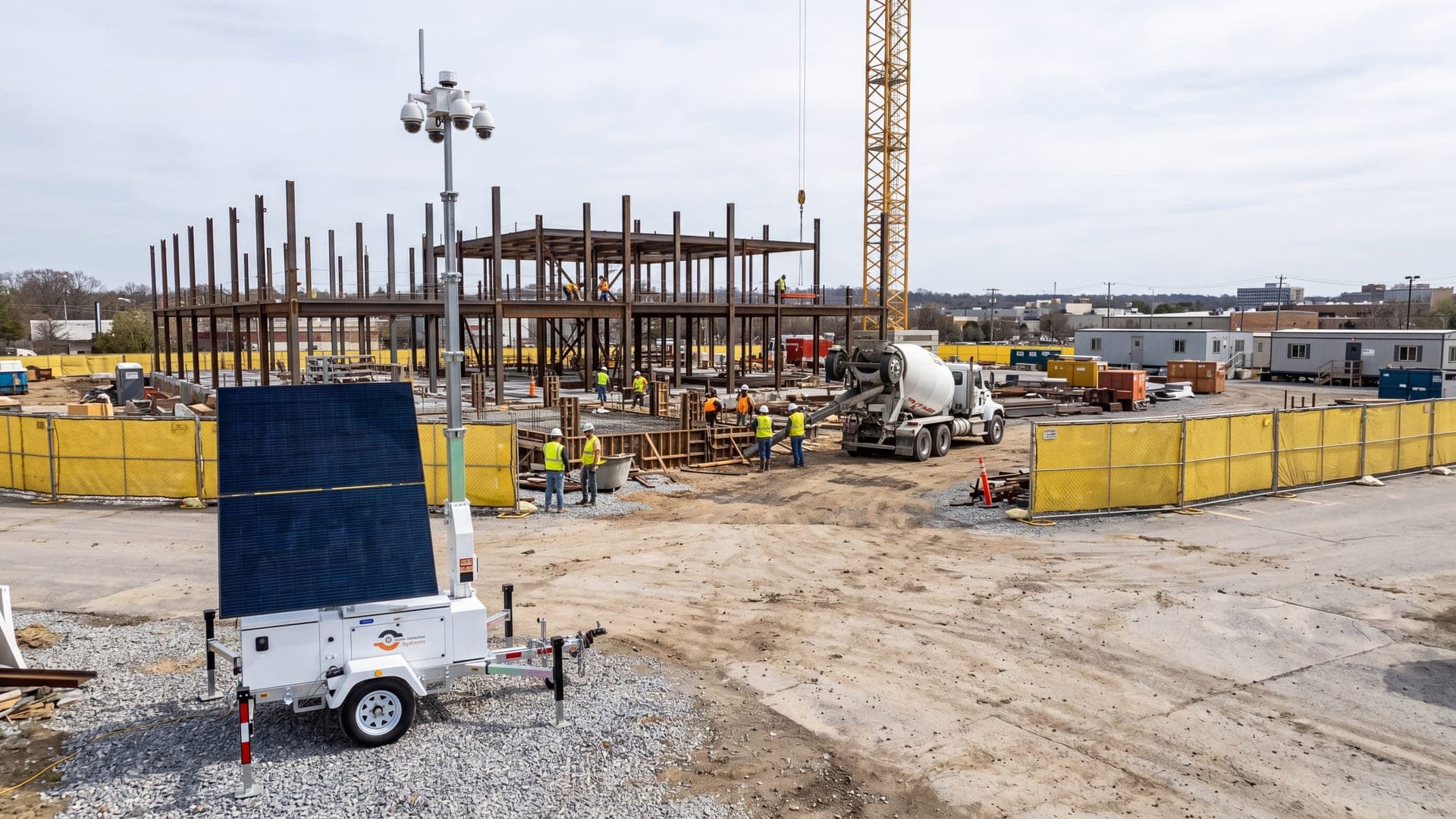
The term covers a wide range of equipment. This guide sorts out the types, explains how they work, and sets out what to check before you rent or buy.
Types of mobile security cameras
| Type | What it is | Best for | Limits |
|---|---|---|---|
| Surveillance trailer | Towable trailer with a telescoping mast, several cameras, solar, battery and cellular | Open sites, long perimeters, weeks to years | Needs a parking-space-sized footprint |
| Mobile security tower | A mast unit on a skid or compact base instead of a road trailer | Tight sites, rooftops, placements by forklift | Usually delivered, not towed |
| Pole or wall camera kit | Camera with a small solar panel and cellular modem on an existing pole or wall | A single gate or spot | Small power reserve, limited view |
| Vehicle-mounted camera | Cameras fixed to a patrol or fleet vehicle | Patrol and enforcement | Covers only where the vehicle is |
| Battery cellular camera | Small self-contained camera | Very short-term or low-activity use | Short battery life, basic image |
For a closer comparison of the first two, see mobile security tower vs trailer. For a full breakdown of the trailer type, see our remote surveillance trailer guide.
How mobile security cameras work
Power. Solar panels charge a battery bank that runs the cameras, lights and electronics around the clock. Panel size gets the attention, but the number to ask for is autonomy: how many consecutive cloudy days the unit runs before it needs sun or a backup source.
Connection. A cellular modem sends video and alerts over 4G or 5G. Units with two SIMs can use more than one carrier. Ask what happens to recording if the signal drops; a unit that stores footage on board keeps the record intact.
Cameras. Most units combine fixed wide-angle cameras, which see the whole scene all the time, with a pan-tilt-zoom camera that can look closely at one thing. Some add thermal imaging or a dedicated license plate camera. A mast puts the cameras above obstructions and out of easy reach.
Detection. Analytics software detects people and vehicles and ignores most of what is not a threat. Detection quality decides whether the system produces a few useful alerts or a flood of false ones.
Deterrence. Lights, strobes and a loudspeaker let the system, or an operator, warn someone off before anything is taken or damaged.
Viewing and storage. Video is available on a phone or computer and is stored on the unit, in the cloud, or both.
Monitored or unmonitored
This is the most important choice, and it is separate from the hardware.
- Record only. The camera keeps footage for review after an incident.
- Self-monitored. Alerts go to you or your staff, and you decide what to do.
- Professionally monitored. Operators in a monitoring center verify each alert, speak to the person on site through the loudspeaker, and call police with a confirmed report when needed.
Research on fixed camera systems points the same way: a 2019 review of 76 studies found that actively monitored systems were associated with about a 15% reduction in crime, while recording-only systems showed no significant effect. Monitoring also works with on-site security staff instead of in place of them. Cameras handle the watching, so people, yours or your security partner's, handle verified incidents. More on remote video monitoring.
Where mobile security cameras are used
- Construction sites, where power and network arrive late and the layout changes every few weeks. See construction site security.
- Parking lots and dealerships, for vehicle theft and break-ins.
- Events and temporary venues, set up before load-in and removed afterward.
- Utilities, energy and remote yards, where sites are unstaffed and far from help.
- Public safety, for hot spots that move faster than fixed cameras can be installed.
- Retail and logistics, for lots, loading areas and seasonal peaks.
What to look for
- Camera coverage. Can the cameras identify a person or read a plate at the distances your site needs, at night as well as by day?
- Power autonomy. How many cloudy days of reserve, and what is the backup?
- Connectivity. One carrier or more, and is footage stored on the unit if the link drops?
- Detection quality. What share of alerts are real, and who tunes the system?
- Deterrence. Are there lights and a loudspeaker, and is the voice live or recorded?
- Setup and moving. How many people and how long to deploy, and who relocates it?
- Monitoring. Who watches, during what hours, and what do they do when something happens?
- Compliance. If federal funds are involved, ask for written NDAA compliance documentation.
- Support. Who notices when the unit has a problem, and how fast is it fixed?
- Evidence. How long is footage kept, and how do you get a clip to police or an insurer?
Rent, subscribe or buy
Renting suits short projects, events and trying a unit before committing. Subscriptions bundle the unit with monitoring and service for a monthly fee over a term. Buying suits organisations that will keep units in use for years and have the people to maintain them. What you pay in any of these depends on the number of cameras, monitoring hours, contract length and delivery distance. See surveillance trailer rental, or our buyer's guide to surveillance trailers for sale.
How VDS builds mobile security cameras
The VDS mobile surveillance unit is a solar-powered trailer built around the monitored model:
- A 5MP PTZ with 25× optical zoom plus three 8MP wide-angle cameras on a 22 ft telescopic mast (30 ft available).
- A 900W bifacial solar array charging an 11.8 kWh LiFePO4 battery bank, with reserve for 3–5 consecutive cloudy days, and dual-SIM 4G/5G cellular.
- AI detection for people, vehicles, loitering, objects and license plates.
- A 24/7 US-based security operations center that verifies events and responds with live talk-down, then police dispatch.
- NDAA Section 889 compliant hardware.
Most deployments go from signed quote to live monitoring in about a week, and on-site setup takes one person under 20 minutes. Get a site-specific plan or call (410) 401-1986.
Sources
- Piza, E. L., Welsh, B. C., Farrington, D. P., & Thomas, A. L. (2019). CCTV surveillance for crime prevention: A 40-year systematic review with meta-analysis. Criminology & Public Policy, 18(1). onlinelibrary.wiley.com