
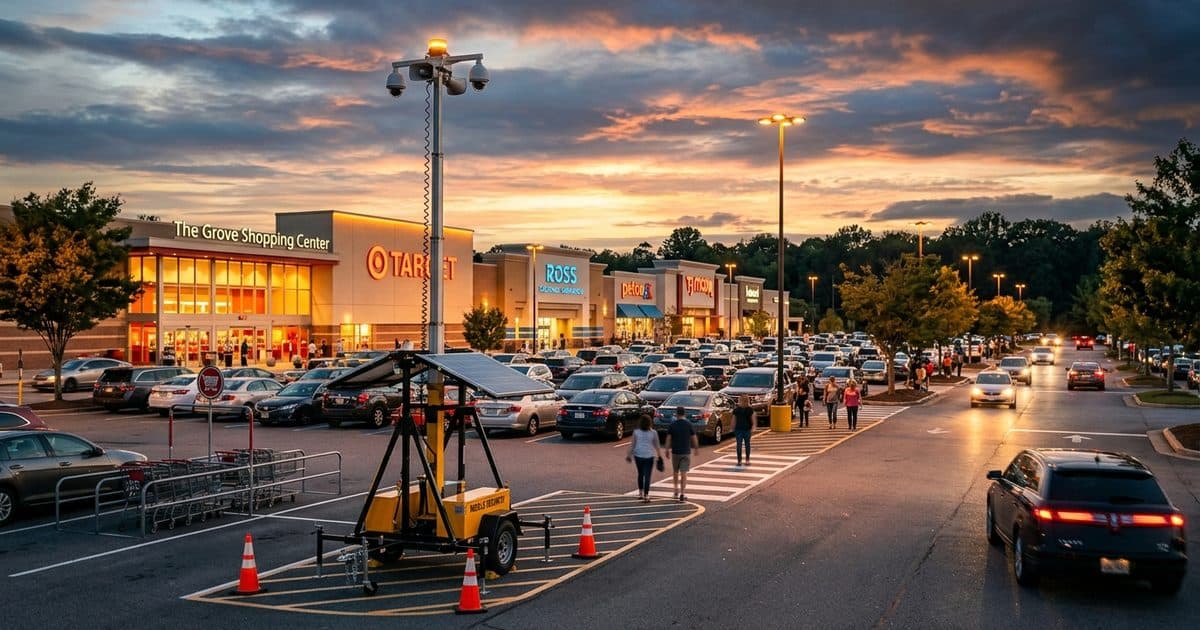
Why shopping centers are harder to secure than a single store
A freestanding store has one owner, one set of hours and one budget. A strip mall has a landlord, several tenants, a shared lot and often a mix of businesses that open and close at different times. A restaurant may run late while the store next door shuts at six. That means the lot is never fully empty and never fully active, which is exactly the condition that makes incidents hard to spot.
Shared property also creates gaps in responsibility. A tenant's interior cameras cannot see the lot, and a landlord who relies on tenants to look after their own storefronts ends up with uneven coverage. Break-ins, vehicle theft, loitering and vandalism tend to happen in the gaps between what each party thinks the other is watching. A strip mall with a nail salon, a restaurant, a dollar store and a pharmacy has four sets of hours, four managers and often four different views of what the property needs. Without a single plan for the common areas, each tenant tends to wait for someone else to act, and the lot stays uncovered.
Decide who owns which part of the property
Before choosing equipment, settle the split of responsibility. Check the leases and the common area maintenance language, and write down which areas the landlord covers and which each tenant covers.
- Landlord: parking lot, drive aisles, entrances and exits, sidewalks, shared walkways, dumpster enclosures and the rear service lane.
- Tenant: the interior, the register area, stockrooms and anything inside the leased space.
- Shared decision: cameras mounted on a storefront but pointed at the lot, rear doors that open to the common service area, and any tenant that wants its own exterior camera.
This is also where policy matters. Decide who can view footage, who can request it, how long it is kept and how requests from police are handled. Our guide to security cameras for property management covers how to set up that kind of access and retention policy.
What to cover in the lot and around the buildings
Start with the places where people and vehicles enter, then work outward to the places nobody looks at.
- Entrances and exits. Capture every vehicle that enters or leaves, with a view that can support a license plate read where the angle allows.
- Storefront frontage. Cover the full length of the building so activity at any door is visible from at least one camera.
- The lot itself. Aim for overlapping views across the parking area so no row of cars is a blind spot.
- Rear service areas. Delivery doors, dumpsters and back alleys are common places for forced entry and dumping.
- Dark corners and edges. Check the lighting at dusk and at night, since a camera is only as good as the light it has.
Our parking lot security and retail parking lot security articles go deeper on camera placement and lighting for lots like these. Walk the center at dusk, because lighting that looks fine during the day often leaves long dark stretches along the back of the building and at the far end of the lot, and a camera cannot make a usable image out of a dark scene.
The after-hours problem
Most serious trouble at a shopping center happens when the stores are closed. Catalytic converter theft, vehicle break-ins, copper and equipment theft from rooftop units, and forced entry at a back door all favor the hours when no staff are around. Recorded video helps afterward, but it does not stop an event in progress.
That is where live monitoring changes the outcome. Research on closed-circuit television supports the distinction. A 2019 systematic review of 76 studies found CCTV was associated with roughly a 13% reduction in crime overall and about 37% in parking lots. Actively monitored systems showed about a 15% reduction, while passive recording-only systems showed no significant effect.
For more on this window, see our guide to after-hours security for businesses.
Quick reference for planning
| Area | Main risk | What to look for |
|---|---|---|
| Parking lot | Vehicle break-ins, theft | Overlapping views, good lighting, plate reads at entrances |
| Storefront walkways | Loitering, vandalism | Full-length frontage coverage |
| Rear service lane | Forced entry, dumping | Wide view of doors and dumpsters |
| Rooftop and utilities | Equipment and metal theft | Coverage of access points and ladders |
| Entrances and exits | Unidentified vehicles | Fixed view suited to plate capture |
Cameras alone versus cameras with a response
A recording-only system tells you what happened. A monitored system tells someone while it is happening. For a shopping center, the second option usually matters more, because the landlord rarely has staff on site at 2 a.m.
With remote video monitoring, analytics flag people, vehicles and loitering, and a trained operator checks the video before anything is escalated. The operator can speak to the person through a loudspeaker, and if the situation calls for it, send video to police dispatch. That model fits the way most centers actually work, because cameras do the watching so people, yours or your security partner's, handle verified incidents.
Temporary coverage while you plan a permanent system
Permanent camera projects at a multi-tenant center can take a long time. They involve trenching, power runs, tenant coordination and sometimes a board or ownership approval. If the lot has an active problem, waiting is costly.
A mobile unit can cover the gap. Because it is self-powered and uses cellular connectivity, it can be placed in the lot without wiring, and it can be moved if the trouble shifts to another part of the property. Our article on temporary security cameras explains when that approach makes sense.
How VDS fits a shopping center
The VDS mobile surveillance unit is a solar-powered trailer with a 5MP PTZ camera that has 25x optical zoom, plus three 8MP wide-angle cameras on a 22 ft telescopic mast. It charges from a 900W bifacial solar array into an 11.8 kWh LiFePO4 battery bank, and it connects over dual-SIM 4G/5G cellular, so it needs no site power, internet or trenching.
AI detection looks for people, vehicles, loitering, objects and license plates. Our 24/7 US-based security operations center verifies events, speaks through the loudspeaker, and dispatches police with video when needed. Most deployments go from signed quote to live monitoring in about a week, and setup takes one person under 20 minutes. You can learn more about the mobile surveillance unit, or talk to our team about your center.
Sources
- Piza, E. L., Welsh, B. C., Farrington, D. P., & Thomas, A. L. (2019). CCTV surveillance for crime prevention: A 40-year systematic review with meta-analysis. Criminology & Public Policy, 18(1). onlinelibrary.wiley.com