
Why the lot matters
For most shoppers the parking lot is the first and last part of the visit. A lot that feels unsafe affects whether customers return, especially in the evening and during winter months when it gets dark early. Property owners and tenants also share an interest in the lot because break-ins, assaults and disputes can create liability and damage a center's reputation.
Retail lots are hard to secure because they are open by design. Access must be easy, parking has to be plentiful, and there are many entrances. Security has to work within that openness, which makes lighting, visibility and response more important than physical barriers.
Common problems at retail centers
| Problem | Typical pattern | What helps |
|---|---|---|
| Vehicle break-ins | Items visible in cars, edge-of-lot parking | Lighting, camera coverage, signage, response |
| Loitering | Groups gathering near entrances or in corners | Analytics, verbal warnings, consistent policy |
| Customer safety concerns | Dark walking routes, isolated spaces | Even lighting, clear sightlines, monitored cameras |
| After-hours activity | Vehicles and people on a closed lot | Live monitoring, talk-down audio |
| Organized theft | Crews moving between store and parked vehicles | Plate capture, coordinated response |
Many centers see these problems cluster in a few places, such as one corner, the pad site beside the main building, or the lot behind a closed store. Start by mapping where incidents tend to occur and cover those spots first. Our overview of mall parking lot security goes deeper on large properties.
Lighting and visibility
Lighting is the lowest-cost control and often the most neglected. A few bright areas with dark gaps between them can be worse than uniform dim light, since the gaps become the places people avoid and the places others use. Aim for even coverage across the lot, with particular attention to walking routes from stores to cars, entrances and the lot edges.
Maintenance matters. A failed fixture can go unnoticed for weeks. Build a simple routine to walk the lot after dark and log anything that is out. Landscaping also affects visibility, since overgrown trees and shrubs block both light and camera views.
Camera coverage and placement
A camera plan should follow the way people and vehicles actually use the lot.
- Entrances and exits. Record vehicles and people entering the property.
- Main walking routes. Cover the paths between storefronts and the busiest parking areas.
- Edge rows and corners. These are the usual places for break-ins.
- Loading and rear areas. These may be quiet during the day and unobserved at night.
Mounting height is a balance. A higher camera sees more of the lot, but facial detail drops with distance. Many properties use a tall mounted unit for overall coverage and add closer cameras where detail is needed. Our guide to parking lot security covers layout in more detail.
Handling loitering
Loitering is a judgment call because the people involved may not be doing anything illegal. A consistent approach protects both customers and the property.
- Post clear signage that states the property's policy
- Decide in advance what behavior triggers a response and who responds
- Document each incident with time, location and what was done
- Start with a verbal warning, then involve police if the person does not leave or if there are safety concerns
- Review incidents regularly to see whether they point to a lighting or layout problem
Detection analytics can flag people who stay in an area longer than expected, which gives monitoring staff an early signal. See our guide to loitering detection cameras for how this works. Rules on trespass and removal vary by state, so confirm your process with counsel.
Monitoring turns cameras into response
Cameras that only record give you evidence after a break-in. Monitored cameras give you a chance to stop one. A 2019 systematic review of CCTV research found that actively monitored systems were associated with about a 15% reduction in crime, while passive recording-only systems showed no significant effect. Parking lots stood out in that review, with about a 37% reduction in the studies covered.
When a monitoring team sees someone moving between parked cars at 11 p.m., they can verify what is happening, speak to the person through a loudspeaker, and call police with live video if needed. This is the idea behind live talk-down audio deterrence. For retail properties with organized theft concerns, our article on organized retail crime and remote monitoring response shows how monitoring supports coordinated action.
The cameras and analytics do the watching so people, yours or your security partner's, handle verified incidents.
Coverage without construction
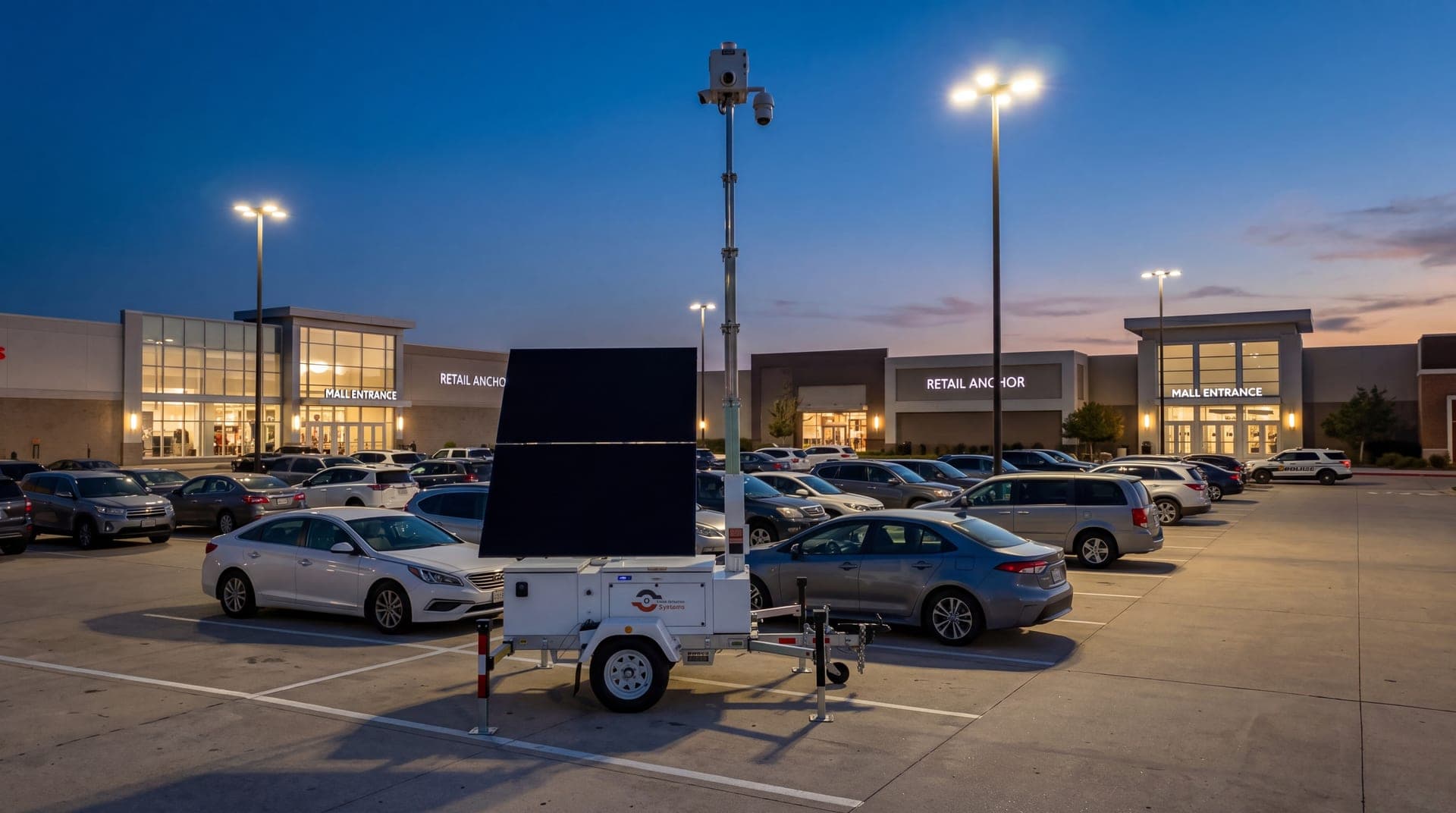
Many retail properties have lots that were not built with cameras in mind. Trenching across asphalt is disruptive, and landlord approvals can slow projects. Mobile surveillance trailers avoid most of that. They arrive with their own power and connection, they can be positioned for the busiest area, and they can move if the pattern of incidents moves.
Working with tenants and police
Retail centers often have several tenants, a landlord and a management company, which can make security decisions slow. Agree on who owns the lot, who pays for lighting and cameras, and who responds when something happens. A shared incident log helps everyone see patterns that individual stores would miss.
Local police are also part of the plan. Tell them about your cameras, how to reach your monitoring team and when your busiest hours are. Officers respond more effectively when they receive clear information, such as a location in the lot, a description of the people involved and live video. If your center has recurring problems, ask for a meeting to review them and keep a record of the dates, since patterns support requests for patrols.
How VDS fits
VDS builds solar-powered mobile surveillance trailers. Each carries a 5MP PTZ camera with 25x optical zoom and three 8MP wide-angle cameras on a 22 ft telescopic mast, with 30 ft available. A 900W bifacial solar array charges an 11.8 kWh LiFePO4 battery bank with reserve for 3-5 consecutive cloudy days, and dual-SIM 4G/5G cellular means no site power, internet or trenching is needed.
AI detection covers people, vehicles, loitering, objects and license plates. A 24/7 US-based security operations center verifies events, responds with live talk-down through a loudspeaker, then dispatches police with video. The hardware is NDAA Section 889 compliant. Most deployments go from signed quote to live monitoring in about a week, and setup takes one person under 20 minutes. Rental, month-to-month and term subscriptions are available. Learn about remote monitoring or talk to our team.
Sources
- Piza, E. L., Welsh, B. C., Farrington, D. P., & Thomas, A. L. (2019). CCTV surveillance for crime prevention: A 40-year systematic review with meta-analysis. Criminology & Public Policy, 18(1). onlinelibrary.wiley.com