
What is event-based video monitoring?
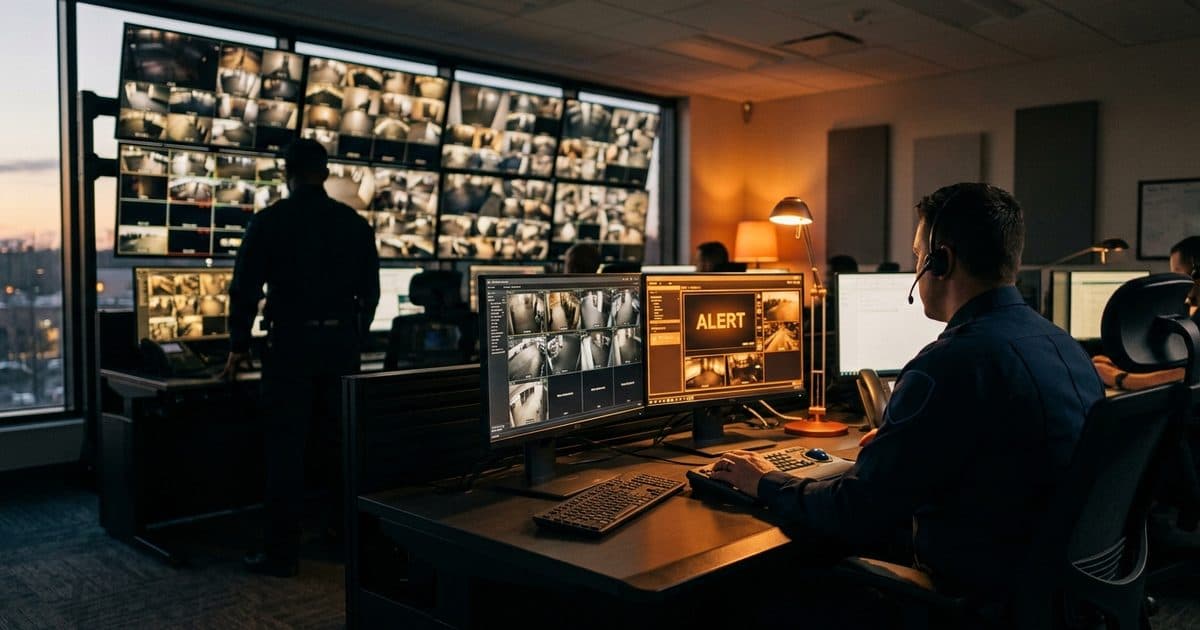
Event-based video monitoring pairs camera analytics with human review. The cameras record continuously, but no person stares at a wall of feeds. Instead, analytics flag defined events, such as a person entering a fenced yard after hours or a vehicle stopping near a laydown area, and route a short clip or live view to an operator in a security operations center. The operator confirms what the analytics saw before any response begins.
That verification step is what separates event-based monitoring from a basic alarm system. A motion sensor cannot tell a trespasser from a raccoon or a wind-blown tarp; a trained operator looking at live video can. If you are new to the model, our primer on what remote video monitoring is walks through the full workflow from detection to police handoff.
Event-based monitoring scales well because operator time is spent only on flagged activity. One operator can cover many sites, which keeps the cost per site far below a dedicated watch, and well-configured analytics let you tune detection zones, schedules, and object classes so alerts track your actual risk. The trade-off is that the system surfaces only what its detection rules catch. A slow-building pattern, such as scouting behavior spread across several nights, gets flagged only if the detection logic and the operators reviewing alerts are set up to connect those dots.
What is continuous live monitoring?
Continuous live monitoring assigns dedicated operator attention to your cameras for a defined window, often overnight or around the clock. Rather than waiting for analytics to raise a flag, the operator actively watches feeds, runs virtual patrols through camera views on a set cadence, and reports conditions in real time.
This model behaves less like an alarm and more like a remote guard post. It suits situations where the concern is not a discrete trip-wire event but ongoing awareness: a high-value load staged overnight before pickup, a facility that has been hit repeatedly in a short period, an access gate that needs live oversight during specific operations, or a contractual requirement that someone watch in real time.
The cost driver is human hours. Where event-based monitoring spreads an operator across many sites, continuous monitoring concentrates attention on yours, and the price reflects that. Sustained watching is also demanding work, which is why credible providers rotate operators and layer analytics underneath the human watch rather than relying on eyes alone.

How does the verification chain work in both models?
Whichever model you choose, the response chain after detection should look the same: detection, human verification, talk-down, then escalation to people who can act.
- Detection. In event-based monitoring, analytics trigger the alert. In continuous monitoring, the operator's own observation is the trigger. Either way, something specific starts the clock.
- Human verification. An operator looks at live video and confirms whether the activity is a genuine concern, a legitimate worker, or a false trigger. This is the step that keeps responders from being sent to nothing.
- Talk-down. For confirmed trespass, the operator uses on-site speakers to address the person directly, naming their clothing and location and stating that police will be called. Many intrusions end here, because the subject learns in seconds that a person, not a passive camera, is watching.
- Escalation. If the subject does not leave, the operator escalates with verified, real-time detail, so people, yours or your security partner's, handle the incident knowing exactly what they are walking into. In many jurisdictions, video-verified incidents also receive higher dispatch priority than unverified alarm signals.
Speed matters at every link in this chain. We have written about how a tight 60-second SOC workflow compresses the time from detection to talk-down, and the same discipline applies whether the trigger came from an analytic or an operator's eyes.
Event-based vs. continuous monitoring: side-by-side
The two models differ less in technology than in where human attention sits. The table below summarizes the practical differences most buyers care about.
| Factor | Event-based monitoring | Continuous live monitoring |
|---|---|---|
| What starts a response | Analytics detect a defined event | Operator observation during a dedicated watch |
| Operator attention | Shared across sites, focused on verified alerts | Dedicated to your site for the covered window |
| Best fit | Most perimeter and after-hours security needs | High incident frequency, high-risk windows, live-watch requirements |
| Primary cost driver | Camera count and alert volume | Hours of dedicated human attention |
| Coverage character | Always armed, responds to triggers | Proactive awareness with scheduled virtual patrols |
| Weakness to manage | Surfaces only what detection rules catch | Cost and operator fatigue over long windows |
Neither column is universally better. The question is which cost structure and attention model matches your site's exposure.
Which model does your site need? A four-factor framework
Risk profile: what would one incident cost you?
Start with consequences, not likelihood. If a single successful intrusion means stripped copper, a torched excavator, or a stolen trailer of finished goods, the loss from one event can dwarf months of monitoring cost. High-consequence sites justify continuous attention during their worst exposure windows. If a typical incident is minor trespass or petty pilferage, event-based verification with fast talk-down usually covers the risk.
Incident frequency: how often does something actually happen?
Pull your own incident log, police reports, and alert history for the last 6 to 12 months. Sites with rare, sporadic activity waste money on a dedicated watch that spends most of its hours observing nothing. Sites experiencing repeated hits in a short period, which often happens when a crew has identified a target, may warrant a continuous watch until the pattern breaks, then a step back down to event-based coverage.
Hours of exposure: when is the site actually vulnerable?
A distribution yard that is staffed 12 hours a day has a very different exposure window than a vacant property that sits empty around the clock. Map your unstaffed hours against when incidents occur. Many sites need serious coverage only from last-out to first-in, which shrinks the cost gap between the two models and sometimes makes a short continuous window affordable where 24/7 dedicated watch would not be.
Budget: spend where the exposure is
Monitoring budgets are finite, so allocate them against the hours and assets that carry real risk. Event-based monitoring generally delivers the lowest cost per protected hour because operator time is shared. Continuous monitoring buys certainty of attention at a premium. The wrong answer is paying for continuous watch across low-risk hours while under-covering the window when losses actually happen.
Why human verification matters either way
False alarms are the failure mode that breaks unverified security systems. A dated but still canonical national estimate from the Department of Justice put police responses at roughly 36 million alarm activations per year at an annual cost of about $1.8 billion, using a 2002 baseline. The Urban Institute has reported that false alarms account for 10–25% of all police calls for service. The practical consequences for site owners are familiar: false alarm fines, slower response, and in some jurisdictions formal non-response policies for unverified alarms.
Human verification addresses this at the source. When every escalated incident has been confirmed on live video by an operator, responders stop treating your calls as background noise. There is evidence that active human attention changes outcomes more broadly: a multi-city Urban Institute 2011 evaluation found that actively monitored public camera systems reduced crime by up to roughly 20% in evaluated areas, while poorly monitored systems showed much weaker effects.
Verification quality depends on alert quality. An event-based system that cries wolf dozens of times a night fatigues operators the same way raw alarms fatigue police. Our guide on reducing false alarms in video analytics covers the tuning work, detection zones, schedules, object filtering, and threshold discipline, that keeps the verification chain fast and credible.
Can you combine event-based and continuous monitoring?
Yes, and many sites should. A hybrid approach runs continuous watch during known high-risk windows, such as the overnight hours after a theft attempt, the final weeks of a project when finished materials sit on site, or a period of elevated regional activity, and event-based monitoring the rest of the time. Because both models share the same cameras and the same verification chain, moving between them is an operational decision, not a hardware change.
This is where monitored mobile surveillance fits naturally. VDS deploys solar-powered surveillance units connected to 24/7 remote video monitoring, where SOC operators verify analytics-triggered events, deliver live talk-downs, and can concentrate dedicated attention on a site when its risk window demands it. The platform supports both models on the same equipment, so coverage flexes with your exposure instead of locking you into one attention model, and every verified incident lands with your people or your security partner's responders with the context they need to act.
Whichever direction you lean, insist on the same fundamentals: defined detection logic, human verification before escalation, documented talk-down capability, and a clear escalation path. Get those right, and the event-based versus continuous question becomes what it should be: a budgeting decision about where human attention earns its keep on your site.