
What makes rental lots different
A rental lot is not like a dealership or a standard parking lot. Vehicles are constantly in motion, with returns, cleaning, refueling, transfers and new rentals happening around the clock. Dozens or hundreds of vehicles may sit within a small footprint, many with keys stored nearby for quick turnaround.
That constant movement creates two security challenges. First, theft and break-ins can blend into normal activity, since a vehicle driving off the lot at night might be a legitimate transfer or a theft. Second, many disputes depend on what condition a vehicle was in at a specific moment. A strong security setup answers both questions with records instead of recollection.
Common problems and what addresses them
| Problem | Why it happens | What helps |
|---|---|---|
| Vehicle theft | Vehicles and keys are concentrated and always moving | Controlled entry and exit, plate logs, monitored cameras |
| Break-ins and item theft | Renters leave belongings in returned vehicles | Lighting, camera coverage, quick cleaning routines |
| Damage disputes | No clear record of vehicle condition | Pickup and return video, check-in photos |
| Unauthorized after-hours entry | Open lots with multiple access points | Gates, barriers, live monitoring |
| Vandalism | Isolated overflow areas | Lighting, camera coverage, talk-down audio |
Controlling entry and exit
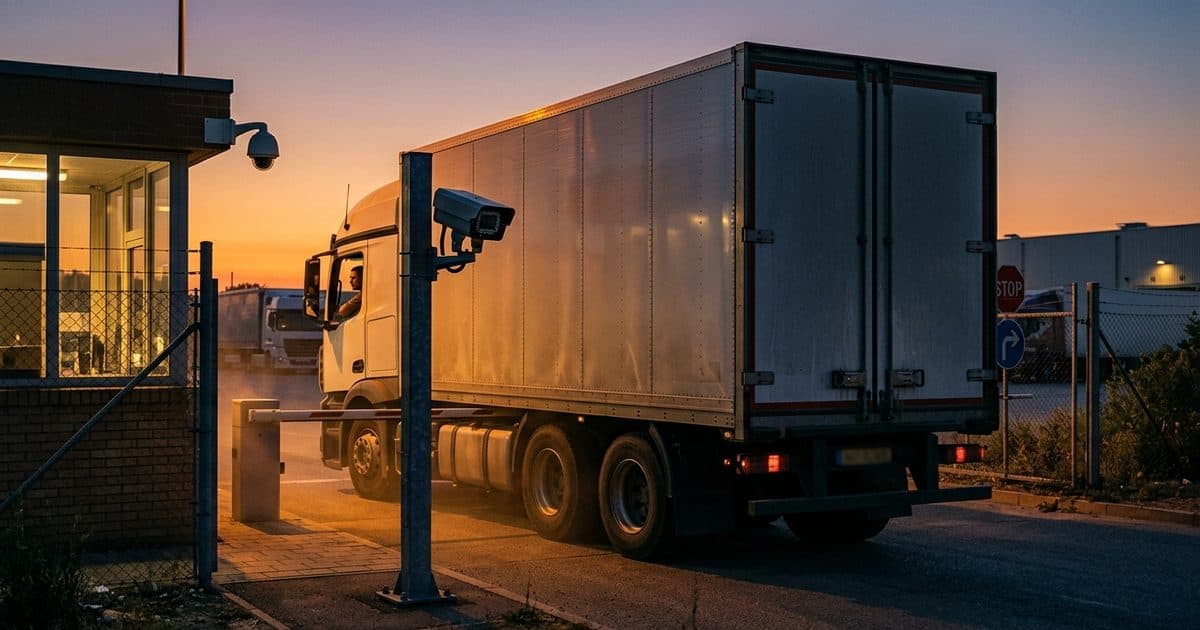
Every vehicle that enters or leaves should pass through a point you can see and record. Depending on the site, that might be a gate, a barrier arm, a staffed lane or a combination. The goal is to reduce the number of ways in and out so you know what is on the lot at any time.
Multiple access points are the usual weak spot. Side exits, service roads and gaps in fencing let vehicles leave without passing a camera. Walk the perimeter and note every place a vehicle could physically drive out, then decide whether to close it, gate it or cover it with a camera. Our guide to automated gate access with license plate recognition explains how gates and plate reading can work together.
License plate capture for fleet movement
License plate recognition reads plates from video and turns them into searchable text with a timestamp. For a rental lot, this builds a log of what came in and out and when. If a vehicle leaves at 3 a.m. with no scheduled transfer, that is worth a call. If a renter claims a return time, the log helps confirm it.
Plate capture needs the right setup to work reliably. Plate characters need roughly 20-30 pixels of height in the image, the camera angle should stay within about 15-30 degrees of the plate, and moving vehicles call for a shutter speed of 1/1000s or faster. Capturing at 15-30 fps in the capture zone helps avoid blur. Our LPR camera settings guide and license plate recognition camera guide walk through the details, and what is ALPR covers the basics.
Rules on collecting and keeping plate data vary by state, so confirm your retention and sharing practices with counsel.
Video that settles damage disputes
Damage disputes are common in rental operations, and they often come down to one question. Was the damage there before the rental or after? Video helps when it is organized well.
- Position a camera at the pickup and return lanes so each vehicle is recorded as it arrives and leaves.
- Combine video with timestamped check-in photos so there is more than one record.
- Keep clear, consistent retention for the footage and logs you may need.
- Make sure your staff know how to find and export footage quickly.
- Share footage with customers, insurers or police according to your policies and local rules.
Video is not a substitute for a clear inspection process, but it adds an objective record that both sides can understand.
Watching the lot between rentals
The quiet hours are when the lot is most exposed. Fleet vehicles sit in rows with keys nearby, and nobody is at the counter. Cameras that only record leave you reviewing losses after the fact.
Monitored cameras change that. Analytics can flag people and vehicles on the lot after hours, and a monitoring team can verify what the camera sees before acting. If someone is walking the rows, they can be warned over a loudspeaker. If a vehicle is leaving without authorization, police can be sent with live video. The 2019 CCTV systematic review found actively monitored systems performed better than passive recording-only systems, and parking lots were among the settings with the largest effects, at about 37%.
The point is not to remove staff. Cameras do the watching so people, yours or your security partner's, handle verified incidents. See our piece on parking lot security for more on layout and lighting.
Overflow lots and temporary space
Rental operations often add overflow space during busy seasons, with extra vehicles parked on a nearby lot, a gravel field or a leased property. These lots usually have no power, no network and no fencing. They are also more exposed, since staff are not present and the fleet sits for days.
A mobile surveillance trailer can cover that space without construction. It supplies its own power and connection, and it can be moved when the extra space is no longer needed.
Keys, counters and staff routines
Rental operations often leave keys in vehicles or in nearby boxes to speed up returns. That convenience is a risk if the lot is open at night. Where possible, collect keys at the counter or a secure drop, and keep the key area on camera.
Staff routines matter as well. Returned vehicles should be checked and cleaned promptly so items left behind are not exposed to passersby. Fuel and mileage records should be logged at return. Employees who move vehicles between lots should have a documented process, so a legitimate transfer is not mistaken for theft. A monitoring team works best when it has a clear list of authorized after-hours activity, so it can tell the difference between a scheduled move and something unexpected.
How VDS fits
VDS builds solar-powered mobile surveillance trailers. Each carries a 5MP PTZ camera with 25x optical zoom and three 8MP wide-angle cameras on a 22 ft telescopic mast, with 30 ft available. A 900W bifacial solar array charges an 11.8 kWh LiFePO4 battery bank with reserve for 3-5 consecutive cloudy days, and dual-SIM 4G/5G cellular means no site power, internet or trenching is needed.
AI detection covers people, vehicles, loitering, objects and license plates. A 24/7 US-based security operations center verifies events, responds with live talk-down through a loudspeaker, then dispatches police with video. The hardware is NDAA Section 889 compliant. Most deployments go from signed quote to live monitoring in about a week, and setup takes one person under 20 minutes. Rental, month-to-month and term subscriptions are available. See the mobile surveillance unit or talk to our team.
Sources
- Piza, E. L., Welsh, B. C., Farrington, D. P., & Thomas, A. L. (2019). CCTV surveillance for crime prevention: A 40-year systematic review with meta-analysis. Criminology & Public Policy, 18(1). onlinelibrary.wiley.com