
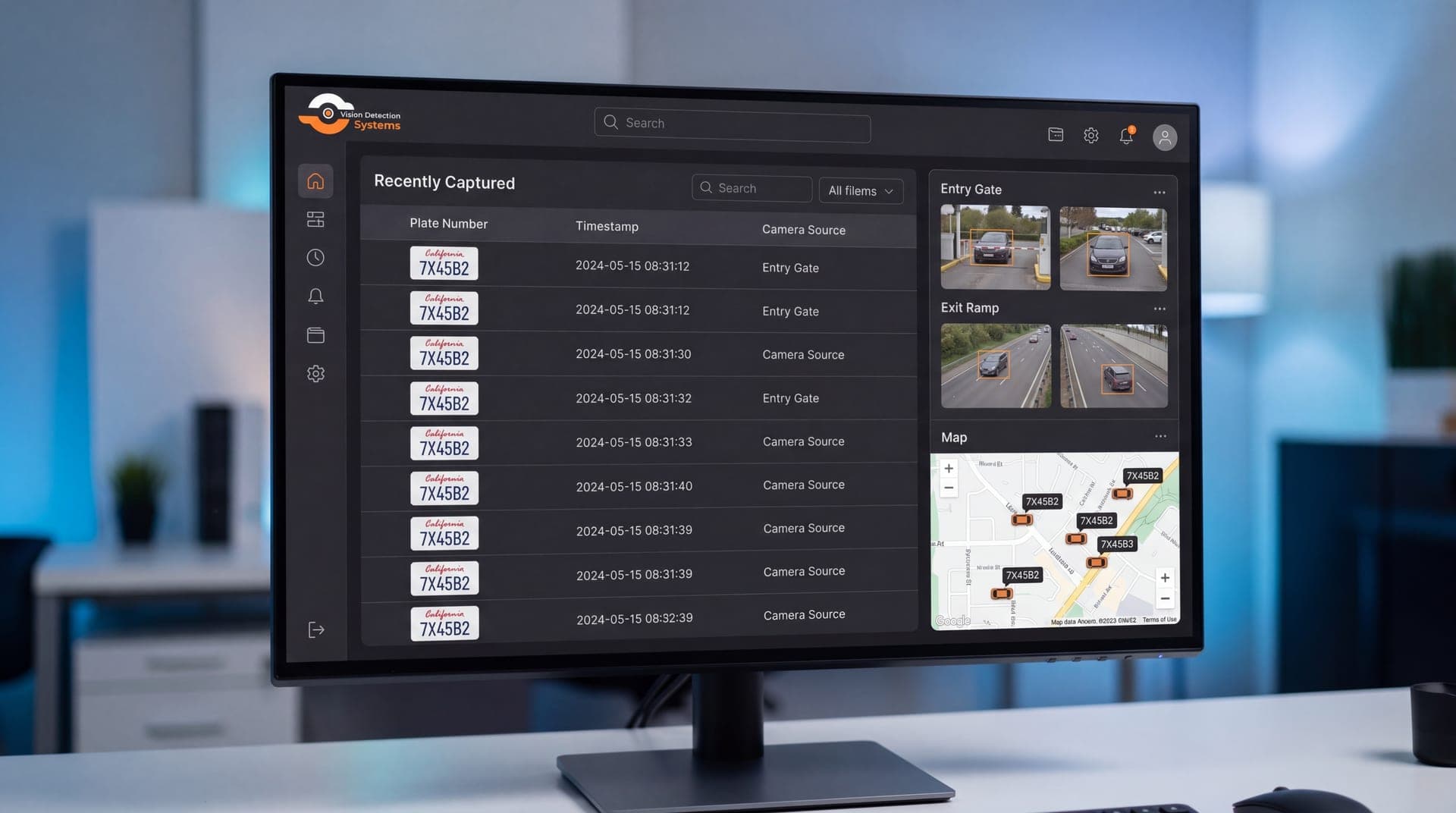
What a gate reader is for
Industrial gates have a different traffic profile from a retail lot. Trucks arrive on schedules, contractors come and go, and drivers may not stop for long. A plate reader gives the site a record of who came in, when, and for how long. That record supports several uses.
- Reviewing an incident by finding which vehicles were on site at the time.
- Matching arrivals against an expected list of carriers or contractors.
- Spotting unknown vehicles after hours.
- Flagging a plate that should not be on site.
- Supporting access decisions at the gate.
For a wider introduction, see our license plate recognition camera guide.
Capture zone and camera position
The most common mistake is trying to read plates with a camera that was installed for general viewing. A camera that watches the whole yard will not read plates reliably at the gate. A plate reader needs its own position and its own view.
Place the camera to look at the lane, not across it. The horizontal and vertical angle to the plate should stay within about 15-30 degrees, which usually means mounting at a modest height and some distance back from the stopping point, aimed down the lane. Steeper angles stretch and skew the characters.
Plate characters need roughly 20-30 pixels of height in the image to read well. This depends on the lens, the distance and the resolution, so set the zoom so a plate fills enough of the frame at the point where vehicles are captured. A narrow view of one lane works better than a wide view of three. If a gate has separate inbound and outbound lanes, give each lane its own camera, since the angle that suits one direction rarely suits the other.
Shutter speed, frame rate and motion
Moving vehicles blur at slow shutter speeds. Set the shutter to 1/1000s or faster for vehicles in motion, and aim for 15-30 fps at the capture zone so that at least one frame has a clean plate. If the gate has a stop line, such as a barrier arm or a guard window, many readers capture the plate while the vehicle is stationary, which makes everything easier.
Faster shutter speeds let in less light, which creates a trade-off at night. That is why lighting matters so much.
Night, glare and weather
Plates are designed to reflect light, which helps at night but can also cause trouble. A bright headlight pointed at the camera can wash out the image, and infrared illumination bouncing off a reflective plate can turn it into a white rectangle.
A few practical measures help.
- Angle the camera away from headlights. An offset position reduces glare.
- Control the illumination. Use infrared or white light intended for plate capture and test it, since too much washes out the plate.
- Watch for backlight. A bright sky or floodlight behind the vehicle can darken the plate.
- Keep the lens clean. Dust, rain and spider webs affect reads.
- Test at several times. Check dawn, noon, dusk and midnight, in wet and dry conditions.
Our LPR camera settings guide gives more on shutter, gain and exposure, and the LPR troubleshooting guide covers common failure modes.
Quick reference
| Variable | Guideline | Why it matters |
|---|---|---|
| Camera angle | Within about 15-30 degrees of travel | Reduces distortion |
| Plate size in image | Roughly 20-30 pixels of character height | Needed to read characters |
| Shutter speed | 1/1000s or faster for moving vehicles | Prevents blur |
| Frame rate | 15-30 fps at the capture zone | Gives clean frames |
| Lighting | Controlled, tested at night | Avoids glare and washout |
| Lane view | One lane per camera where possible | Improves pixel density |
Gate workflow and exceptions
Reading a plate is only half the system. Decide what happens next. If the plate is on an approved list, does a gate open automatically, or does a guard confirm it? If it is unknown, who is alerted? If the reader cannot read the plate, what is the fallback? Industrial sites see many exceptions, such as a new driver, a rented trailer, a temporary tag or a plate covered in mud.
A gate access system built on plate reading works best when exceptions have a clear human path. Build in a manual override, a way to add a visitor quickly, and a log of every override. Treat automation as a way to handle the routine traffic so people spend their time on the exceptions. Review the exception log regularly. A pattern of unreadable plates at one lane usually points to a camera problem, such as a dirty lens or a changed light, not a driver problem.
Data, retention and privacy
Plate reads build into a database of vehicle movements. Decide how long to keep them, who can search them and when they are shared. Keep access limited to people who need it, and record who searched for what. Rules on collecting, retaining and sharing plate data vary by state, and some places restrict or regulate it. Confirm your policy with counsel before deployment, and write it down.
Treat the plate reader as one layer. A gate read tells you who passed one point. It does not tell you what they did inside the fence, which is why many sites pair it with perimeter and yard cameras.
How VDS fits
VDS includes license plate detection among its AI detection capabilities, alongside people, vehicles, loitering and objects. For more on plate reading, see our LPR products page. For sites with no power or internet at the gate, or for a temporary entrance, a VDS solar-powered mobile surveillance unit can carry the cameras. It uses a 5MP PTZ with 25x optical zoom and three 8MP wide-angle cameras, dual-SIM 4G/5G cellular, and needs no trenching.
Our 24/7 US-based security operations center verifies events, uses live talk-down through a loudspeaker, and can dispatch police with video. Hardware is NDAA Section 889 compliant. Learn about the mobile surveillance unit or talk to our team.