
Key takeaways
- An ALPR system combines specialized cameras, OCR software, and a database that stores and searches plate reads.
- ALPR and LPR are mostly interchangeable terms; ALPR tends to describe hot-list alerting, LPR tends to describe commercial access and parking use.
- ALPR cameras come in fixed, vehicle-mounted, trailer-mounted, and gate/access configurations.
- Read accuracy depends on angle, speed, distance, lighting, weather, and plate condition—test in your real conditions.
- ALPR data is regulated differently state by state. Retention, access, and sharing policies matter as much as the camera.
- Mobile, solar-powered units bring license plate detection to sites with no power or network.
What is an ALPR system?
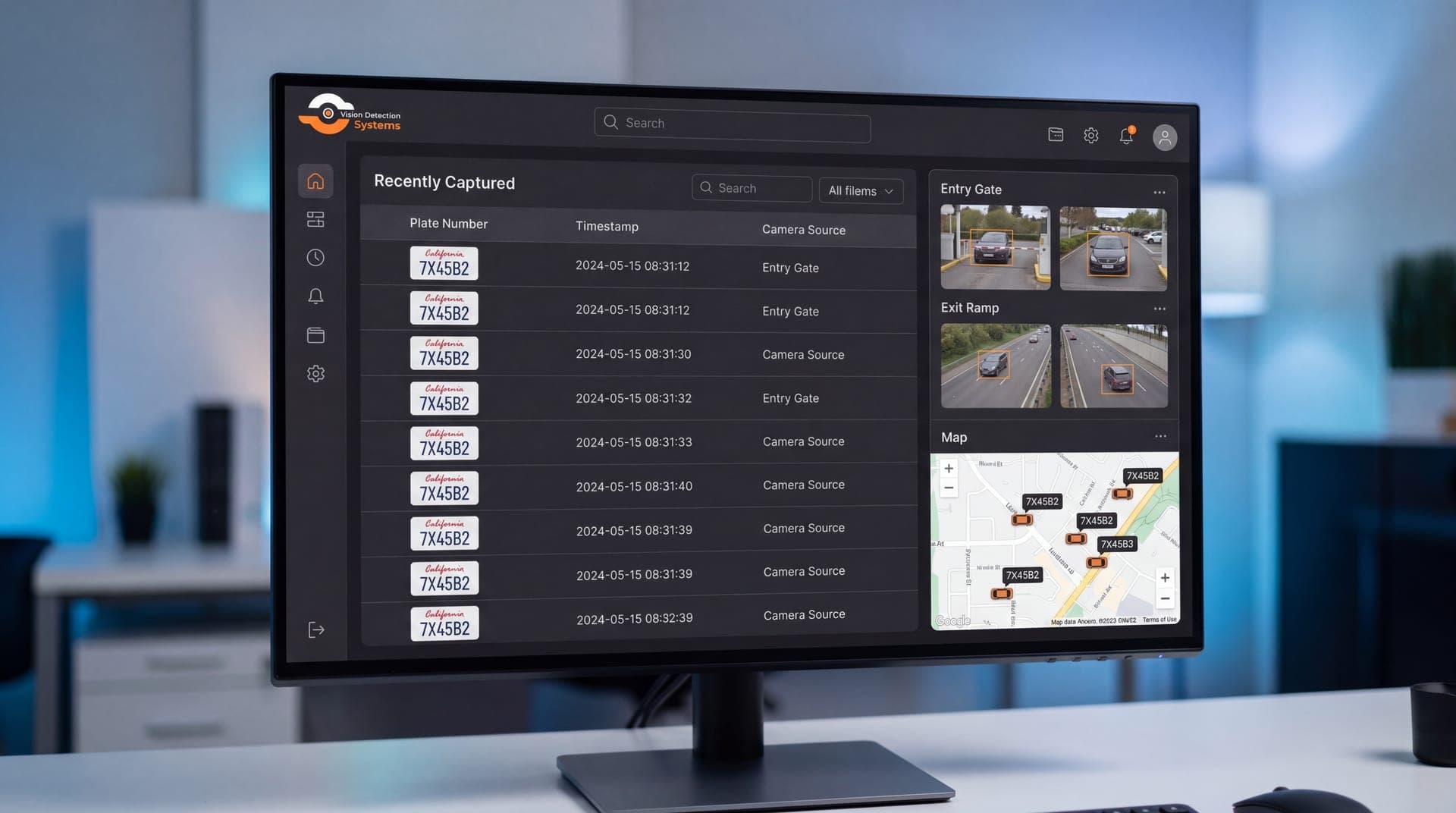
An ALPR system is the full chain that turns a passing vehicle into a searchable record: the camera that captures the plate, the software that reads it, and the database that stores, matches, and retrieves those reads. The International Association of Chiefs of Police (IACP) describes ALPR systems as ones that capture an image of a plate, transform it into alphanumeric characters, compare the plate to databases of vehicles suspected in crimes, and alert the officer when a suspect vehicle is observed.
That description reflects ALPR's law enforcement origins, but the same technology now runs parking garages, gated communities, construction gates, and truck yards. The hardware is the camera; the value is in what the system does with each read. If you're shopping for hardware specifically, start with our overview of the LPR camera lineup.
ALPR vs LPR: is there a difference?
In practice, "ALPR" (automated license plate reader or recognition) and "LPR" (license plate recognition) describe the same core technology. Vendors, agencies, and state statutes use both. Other names you'll see include ANPR (automatic number plate recognition, common outside the US) and "license plate reader camera."
When people do draw a distinction, it usually looks like this:
| Term | Typical usage | Common context |
|---|---|---|
| ALPR | Automated reading plus matching against hot lists, with real-time alerts and historical search | Law enforcement, public safety, community-wide deployments |
| LPR | Reading and logging plates, often tied to a rule (open gate, flag overstay, record entry) | Parking, access control, HOAs, commercial and industrial sites |
| ANPR | Same technology; international term | UK, Europe, Australia |
Don't choose a product based on which acronym is on the brochure. Ask what the system does after the read.
How ALPR works
Every ALPR read moves through the same basic pipeline.
1. Capture. A camera designed for plate capture takes one or more frames as the vehicle passes. Most ALPR cameras use infrared (IR) illumination, because retroreflective plates bounce IR back strongly and the image stays consistent day or night without visible glare. A fast shutter freezes motion so characters don't blur, and the camera is aimed at a shallow angle to the lane so the plate isn't skewed.
2. Plate localization. Software finds the rectangular plate region within the frame, separating it from bumpers, stickers, and signage.
3. Optical character recognition (OCR). The plate region is segmented into characters and converted to text. Many systems also try to infer the issuing state from plate design.
4. Vehicle attributes. Modern AI-based systems often add context from the overview image—vehicle type, color, and sometimes make—which helps when a plate is partially obscured or missing.
5. Hot-list matching and alerts. The read is compared against one or more lists. For law enforcement, a 2012 IACP report published through the National Institute of Justice notes that hot lists can include stolen vehicle information from the National Crime Information Center (NCIC), AMBER Alerts, and Department of Homeland Security watch lists. Private operators use their own lists: residents, authorized vendors, banned vehicles, or permit holders. A match triggers an alert to an officer, operator, or monitoring center, who should verify the read before acting.
6. Storage and search. Each read is stored with the image, timestamp, and location. Authorized users can later search by full or partial plate, time window, or camera—which is where retention and access policy becomes critical.
For how that pipeline shows up as AI analytics on a video platform, see license plate recognition analytics.
Types of ALPR systems
| Type | How it's deployed | Best for | Trade-offs |
|---|---|---|---|
| Fixed | Permanently mounted on poles, gantries, buildings, or bridges | Permanent chokepoints: entrances, main roads, toll points | Needs power, network, and often permits; can't move when needs change |
| Mobile / vehicle-mounted | Cameras on patrol or enforcement vehicles | Patrol, parking enforcement sweeps | Coverage only where the vehicle drives; angles vary |
| Trailer-mounted / portable | Self-contained unit with mast, power, and connectivity | Temporary sites, hot spots, sites without infrastructure | Must be positioned carefully for each lane |
| Gate / access | Camera at a controlled entry, often tied to a barrier arm | HOAs, parking facilities, yards, jobsites | Limited to that entry; speed and stop position help accuracy |
The IACP/NIJ report found vehicle-mounted systems were by far the most common among the agencies it surveyed in 2012, though fixed and portable deployments have grown with better cameras and cellular connectivity. For installation details on fixed and gate cameras, our license plate recognition camera guide covers camera selection, mounting, and aiming.
Components and what affects ALPR accuracy
A working ALPR system has four parts: the capture camera (often paired with an overview camera), IR illumination, recognition software running on the camera, a local device, or the cloud, and a back-end for storage, alerts, and search.
Read rates rise or fall with conditions at the lane:
- Angle. Steep horizontal or vertical angles distort characters. Aim as close to straight-on as the site allows.
- Speed. Faster vehicles need faster shutters and more frames per second. Stop lines and gates help.
- Distance and field of view. The plate must fill enough pixels to be read. A wide shot covering three lanes rarely reads plates well in any of them.
- Lighting. Headlight glare, low sun, and deep shadow all degrade images; IR helps but doesn't solve everything.
- Weather. Rain, snow, fog, and dirt on the lens or plate reduce reads.
- Plate variation. Specialty plates, stacked characters, frames, trailer hitches, damaged or dirty plates, and out-of-state designs all challenge OCR.
Treat any single accuracy percentage with caution. Ask vendors how it was measured, and run your own pilot at the actual entry point, day and night.
Common uses of ALPR cameras
- Law enforcement and public safety. Locating stolen vehicles and vehicles tied to AMBER Alerts or investigations, and searching historical reads after an incident. See how VDS supports public safety agencies.
- Parking enforcement and access. Ticketless entry, permit validation, overstay detection, and gateless enforcement at parking facilities.
- HOA and gated communities. Logging every vehicle in and out, recognizing resident vehicles, and flagging unknown or banned vehicles for HOA communities.
- Construction gates. Recording which trucks and vehicles entered a jobsite and when—useful for theft investigations and delivery verification on construction sites.
- Retail and commercial lots. Identifying repeat vehicles linked to organized theft or after-hours dumping.
- Logistics yards. Matching trucks and trailers to appointments, tracking dwell time, and controlling gate access in logistics operations.
- Toll collection. Plate-based billing where a vehicle lacks a transponder.
ALPR data, privacy, and the law
ALPR is powerful because it creates a record of where vehicles have been. That same record is why privacy groups, legislators, and courts scrutinize it.
State laws vary. According to the National Conference of State Legislatures (NCSL), at least 16 states have statutes that expressly address ALPR use or the retention of ALPR data (as of NCSL's last update in 2022). Those laws cover which entities may operate ALPR, permitted purposes, data sharing between agencies, and in some cases private use. Retention limits in NCSL's summary range widely—for example, 21 days in Maine, 60 days for certain California entities, 90 days in Montana and North Carolina, 150 days in Arkansas, and 30 months in Georgia. Many states have no ALPR-specific statute, and local ordinances may add rules.
Private property adds its own questions. When a business or community shares ALPR data with third parties or law enforcement, owners should understand who can search it and on what terms. We cover that topic in ALPR exposure on private property.
Policy basics any operator should have:
- A written purpose statement and list of permitted uses.
- A defined retention period, with automatic deletion—see how long security cameras should keep footage.
- Role-based access and audit logs of every search and export.
- Clear rules for sharing data with other organizations.
- Human verification of hot-list alerts before any action.
This section is general information, not legal advice. Consult counsel about the laws that apply in your state and locality.
How to evaluate an ALPR system
Use this checklist when comparing an automated license plate reader for your site.
| Criterion | What to ask | Why it matters |
|---|---|---|
| Capture rate | What share of passing vehicles produce a correct read at our entry points? How was it tested? | Lab numbers rarely match real lanes |
| Night performance | Does it use IR? Can we see sample night reads with headlight glare? | Many incidents happen after dark |
| Vehicle attributes | Does it log type and color alongside the plate? | Helps when plates are missing or obscured |
| Alerts | Can we build custom lists? How are alerts delivered and to whom? | An unread alert is no alert |
| Search | Can we search partial plates, time windows, and locations? | Investigations start with incomplete information |
| Integration / API | Is there an API or integration with our VMS, access control, or parking system? | Avoids another siloed system |
| Retention controls | Can we set retention per site and enforce automatic deletion? | Supports compliance with state law and your policy |
| Audit logs | Is every search, export, and share logged with user identity? | Accountability and legal defensibility |
| NDAA compliance | Is the hardware NDAA Section 889 compliant, in writing? | Required for federally funded purchases |
| Cybersecurity | Encryption in transit and at rest, access control, update process? | Plate data is sensitive |
| Power and connectivity | Does the site need trenching, power, and network, or can it run on solar and cellular? | Drives install cost and timeline |
For the API side, see the VDS platform API. For hardware compliance, see NDAA compliance and our cybersecurity practices.
Mobile and portable ALPR for sites without infrastructure
Fixed ALPR assumes a pole, power, and a network drop at the right spot. Many sites don't have that: a jobsite gate that moves as phases change, a seasonal overflow lot, a remote equipment yard, or a problem road where an agency needs coverage for a few months.
Portable, trailer-mounted units solve that by carrying their own power and connectivity. A solar-powered mobile surveillance trailer can be positioned at an entry lane, raise its cameras on a mast, and add license plate detection to general video monitoring—then relocate when the need shifts. Placement still matters: position the unit so the capture camera sees the plate at a shallow angle, where vehicles slow down.
How VDS approaches ALPR
Vision Detection Systems deploys license plate detection as part of monitored mobile surveillance, not as a standalone gadget.
- Self-contained units: a 5MP PTZ and three 8MP wide-angle cameras on a 22 ft telescopic mast (30 ft available), powered by a 900W bifacial solar array with battery reserve for 3–5 consecutive cloudy days, connected over dual-SIM 4G/5G cellular. No site power, internet, trenching, or permits for temporary placement.
- AI detection: person, vehicle, loitering, object, and license plate recognition on the same unit.
- Monitoring and response: a 24/7 US-based SOC verifies events and escalates through live talk-down and police dispatch.
- Evidence and control: evidence-ready video with managed retention, on NDAA Section 889 compliant hardware.
- Flexible terms: rental or month-to-month/term subscription.
Most deployments go from signed quote to live monitoring in about a week, with on-site setup in under 20 minutes by one person. Compare options on the VDS LPR page or get a deployment plan for your site. Prefer to talk? Call (410) 401-1986.
Sources
- International Association of Chiefs of Police. Automated License Plate Recognition. theiacp.org
- Roberts, D. J., & Casanova, M. (2012). Automated License Plate Recognition Systems: Policy and Operational Guidance for Law Enforcement. IACP, for the U.S. Department of Justice, National Institute of Justice. ojp.gov
- National Conference of State Legislatures. Automated License Plate Readers: State Statutes (last updated Feb. 3, 2022). ncsl.org