
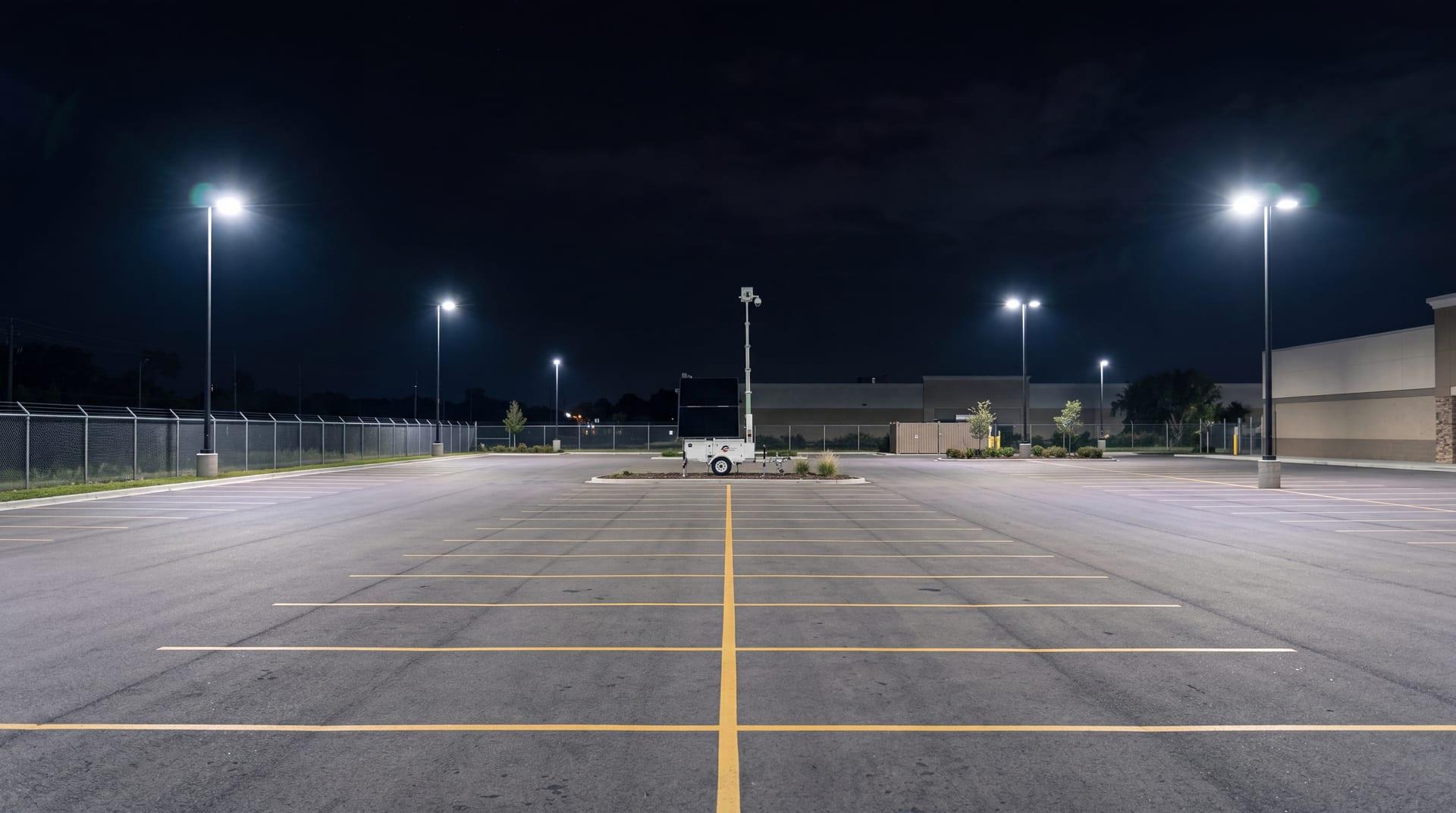
Why office parks have a specific kind of exposure
An office campus has a rhythm. Cars arrive in the morning, the lots are full through the afternoon, and by early evening most of the property is empty. That daily swing creates two problems.
First, a full lot gives a thief plenty of vehicles to choose from, many parked for eight hours in the same place. Second, an empty campus at night has few witnesses. Nobody is walking to a car, and the buildings are locked, so a person walking between vehicles or trying doors can go unnoticed for a long time.
Large footprints add to the difficulty. A multi-building campus may have lots that are far apart, rear access roads, landscaped edges and pockets of shadow. A guard on a single patrol route cannot see all of it at once.
The common threats
Office parks are not usually targeted for the same reasons as a warehouse or a construction site. The typical concerns are more about vehicles, access and nuisance.
- Vehicle break-ins. Laptops, bags and personal items left in cars are a draw, and a quiet lot gives time to work.
- Catalytic converter and parts theft. Vehicles parked all day in the same spot are easy to target. See our guide to catalytic converter theft prevention for what works.
- Trespassing and loitering. People using the property after hours, sleeping in cars or gathering in corners can create liability and make tenants uncomfortable.
- Tailgating and door access. Someone following an employee into a building can reach tenant suites.
- Vandalism and dumping. Rear lots and service areas are common targets.
Not every park faces every threat. A walk of the property at dusk, along with a review of past incident reports from property management, will show which ones apply.
Plan coverage by zone, not by camera count
Rather than start with a number of cameras, divide the campus into zones and decide what each needs.
| Zone | What you want to see | Main concern |
|---|---|---|
| Main entrances and exits | Every vehicle and person coming and going | Identification, tailgating |
| Employee and visitor lots | Overlapping views of parked vehicles | Break-ins, theft |
| Building entrances | Doors and approach paths | Unauthorized access |
| Rear and service areas | Loading doors, dumpsters, access roads | Forced entry, dumping |
| Campus edges | Fence lines, tree lines, back lots | Trespassing |
A zone plan makes it easier to decide which areas need continuous monitoring and which can rely on recording alone. It also helps when dividing costs, since common-area zones are usually the property's responsibility while individual suites remain the tenant's. Our guide to security cameras for property management covers that split.
Lighting is part of the camera plan
A camera needs usable light to produce a clear image, and many office park lots were designed for comfort and appearance rather than for video. Pole lights may be spaced widely, burned out or blocked by trees. Check the lot at night, not in the afternoon (our parking lot security guide has a walkthrough), and note where a face or a plate would be hard to read.
Infrared illumination helps in low light, but it does not replace good white light where you need detail. For practical advice, read our security camera lighting guide. If lighting upgrades take time, mobile units that bring their own coverage can reduce risk in the meantime.
What after-hours monitoring looks like
The after-hours problem is a staffing problem. Few office parks pay for overnight on-site staff, and a periodic patrol can miss a short break-in that happens between visits. Our guide on after-hours security for businesses lays out the options.
Remote video monitoring offers an alternative. Analytics flag a person or vehicle in a restricted zone, and an operator reviews the video to confirm what is happening. If it is a real event, the operator can speak through a loudspeaker to tell the person they are being watched, and if they stay, escalate to police with video. The point is that cameras do the watching so people, yours or your security partner's, handle verified incidents.
Research supports the idea that monitoring matters. A 2019 systematic review of 76 studies found CCTV associated with roughly a 13% reduction in crime in target areas and about 37% in parking lots. Actively monitored systems showed about a 15% reduction, while passive recording-only systems showed no significant effect.
Working with tenants
A multi-tenant property works better when tenants know what is being done on their behalf. Share a short written policy that covers:
- Which areas are covered and which are not.
- Who can view live and recorded video.
- How long footage is kept.
- How a tenant requests footage after an incident.
- How police requests are handled.
Posting signs at entrances is a common practice, and the rules on notice and recording vary by state, so confirm the requirements with counsel before finalizing the policy.
Using a mobile unit on a campus
Permanent camera upgrades on a large campus can involve trenching, conduit runs and coordination across buildings. A mobile unit offers a faster option for a lot with a current problem, and it can be moved to a different area if incidents shift. Because it carries its own power and cellular connection, nobody needs to tap into a building's electrical or network service.
For a campus with several problem spots, a common approach is to cover the worst lot first, review the results, then decide where else to place coverage.
How VDS fits an office park
The VDS mobile surveillance unit is a solar-powered trailer with a 5MP PTZ camera with 25x optical zoom and three 8MP wide-angle cameras on a 22 ft telescopic mast. A 900W bifacial solar array charges an 11.8 kWh LiFePO4 battery bank, with reserve for 3-5 consecutive cloudy days, and dual-SIM 4G/5G cellular provides connectivity. No site power, internet or trenching is needed.
AI detection covers people, vehicles, loitering, objects and license plates. Our 24/7 US-based security operations center verifies events, responds with live talk-down through the loudspeaker, and dispatches police with video. Most deployments go from signed quote to live monitoring in about a week. Learn more about remote monitoring or talk to our team.
Sources
- Piza, E. L., Welsh, B. C., Farrington, D. P., & Thomas, A. L. (2019). CCTV surveillance for crime prevention: A 40-year systematic review with meta-analysis. Criminology & Public Policy, 18(1). onlinelibrary.wiley.com